Get posts sent to your inbox:
links for 2008-04-02
-
My notes on the Society of Authors’ concerns about online literary piracy

An online notebook
Get posts sent to your inbox:
An online notebook
Sounds like Fav.or.it is going to solve the issue of bringing my comments back to my blog, better than Co-comment does (which seems borked at the moment?). From Mike Butcher at Techcrunch UK:
Fav.or.it is tapping into some powerful ideas floating around right now. ReadWriteWeb reckons the conversation has left the blogosphere and leading entrepreneurs like Loic Le Meur want the conversations back on his blog, which he owns, not DIgg/Twitter/ etc. FriendFeed is trying to do this, but it’s basically just another platform owned by someone else, not your blog.
Conversation Tracker will show what posts you have commented upon before and now have replies that you may want to respond to. To date, fav.or.it is still the only service out there that sends comments back to the source of the original content.
Tom Watson posted up his speech announcing the Power of Information Task Force on his blog yesterday and it contained some really good stuff. I guess that those who want to can snicker about the notion of creating a task force to promote innovation (shouldn’t we be organising without organisations?), but I’m glad that there will be some folk looking into this stuff, and it would be nice if they do so in an open and collaborative way.
Only last week, the Prime Minister became the first head of Government in Europe to launch his own channel on Twitter, which I can tell you from experience, is extremely useful to his ministers at least.
But we need to make it easier for others too.
Hazel Blears with be leading this agenda when her department will address this in a White Paper on engagement in the summer.But I want to take the Power of Information agenda further and do it faster. So today I am announcing the establishment of the Power of Information Taskforce. I’m pleased to say that Richard Allan has agreed to Chair the Taskforce. Richard has a vast breadth of knowledge in this field. He’s also an all round good guy and I know he will help us provide clarity to government departments as they contend with the power of information agenda.
Most interesting for me were the bits that focused on community engagement and participation. Let’s have a look at one or two now.
And in the week where the digital world went crazy over Mystarbucksidea.com (I’ve already voted for free Wifi), NHS choices launched a blog about diabetes, bringing together the people who treat the illness and the people who receive treatment. It’s a brilliant ideas and hopefully will foster a new information community who can work together to improve things.
I was diagnosed a type 1 diabetic about a year ago, so have quite an interest in this. I was 27 when I was diagnosed, which is a funny age I think, and led to it taking quite a while for the doctors to figure out if I was type 1 (meaning injections) or type 2 (meaning I had to eat less). I still haven’t got to grips with it yet: I’m supposed to inject myself four times a day but manage it twice at best, largely with the result that I feel pretty crap all the time. Last summer I was hospitalised twice and suffered a crippling bout of depression. I guess I am exactly the sort of person that this blog is supposed to be reaching out to: I’ve got the disease, I’m crap at dealing with it, and I like blogs. I hadn’t heard about it though, which renders it pretty useless. Still, now I do, thanks to Tom, I’ll engage with it, leave a comment or two and see what happens. The blog idea is nice, but I wonder whether more of a social network type approach would be better – linking me up with other diabetics who have been through similar issues.
My officials have been working up draft guidance on how public servants can use social media. And the Power of Information Report made a series of recommendations about this too.
I want the taskforce to ensure that the COI and Cabinet Office produce a set of guidelines that adheres to the letter of the law when it comes to the civil service code but also lives within the spirit of the age. I’ll be putting some very draft proposals to the taskforce to consider later this week.
Here, here. I wrote in the wake of the Civil Sef affair that Public servants should be blogging, or engaging through other social networking tools. Public servants are too often characterised as faceless bureaucrats and the more that can be done to dissuade people from that notion, the better. But to get more public sector workers being open, they need to feel safe to do so, and sensible policies will help to do that.
We will also look at, and learn from, the way people are communicating with each other.
The 19th century co-operative movements had their roots in people pooling resources to make, buy or distribute physical goods. Modern online communities are the new co-operatives.
This is a point I have been meaning to blog about for some time: the relationship between online collaborative communities and the co-operative movement. The point is that while the tools are new, the relationships aren’t, and people have been working together to tackle problems since the year dot. What the tools do is make the process easier and more transparent and because they also make it easier to do without forming institutions or organisations, they also remove some of the political undercurrents too. More needs to be written on this, I think.
And when we know we get a delivery channel right we should use the ‘collaboration’ part of Ed’s vision to best effect, to gain, social leverage, as Professor Shirky would say.
Let me use a recent story to illustrate this point. I recently registered my local Labour Party with groupsnearyou.com. This is a new site provided by the MySociety people. It’s a site for people who run small scale community focused groups.
Through the site, I found West Bromwich Freecycle.
I’m the Member of Parliament for West Bromwich East and I didn’t know about an important recycling initiative going on in my own patch. This information now means that a bag load of clothing for a small child and a habitat sofa are about given a second chance to give pleasure.
Nice example, not least because of the use of an existing network to connect with others. The delivery channel – in this case the connecting of local groups – does not therefore need to be created by the government, or the Labour Party, rather by interested folk, doing things in an open and collaborative way like MySociety does. This taps into another long running question of mine which asks whose responsibility is it to push for improvements in civic life using social tools? Is it the government, at whatever level? Is it organisations like MySociety? Or is it every individual with a laptop and a broadband connection? I am beginning to suspect the answer is the latter – individuals pushing the boundaries and demonstrating where the value is, with the institutions following up once the point has been proved. Organisations like MySociety can help but they aren’t necessarily needed
Overall, a great speech to hear from a cabinet minister. I look forward to seeing what happens next.
I attended my first Tuttle Club on Friday morning, and it was well worth having a day off work and the train fare down to London, not least because I got to meet Neville Hobson in person, finally, after several years on chatting online. We spent a happy time talking mobile devices, video, and Qik, with Tim Davies. Tim had some great thoughts on how this kind of content creation can be used to draw young people into greater levels of participation. It has its risks, of course, but potentially great benefits too.
There was also the chance to introduce myself to Josh March, and I am eternally grateful to him for not punching me 😉 Lloyd Davis was, as always, a great host and good conversational value. Even if the Tuttle Club develops no further, as a weekly gathering of like-minded folk it can’t be beaten, and he deserves our thanks for that. Hopefully, though, things will gain more momentum and it sounds like Lloyd has a number of volunteers ready for action. With Lloyd’s vision and the enthusiasm of this remarkable community, anything is possible.
Most of my time was spent with Tim and David Wilcox, talking through ideas around increasing participation and how roles, worldviews, platforms and processes can be developed. Here Comes Everybody was mentioned, of course, and the Shirky mantra of organising without organisations is becoming central to our thinking about issues. It’s a great concept because the online isn’t necessarily given priority and the blending of offline techniques with social media will probably produce the best results. Discussions around news and journalism were interesting, especially in the light of David rebranding himself as a ‘social reporter’.
The three of us then had a chat with some ladies from Qik, the live video streaming from your Nokia people. We had a great chat recorded onto Qik which I also recorded on my traditional camcorder. I’ll bung the results up on YouTube when I get the chance. Qik is an amazing service technologically, but it also has potentially huge ramifications for citizen journalism and the setting of the news agenda. Every person with a decent Nokia phone now has a TV studio in their pockets. Amazing. I’m sure I will be writing more on this in the near future.
Tuttle Club is fab, therefore, and I’m hoping to get back down there before too long.
David Wilcox has taken the bull by the horns and created an open thread on the OpenRSA blog calling for a more collaborative approach to the discussion on jounalism being carried out on the RSA networks platform. This debate is one which takes into account trust in news media, and could also pull in issues around the role of the BBC in civic life.
I’m personally most interested in breaking out of the old media professional boundaries because I think greatest innovation – and citizen empowerment – is likely to take place as old cultures are challenged, openly. It’s time the newspeople stopped seeing those that they write for as “news users”, now we are producing a lot of our own content online.
The issue at the RSA is not one of platform – the Drupal based system used by the Networks is superb – but of worldview. David and I were the most consistent contributors to the discussion, but I felt my time there was up when a message was posted by a project leader confirming that the desire was to keep the debate ‘on topic’ and ‘informed’. As neither a journalist nor a fellow of the RSA, I guess this counted me, and anything I had to add, out.
I’ll be following the debate through the comments to David’s post, and anything else tagged with civicjournalismuk. I have my platform here, which I am happy to use to contribute with – or when the time is right for a dedicated platform to be created, I can use that – as long as it is open!
Went live for download over the weekend. Will be having a look at it over the next day or so. Looks a great release, with some much needed improvements, including:
So, plenty of stuff to get your teeth into. Neville Hobson has some great notes on upgrading.
Part of the joys of the social web and the community that has built up around it is the sheer informality of the whole thing. Take this, for example: a tweet from Loic Le Meur, CEO of Seesmic this morning:
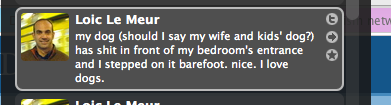
Now, how many chief exec’s have you heard of that broadcast messages to the world about how they have just trampled some dog poo barefoot?
Not enough in my view. Thanks for sharing, Loic!
And you can follow the rather dull news updates at http://twitter.com/downingstreet.
Still, well done whoever got this going!

OurPress is a project I have been working on for aaaages, which stalled quite badly for a while. Essentially, the idea emerged in a discussion with Nick Booth in the comments of a blog post of his. We were talking about the paucity of options available to community groups to easily create open, social websites. At first I thought of Drupal, but soon moved on from there.
I had the idea of setting something up with the multi-user version of WordPress, called WordPressµ, which is what is used to run WordPress.com. Sites could be created either as blogs, or as static sites using WordPress pages. Help and guidance would be provided in getting stuff up and running, and customisation of templates would be possible, with the results being shared among the rest of the users too. I gave the idea the name OurPress, and was shocked to find the .org was still available. I snaffled it right away, as well as a few of the .whatever variants.
Then the project pretty much stalled, for two reasons. One, I forgot about it (probably because of Facebook or Twitter or something equally shiny); and two because I couldn’t find anywhere decent to host it. The trouble was that WordPressµ demands that you have something called ‘wildcard DNS’ to be able to create blogs at addresses like myblog.ourpress.org (for example). The other option is to have them at ourpress.org/myblog but problems can be created with static pages having the same name as blogs and the whole thing getting confused.
However, I recently returned to looking at the project, after a chat with Shane McCracken, and in my search for a host, I hit upon gold, or rather orange, in the form of A Small Orange. ASO are a bunch of cool guys in the US who happily host pretty much anything. They were quite happy to set up the wildcard DNS for me and when I asked if I could integrate with Google Apps, someone went ahead and amended all my MX records for me! Ace stuff!
Here’s the deal with the Google Apps: I get to have 200 accounts for free, so I can pretty much offer everyone who has an OurPress blog a free email account which will be blogname@ourpress.org. When I create the email account I will also setup an OurPress branded iGoogle page which will track web responses to the blog in question, so people have that important element set up even if they haven’t heard of RSS themselves before. Also, using Sites, I will give them access to a tonne of documentation about using the OurPress platform and blogging, social media etc.
Essentially, OurPress will be a completely contained and functional online platform to run community websites. And it’ll be free.
So who might want to use OurPress?
The advantages of OurPress over, say, WordPress.com include:
So where am I up to? I’ve installed WordPressµ and that’s about it. I need to get a look ‘n’ feel sorted for the homepage and arrange how the sign-up process will work for new blogs, but other than that, I am more or less there. Any comments or suggestions gratefully received!

There is an interesting project underway at RSA Networks, the social network for Royal Society fellows, and, for the moment at least, anyone else who fancies joining in (that’s the category I belong to, by the way). It has been proposed by Stephen Coleman, Professor of Political Communication at the University of Leeds, and goes by the name of the “RSA Journalism Network”:
The public’s declining trust in the news media is a worrying trend. The RSA and the Reuters Institute of Journalism are looking at how we can support the civic function of news. We’re particularly interested in how professional journalists and Fellows relate to the public’s ideas about news and what it is for.
This is a great idea, and an important and interesting area for discussion. The web is a perfect place for the coversation to be held in, of course, because online developments are a part of both the problem and the cure for the relevance of news to people’s lives.
David Wilcox has commented on his blog about this project – again supportive of it but questioning the closed nature of the discussion on the RSA Networks platform. As anyone not a member of the network will find out, when clicking my link above, you can’t see anything without first logging in.
I can’t see how it is possible to have a useful discussion about media and citizenship in an old-style walled garden. You can link out – but people outside are then forced to come to “your place” to join in. This seems particularly inappropriate on this topic, where issues are so interesting precisely because the Internet has created a public commons.
David has started a similar thread within the project space on the RSA Network too. I’m fully supportive of his stance, having been happily involved in open online collaborative projects such as the Open Innovation Exchange, RuralNetOnline, the Membership Project and the etoolkit.
It’s far better to have these conversations out in the open, where people can read and find out more before they decide to dive in, and where people can add their thoughts whether they are a member of a specific network or not. The civic role of news is something that matters to everyone, not just RSA members, or whatever.
One of the ways that the web can help us to bring conversations together is through the use of tagging. By using tags effectively, people can write about a subject on their own blogs without needing to join another platform. All you need is way of bringing them together, easily achieved by mixing up Technorati or Google Blog Search with RSS. Services like Pageflakes or Planetaki can then be used to publish the results.
Another way is to create the new platform, but make it open, rather as David does with his Drupal-based group blogs. Anyone can join and have an input, even if it is just to point to what they have written elsewhere. Indeed, David has taken this further by incorporating a Grazr-based widget displaying relevant content from various external blogs within the Membership Project group blog. In this way, those that have a blog can write there, and those that don’t can contribute directly to the group blog.
David is actively facilitating the Membership Project by posting regular updates and transferring the points that are made in the blog posts into a project timeline and associated work packages, thereby creating outputs from the organic content created through the group blogging process. This will be vital to keep the project moving forward, and is a great example of online community facilitation.
Taking this approach would therefore create a far more useful project, or network, than the current arrangements for the RSA Journalism Network. I think this is too important a topic for discussion to be held behind closed doors, and for the moment I would like to suggest the use of the common tag civicjournalismuk to hold the conversation together for anyone who would like to have a say. We can figure out what to do with it all later. Let’s see how our open approach can feed into and add to what’s happening within the walled garden…
I’ve lost track of how many posts I have written on anonymous blogging. It’s like picking a scab: I just can’t leave it alone. There’s a real debate going on in the comments of my last post between me and Joshua March – Josh is coming up with some interesting arguments, but I’m not swaying on this one.
I knew I had read something by Robert Scoble once about anonymity. Turns out he’s written loads. But this one stuck out for me:
…I don’t advise anyone try the anonymous route: either be straight up with your boss and everyone, or stay off the Internet.
Wise words.
In the wake of the Civil Serf debacle, the issue of anonymous blogging has once more raised its grubby head. I maintain that it is a dumb idea that encourages dickwadery. Most folk agree.
Some don’t however, and – more dangerously – they put this into action and start an anonymous blog themselves. Take, for example, ‘The UK Libertarian‘ which published its first and only post a few days ago. Now, the UK Libertarian isn’t pulling his or her punches. Oh no!
[Quote removed on humanitarian grounds – see the comments]
Now then, that’s not very nice! Not surprising then, with such incendiary views, that the author notes:
I’ve kept this blog anonymous so that I can shout out what I think, and I want you to shout right back at me.
I would be tempted. Only, I think that whole anonymous thing is about to come crashing down.
The thing is that the UK Libertarian is on blogger. Blogger gives you a global profile which lists all your blogs. If you want to keep a blog anonymous, then it’s a good idea to keep that blog off your profile. Bet you know what’s coming now, right?

The image above is a screen grab of the Blogger profile of Josh March, who writes a blog about PR and social media called Social Marketing Strategy by Joshua (and from which his profile is linked, which is how I found it) and runs a company by the name of inetworkmarketing. It turns out Josh’s other blog is none other than…UK Libertarian! Ooerwhatagiveaway.
Let’s hope inetworkmarketing’s business plan isn’t predicated on getting any government or public sector work…
I was musing the other day about a method of aggregating news about government in one place. Justin Kerr-Stevens – government communications consultant, barcamper and general good egg – has combined a job lot of gov news sources into a combined Twitter feed, handily called HMGOV.
I’d never considered using twitter to pull all this together. The great thing about it is that you don’t need to be a twitter user to read it, as each twitter account generates an RSS feed. Also, if people want it in their emai boxes, Justin could cobble something together in no time with FeedBurner, meaning that however people want their news delivered, he has it covered.
Great work. And in the wake of the Civil Serf affair, it’s good to see someone else working in government starting a blog. It isn’t all bad news, folks.
Most people have WordPress’ rich text editor turned on, because generally speaking, it makes life a lot easier. It does have its problems though – one is when embedding media from places like YouTube and SlideShare and the other is when copying and pasting content from other applications like (gasp!) Word. I’ll cover the latter here, and show how you can stop your formatting going all wonky when pasting in.
The secret is in an additional set of tools which can only be discovered when the ‘advanced toolbar’ is displayed. You can do this by clicking the little button that looks like this:

This then pops open another row of icons which let you do all sorts of exciting things:

They are, from left to right: select formatting from your stylesheet; underline (this is baaad); full justify text; choose font colour; paste without formatting; paste from Word (aha!); remove formatting; clean up code; insert symbol (like this: © for example); undo; and finally redo.
To paste text from Word, then, select and copy your text in the document in Word, then switch to your browser where you are posting from, and click the paste from Word icon. This will pop up another window for you to paste your text into, so do that and then hit ‘Insert’. WordPress will then have a pretty good stab at converting your formatting into something it understands. Bingo!
If that doesn’t work, you are probably best off using the paste without formatting option, and then reformatting your text within the WordPress editor itself.

lgSHOUT! is another little service I have put together for local government, following on from LGSearch, which went a little way to fixing the problem of getting relevant search results. lgSHOUT! tries to do something about communication.
The idea behind it is that it’s a Twitter for local government types. People can easily sign up and then post short messages to the rest of the community using a box on the home page, so no need to mess about with complicated blog editors and the like. People can respond to others by directly commenting on a shout, or by posting a shout of their own. Everyone can have an avatar and at the moment that’s handled by Gravatar.
So what sort of things might people want to use this service for?
It’s built on WordPress and the Prologue theme, and as such took about an hour to put together. The biggest problem was getting URLs that were pasted into the box to be parsed into clickable links – in the end I found this plugin. Bits of work to do include:
So, I hope it’s useful to local gov folk. If you’ve got any queries about it, or fancy having something similar for another sector, just let me know!
Here’s an interesting development: AOL have announced the purchase of social network Bebo for $850 million in cash. Previous coverage didn’t even mention AOL as a potential buyer.
From BusinessWire:
With a total membership of more than 40 million worldwide, Bebo is a global social media network which combines community, self-expression and entertainment to enable its users to consume, create, discover and share content. Bebo is one of the leading social networks in the UK, and is ranked number one in Ireland and New Zealand, and number three in the U.S. Its users are heavily engaged and view an average of 78 pages per usage day. Bebo has approximately 100 employees operating in offices in the UK, San Francisco and Austin, TX.
The deal comes just one week after AOL’s launch of Open AIM 2.0, an initiative that allows the developer community greater freedom to access the AIM network and integrate AIM into its sites and applications, and the announcement by Apple of a downloadable AIM application for the iPhone.
Under the terms of the agreement, AOL will acquire Bebo for $850 million in cash.
“Bebo is the perfect complement to AOL’s personal communications network and puts us in a leading position in social media,” said Randy Falco, Chairman and CEO, AOL. “What drew us to Bebo was its substantial and fast-growing worldwide user-base, its vision of a truly social web, and the monetization opportunities that leverage Platform-A across our combined global audience. This positions us to offer advertisers even greater reach and marketers significant insights into the desires and needs of consumers.”
Allen Stern at CentreNetworks:
What does this mean for AOL? It brings their ad inventory for Platform-A skyrocketing upwards with a youth and young adult demographic. This is a good complement to their current AOL properties which tend to tick a bit further up the age chain. AOL also announced last month the launch of 20+ Web sites in 2008.
Bebo is based out of the UK, San Francisco and Texas and has become the social network of choice among British Internet users and those in commonwealths, being the #1 social network in Ireland and New Zealand.
With 40 milllion worldwide members, Bebo will introduce a new outlet for AOL’s Platform-A behavioral driven advertising, AOL search and AOL properties to grow in conjunction with (Bebo is currently a Yahoo advertising partner).
Will post up more coverage as it comes in.
Updates:
The deal also shows the schizophrenic nature of my former employer, Time Warner. Jeff Bewkes wants to get rid of AOL (and Time Warner Cable) and focus entirely on his old Hollywood style businesses. Earlier this week he was happy to talk deal with Yahoo and get rid of AOL, which is going to through a major crisis, as reported by several other outlets. And at the same time they are spending $850 million in cash on Bebo. Maybe it helps AOL become a more sexy acquisition, or a spin-off candidate?
Charles Arthur in The Guardian:
But now the question is – as it always is – has AOL bought just after the wave has broken? News Corp’s acquisition of MySpace initially looked like a mistake, but now seems sensible. Do AOL and Bebo make a match made in heaven… or hell? After all, AOL’s tried an old-world merger. Now it seems it’s trying a new-world one.
As an aside, and despite rumors of their possible sale, AOL is clearly putting a massive effort into transforming the company from a dial up broadband provider into a company has the competitive fire. The opening of AIM, mentioned above, is just one indication. The company has been releasing genuinely innovative new products and has also made a number of smaller strategic acquisitions over the last year or so. And there are lots more to come, apparently.
Time Warner’s AOL has acquired leading social media network Bebo for $850 million in cash. It seems like a good move which will supercharge AOL’s advertising reach into social networking, and immediately put the heat on Microsoft, which has failed in social networking, and ailing Yahoo!, almost certain to be acquired itself very soon.
Where do government and other public sector folk get their news from?
I wonder if there is a possibility for putting together a one-stop-shop for news, aggregating the popular sources in one place. I’d also like to see conversations added to the mix, so the news items could spawn discussion.
There are a few models one could use:
Would appreciate any thoughts on this: Where do you go now for your news? Is there a need for such a site? Which of the three models would be of most use to government folk?
Interesting news item this morning on eGov monitor:
A new £4 million programme to help local authorities tackle climate change was announced by Environment Minister Phil Woolas and Local Government Minister John Healey today.
The programme will spread existing best practice on climate change among local authorities, and provide training and mentoring to help them reduce emissions and adapt to the already unavoidable effects of climate change.
The programme, jointly funded by Defra and Communities and Local Government, will be tailored to local needs and priorities, with delivery being co-ordinated at a regional level.
It will be interesting to learn how this best practice is going to be shared. The first thing I would do would be to start a Community of Practice on the subject.