Tuesday, 21 June, 2011

The Preston Social Media Toolkit

A bit of a flurry on Twitter about Preston City Council’s ‘Social Media Toolkit‘ which describes itself as

a complete guide to joining the social media revolution

It costs £199 (plus VAT).

I wish them luck. I do this stuff for living and it’s very, very hard to make money from content. Apparently newspapers and record labels are finding it tricky too.

My preferred method is to give it away, publish it for free, and gain a reputation for helpfulness and perhaps a little expertise. That reputation, somewhere down the line, turns into paid work. That’s the theory anyway.

So would I advise any councils to buy this document? Probably not. There’s plenty of free content out there – possibly on this blog, if you take the time to hunt for it.

But if it’s easy to read documents you are after, then download Social by Social and Local by Social for free. The latter is a fantastic general document on the practicalities of using social technology, and the former puts it all into the local government context beautifully.

Another read is the 21st century councillor one for that particular group of people – and I understand that it’s being refreshed at the moment.

I did put out the idea of perhaps writing something like this collaboratively, on a wiki, for the benefit of everyone, but that might not even be necessary. Maybe we just need to produce a list of links to public, freely available blog posts written by people like Dan, Carl, Sarah, Sharon, Ingrid and others (sorry if I missed you out) which already have all that info in them.

That way, newcomers have a curated list of great content that will answer most of their questions, and the authors still get the clicks and the page views, which may or may not be important to them.

PermalinkThe Preston Social Media Toolkit

Monday, 20 June, 2011

Telling tales

One of my favourite sessions at LocalGovCamp was Lloyd Davis talking about his trip across the States and his upcoming project to go where the work is in the UK.

Here’s a video (if you can see it):

I speak up with a few minutes to go at the end, making the point that I am going to write about here, that the best bit about lloyd’s adventures are the stories he tells about them, whether at events like LocalGovCamp, his live shows or the blogs and videos he publishes.

Indeed, this is the lesson that public services can learn from folk like Lloyd – that having the ability to tell stories, the platforms on which to do so and the culture where stories are listened to, is really vital for an organisation to be considered healthy.

Consider feedback platforms like Patient Opinion, mentioned in the video above. It’s really a platform for service users to tell their stories and the key is that health service providers listen and act upon those stories.

Just as important though is for people working with public services to tell their stories. There are benefits internally – keeping colleagues up to date and informed; and externally – providing a human face to the world.

Telling stories shouldn’t just be something that we do with our children. Think of the best talks you have heard at conferences and other events – no doubt they will be packed with stories that contain some personal detail or humorous remark that helps you remember them.

In many ways that’s what LocalGovCamp itself should be all about. People getting together and telling stories, leaving those that hear them to take from them what they will.

Do follow Lloyd on Twitter – he is consistently entertaining and occasionally useful – and if you get the chance to offer him some work as he travels around the country, do so. You can find out what he does best here.

PermalinkTelling tales

Innovating doesn’t mean doing something new

I’ve been a big fan of James Gardner‘s work on innovation for a while now. His blog is a great read and his Little Innovation Book is a fantastic run down of the things you need to know.

His new book is going to be called Sidestep and Twist and it’s main point is that the big, impactful innovations are usually improvements or adaptations of existing ideas.

So you don’t need to be first with an idea, you just need to be able to execute well. Think iPod – not the first MP3 player by a long shot, but it was better than the others and made such devices mainstream.

In this video, James gives a really thought provoking thirty minute-odd talk about this idea. It’s well worth watching:

If you can’t see the video, you’ll find it on YouTube.

PermalinkInnovating doesn’t mean doing something new

Sunday, 19 June, 2011

LocalGovCamp 2011

LocalGovCamp

Saturday’s LocalGovCamp was a marvellous day, entirely thanks to the superb organisation of Digital Birmingham’s Simon Whitehouse and Sammy Williams; and of course the 130-odd people who turned up on the day, giving up the best part of their weekends to talk about work.

Also: thanks to the great sponsors who made the event a reality:

  • Podnosh – “Our aim is to change the way the public and the public sector talk to each other”
  • Public-i – “Using the virtual world to make a difference in the real world”
  • National Association of Local Councils – “We are committed to developing the role of town and parish councils, in order that they can represent the communities which they serve effectively and be at the forefront of community leadership.”
  • LGIU – “Our mission is to strengthen local democracy to put citizens in control of their own lives, communities and local services”
  • Firmstep – “We help government to help citizens”
  • Talk About Local – “helping people find a powerful voice online”
  • Arcus Global – “Arcus provides software, tools and methods that help public sector organisations to run efficient, modern ICT environments for their customers and employees”
  • Global Crossing – “We are a leading global IP solutions provider with the world’s first integrated global IP-based network”

There were about 35 sessions in total, and of course many conversations that cropped up over coffee. There were lots of smiles on the day, and as far as evaluation goes, that’s good enough for me.

There’s been plenty of coverage and we’re trying to collect as much of it as possible on this Posterous-based site. You can easily contribute by emailing thoughts, links, ideas, videos, photos, whatevers to localgovcamp@posterous.com.

The Twitter hashtag, #localgovcamp, is still being populated and you’ll find plenty of resources, feedback and stuff there.

You’ll notice a certain amount of challenge in some of what people are writing. Quite right too! Nothing’s perfect and can always improve.

I’d only make two points in mitigation of some of the feedback. Firstly, LocalGovCamp is a volunteer effort and built on participation. So, if you see something that could be done better, volunteer, participate! If you get annoyed and blog about it afterwards, it doesn’t give anyone much of a chance to improve things.

Secondly, I think it’s important to remember what LocalGovCamp actually is. My definition – which of course carries no more weight than anyone else’s – is that it’s a very lightly structured space that is created for people to do stuff in. That’s it. It is what people choose to do in that space that counts – and sometimes it works, and sometimes it doesn’t.

And that’s okay.

Photo credit: Mark Braggins

PermalinkLocalGovCamp 2011

Friday, 17 June, 2011

Launching the public sector web network

The webIt’s only a soft launch, but a launch nonetheless.
Public Sector Customer Services Forum and Kind of Digital are coming together to develop a content and events focused online community for those that use the web in their work delivering public services.

So, it’s not a network just for those that work in web teams. We know that people in all sorts of roles are now heavily web focused in their activity and we want to reflect that in the events we run and the content we publish here.

Our first event is a social media themed conference in Glasgow in September – you can find out more here. It features presentations about the very latest good practice in the field, from practitioners making things happen within their organisations right now.

We’ll be adding more to the site over the next few weeks, curating and drawing together resources that are already out there, and generating some brand new content exclusive to the network.

Don’t forgot to make sure you are kept in the loop by signing up to our email newsletter, or grabbing the blog’s RSS feed. Of course, we are also on Twitter and you can follow us there as well!

PermalinkLaunching the public sector web network

Thursday, 16 June, 2011

What I’ve been reading

I find this stuff so that you don’t have to.

You can find all my bookmarks on Pinboard.

PermalinkWhat I’ve been reading

Monday, 13 June, 2011

LocalGovCamp this Saturday

This has rather crept up on me, but this Saturday , 18th June, sees LocalGovCamp coming back to Birmingham.

Around 200 people from across local government will be getting together to figure out how we can keep innovating in this age of austerity.

Following some cancellations, there are still a couple of places free if you want to come along.

Various discussions about the event are happening on the discussion group – it’s easy enough to sign up and join in!

It should be an awesome day!

Photo credit: Arun Marsh

PermalinkLocalGovCamp this Saturday

Sunday, 12 June, 2011

What I’ve been reading

I find this stuff so that you don’t have to.

You can find all my bookmarks on Pinboard.

PermalinkWhat I’ve been reading

Thursday, 9 June, 2011

Digital activism opportunity

This looks like it’s a good opportunity for community groups to get some support in using digital tools, from the Young Foundation:

By practically supporting six communities across England, we hope to understand more about the role that technology can play in connecting and mobilising local communities to act, and to share good practice and lessons with other communities across the country.

Deadline for applications (which I think have to be from community groups, not other organisations like councils) is 17 June. More details available in this PDF.

PermalinkDigital activism opportunity

Tuesday, 7 June, 2011

What I’ve been reading

I find this stuff so that you don’t have to.

You can find all my bookmarks on Pinboard.

PermalinkWhat I’ve been reading

Monday, 6 June, 2011

Just because you can say something…

…doesn’t mean that you should. Of course.

A bit of a Twitter flurry this morning about a case of a civil servant apparently being disciplined because of their use of the service.

The account in question, nakedCservant, is protected, so the updates aren’t public, and as I have never requested access, I can’t see what they are saying. However, according to this report, the civil servant behind the account was critical of ministers and government policy.

Various folk have called this out as being an example of a crack down on public servants being allowed to use services like Twitter in the workplace.

I’m not convinced it is.

The issue here is the message, not the medium, and it reminds me very much of the Civil Serf affair a few years ago. Whilst I don’t know the exact detail of this case, it’s clear that the civil servant is almost certainly in breach of the civil service code in terms of the content of their tweets.

In other words, the Twitter bit of this story is irrelevant. The result would be the same if this person were saying these things in emails, memos, letters to the newspaper, whatever.

I’ll go through my usual list of points when these stories emerge:

1. If you want to stay out of trouble, don’t slag people off in public.

2. Don’t rely on anonymity to protect you. Unless you’re very good, if somebody wants to find out who you are, they can do.

3. Having ‘these are my views, not those of my employer’ in your Twitter biography means absolutely nothing in reality. It’s no protection at all and I worry when I hear people being advised to do it as a way to feel safe about this stuff.

4. Never publish anything on the web you wouldn’t be happy to show your boss, your mother or a journalist. Assume everyone can see everything you write and that way you won’t be surprised when it turns out they can.

5. We’re in a strange situation at the moment where our personal and professional identities are in a state of flux and can’t be separated in a reasonable way. Most people, especially those that work in public services, can easily be traced to their employers online with a bit of Googling.

Maybe at some point in the future this will be sorted out, and we’ll have a common understanding of where work stops and home starts. But until then, be careful and if you have to think twice about posting something online, don’t post it!

Update: Steph adds on Twitter “don’t do politics” – and he’s right.

Update 2: Jimmy Leach blogs the view from the FCO.

PermalinkJust because you can say something…

Sunday, 5 June, 2011

What I’ve been reading

I find this stuff so that you don’t have to.

You can find all my bookmarks on Pinboard.

PermalinkWhat I’ve been reading

Thursday, 2 June, 2011

Wednesday, 1 June, 2011

Localism needs bespoke, not scale

David Wilcox does his usual excellent summarising and commenting job on the latest snafu involving BIG Lottery funding and the internet.

It’s all about a grant of £1.89 million to the Media Trust, to fund the establishment of “connected news hubs around the UK to support citizen journalism and to help communities and charities get their voices heard”.

Hmmmm. I’ve said many a time before that the future of journalism debate is one of the most boring in the world – certainly one of the least relevant to actual people with proper lives with real things to worry about.

So the use of the word journalism in this project concerns me – it brings to the table assumptions and values which I’m not sure belong in this context.

This follows a grant of £830k under the People Powered Change programme to Your Square Mile to develop a network of local community websites. It’s described as a “digital one stop shop” – excellent!

Excuse my sneering, but 1999 is calling and it wants its slogans back.

David writes in his analysis:

The issue is perhaps not so much why the Media Trust got the funding, but why Big Lottery didn’t spend some time exploring the difference between citizen journalism, community reporting, and hyperlocal media. Or if they did, could we please see the report? That would be transparency.

One thing that is becoming clear is that communities come before websites. That is to say, the motivation for starting a community web project must come from the community first and not a solution being imposed from elsewhere. It’s been tried countless times and doesn’t work.

The experts in the field, such as the Talk About Local guys totally get this, which is why their nationally-focused solution takes the lead from local need, and is platform neutral. No one size fits all model there, and rightly so.

It’s also why social media surgeries work so well. Nobody there has a service to push – the ‘surgeons’ listen to people’s problems, or what they want to achieve, and they advise on the quickest, cheapest solution.

There is often an assumption that a centre of power must always fill a vacuum. In this case, there is no doubt that local communities organising themselves online can benefit both those communities and the local council, if it chooses to listen.

That doesn’t mean however, that the council should be the provider or indeed the instigator of the websites. Far better to bring in a third party, who understands this stuff and who will advise the different communities what the best solution is for them – not develop a single platform and assume it will work for everyone.

Likewise with these big national programmes. What if the Your Square Mile product isn’t what communities want? What if the MediaTrust’s understanding of a ‘connected news hub’ (actually, does anyone have an understanding of what one of those is?) doesn’t match anyone else’s?

The point of localism is that different communities have different needs, which means they need different tools and solutions. Yet still ‘scalable’ single solutions get funded. But of course you can’t scale bespoke, even though bespoke is what is needed here.

PermalinkLocalism needs bespoke, not scale

Tuesday, 31 May, 2011

Give us a break

Am sharing the details of this event on behalf of my good friend Jude, who is running what looks to be a really interesting project.

GIVE US A BREAK: Ideas for developing easy ways to source respite breaks for carers online

Give Us A Break tackles the feelings of social isolation that are often experienced by people caring for an ill, frail or disabled family member, friend or partner. Give Us a Break aims to ease the burden of caring by providing a few days away from day-to-day responsibilities, as well as ongoing support over the phone and online. It is the first project run by soundinnovation, a not-for-profit hub to develop projects with a social purpose.

A key part of the project is to develop ideas around online support for carers to enable them to access respite opportunities. There doesn’t seem to be any specific ‘go to’ websites for carers to tap into carer friendly accommodation. For example one of the most interesting carer friendly accommodation like the Kiloran Trust are very hard to find.

How can you help?

On Thursday 9th June from 6.00pm we’re hosting a brainstorming evening with tech savvy individuals to explore and potentially develop ways of enabling carers to access info for breaks – online. For example it could simply be finding a way to map appropriate and available respite opportunities across the country by geo-tagging respite opportunities around the country and getting other carers to rate them or make suggestions for carer friendly accommodation.

We’re not planning on reinventing the wheel but what is clear is that when a carer can get access to a break we want them to be able to find it quickly – but there doesn’t seem to be much available.

Location:

soundinnovation offices at Happy Computers, Cityside House, 40 Adler Street, London E1 1EE.

If you can come along, please RSVP to jude@soundinnovation.org.uk.

PermalinkGive us a break

Thursday, 26 May, 2011

The digital engagement game

At the introduction to digital engagement workshop we ran this week, I debuted the digital engagement game.

It’s a workshop exercise that’s an expansion of my version of David Wilcox‘s social media game, which in turn has been developed into the Social by Social game.

The original game featured a pack of cards detailing various social media tools, and a few traditional ones too. Teams then came up with scenarios, and used the cards to produce solutions.

It was always good fun to run and is helpful in getting people to focus on purpose and not getting hung up on the tools.

Over time though it became clear that the cards needed updating, and if we were going to do that, then we might as well revisit the whole thing.

So, now there are four different sets of cards in the game. These hopefully cover the range of issues people planning digital engagement projects need to consider.

Tools – the technology

  • Blogging
  • Social networks
  • Status updates
  • Media sharing
  • Online collaboration
  • Newsletters
  • Aggregation
  • Social authoring
  • Web conferencing
  • Mobile apps
  • Location services

Roles – the people

  • Champion
  • Community manager
  • Digital mentor
  • Moderator
  • Social reporter
  • Developer
  • Strategist
  • Data expert
  • Evangelist
  • Content wizard

Activities – the other stuff you have to do

  • Training
  • Events
  • Workshops
  • Social media surgeries
  • Network mapping
  • Codesign
  • Listening online
  • Evaluation
  • Publish open data
  • Carry out surveys

Process – tackling the bureaucracy

  • Develop strategy
  • Write policy
  • Campaign plans
  • Project management
  • Identify the keen
  • Make business case
  • Get IT support
  • Get political buy-in
  • Get senior managers on board
  • Manage risks

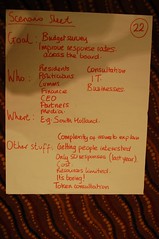
Teams in the game have two sheets, one to set the scenario:

Red team scenario

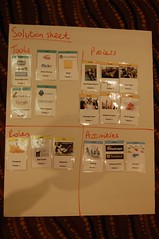
And one to plot the solution:

Red team solutions

This format of the game seems to work pretty well, helping people think about all the issues involved in solving problems using digital tools – especially the idea that the people and the process matter just as much, if not more, than the technology.

If you’d like to make your own set of cards, here’s the PDF (3.1mb) which you can print out, cut up, fold and laminate.

PermalinkThe digital engagement game