Sunday, 21 September, 2008

Barcamp London 5 : the spillover

Next weekend is a busy one for webheads in London. Not only is it UKYouthOnline (which I am attending) but also Barcamp London 5 is happening. Sadly, that’s all booked up. But never fear! Harry Metcalfe is organising a spillover event for those that couldn’t get themselves on the original Barcamp list.

The wiki states:

BarcampLondon5 is full. Lots of people who wanted to go couldn’t get tickets. We figured: why not have our own, extra, mini-barcamp? The British Computer Society kindly volunteered to host, so it’s on: we’ll have a one-day barcamp on the Saturday (27th).

So, if you want some barcampy action in London that day, you’ve still got a chance. And if Harry has anything to do with it, it’ll probably be better than the ‘proper’ one. Book yourself a spot here.

PermalinkBarcamp London 5 : the spillover

Public Sector Bloggers Update

I’ve been putting a bit of work in updating the Public Sector Bloggers site, which aggregates a load of feeds from folk in the public sector who blog (duh…) in one place. The website gives a quick overview on the latest additions, or you can subscribe to a combined RSS feed or by email.

One thing I have changed is how the feed is generated. Before, I used Yahoo! Pipes to merge them all, which was a bit of pain in the neck. So I have now gone for a much easier way, which is to organise all the feeds in my Google Reader into a specific folder, and made that folder public, meaning it produces an RSS feed. I then use that feed to drive the site. Now to add a new feed, I just need to subscribe to it myself, and whack it into the right folder. Easy.

When I mentioned it last time, I had quite a few suggestions for additional feeds to add to the service. I’ve added quite a few more, so the list now looks like this:

Again, if I have missed anyone obvious out, please do let me know.

PermalinkPublic Sector Bloggers Update

Saturday, 20 September, 2008

Thursday, 18 September, 2008

The importance of community management

One of the great arguments in favour of employing social web tools is the fact that they are pretty quick, and usually cheap, to put together. However, that’s not taking into account the other costs, one of which is managing the community created by such sites.

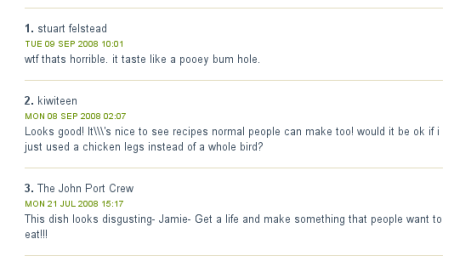
This entails a number of things: welcoming new people, seeding some discussions, encouraging people to get involved. At the bare minimum it should consist of moderating content, getting rid of the rude, the crude and the jibberish. You simply have to allow for time to do this. Otherwise you end up with problems like those that Jamie Oliver, everyone’s favourite fat-tongued foodie, seems to be having.

Does this sort of thing actually present anyone in a good light?!

PermalinkThe importance of community management

Meatball Sundae

I’m working my way through my dead tree reading list, and right now I’m burning through Seth Godin‘s Meatball Sundae. It’s terrific stuff.

Here’s one nugget from early on in the book -a list of ‘the foundations of new marketing’. It works for stuff other than marketing, though, I reckon, and might serve as a useful way of describing what worldview 2.0 might be:

  • Direct communication and commerce between producers and consumers
  • Amplification of the voice of the consumer and independent authorities
  • The need for an authentic story as the number of sources increases
  • Extremely short attention spans due to clutter
  • The Long Tail
  • Outsourcing
  • Google and the dicing of everything
  • Infinite channels of communication
  • Direct communication and commerce between consumers and consumers
  • The shifts in scarcity and abundance
  • The triumph of big ideas
  • The shift from ‘how many’ to ‘who’
  • New gatekeepers, no gatekeepers

I wonder how many of these things can be applied to government and the governed, rather than producers and consumers?

PermalinkMeatball Sundae

Wednesday, 17 September, 2008

ReadWriteGov Update

Bookings are flying in for ReadWriteGov, the social media shindig I am organising along with Fran Paterson, which will be held at Peterborough City Council on 29th October.

Responding to a bit of feedback I have received, I have added an option to pay the (miniscule) cost of the tickets by requesting an invoice, which should make it easier for some folk to come along. So now nobody has an excuse!

PermalinkReadWriteGov Update

Tuesday, 16 September, 2008

10 Social Media Steps

10 Social Media Steps is a guide to how people with very little experience get get engaged with social web tools. Taking in a whole range of different services, from social networks to photos sharing to social bookmarking and blogging, I’ll be introducing each tool in an easy-to-understand way, using as many different types of media as possible. It’ll be fun!

The steps will be as follows:

  1. Join a social network
  2. Subscribe to some RSS feeds
  3. Bookmark stuff socially
  4. Share some photos
  5. Use online video
  6. Start blogging
  7. Stream your thoughts
  8. Aggregate your life
  9. Collaborate on the web
  10. Meet some people

If you want to follow the 10 steps, or (even better) pass them on to people who might get the most benefit, then just point your browser towards here, which will present all the posts.

So, I think that is probably that for this introductory post. You could always amuse yourself watching this video from Common Craft explaining what social media is all about:

[HTML1]

Permalink10 Social Media Steps

Monday, 15 September, 2008

Teacamping this Thursday

Teacamps are the bi-weekly get togethers of people interested in government and the web, which emerged from January’s Barcamp.

I don’t get along nearly as often as I would like – something that will hopefully change now I have a bit more control over my time – but I will be heading down to the House of Fraser cafe on Victoria Street this Thursday. Hope to see plenty of folk there!

PermalinkTeacamping this Thursday

Sunday, 14 September, 2008

Software Freedom Day

Next Saturday (September 20th) is Software Freedom Day:

Software Freedom Day (SFD) is a worldwide celebration of Free and Open Source Software (FOSS). Our goal in this celebration is to educate the worldwide public about of the benefits of using high quality FOSS in education, in government, at home, and in business — in short, everywhere!

There are various get togethers happening around the world to celebrate – here are all the UK ones. If you’d like to know more about free software, this video from Stephen Fry is a pretty nice start:

[HTML1]

Other things you might like to do include tracking down your local Linux User Group – who can help and advise you on any issues you are having – and actually installing some open source software on your computer. Here’s some quick suggestions:

How else could you support or celebrate software freedom day?

PermalinkSoftware Freedom Day

Saturday, 13 September, 2008

Sticky posts in WordPress

Recently it was announced over at WordPress.com that a new feature had arrived – the ability to have ‘sticky’ posts on your blog homepage.

Regular updates are what blogging’s all about, but sometimes you want to keep hot topics or other static info at the top of your posts. This feature has existed as Sticky Topics in the forums, but hasn’t been available on blogs. Until now.

These are posts that exist outside the normal chronology of your blogging, and stay at the top no matter what.

There are a number of uses this feature could be put to – from introducing your blog to new readers, to highlighting important information to your readers.

However, people who manage their own WordPress installs needn’t be dismayed as there is a plugin which provides this functionality to self hosted blogs, which you can find here, courtesy of Lester Chan.

PermalinkSticky posts in WordPress

Bookmarks for September 12th

Stuff I have bookmarked for September 12th:

PermalinkBookmarks for September 12th

Friday, 12 September, 2008

Re-order posts in WordPress

One of the features of a blog is that the posts appear in reverse-chronological order – that is to say, with the latest content first. But there are times when that might not always be appropriate. Let me give you an example.

I’m planning a series of blog posts on a certain topic. Current subscribers and regular readers will spot them as they come in, but what about comers to the party? One way of grouping all the posts would of course be to stick them all in the same category. But all the posts will be displayed in traditional reverse-chronological order, meaning folk have to work their way from the end to the beginning, or dig around for the first post in the set.

There is a way around this though, which can be achieved by fiddling around with the URLs you use. Let’s take the posts on DavePress within the blogging category as an example. The traditional view of the posts can be found at http://davepress.net/category/blogging/ which has the latest at the top. Compare that with the results of http://davepress.net/category/blogging/?order=asc (note the ?order=asc at the end). This view of the posts put them in chronological order, starting at the beginning.

You can apply this to any view of your posts, including the home page, and tag and author views. There are other options too, including sorting posts or pages alphabetically. If you really wanted to, you could also incorporate it into your theme, making such presentation an integrated part of your blog.

I’ll be using it to help promote the blog series I’m planning. By circulating the URL including the extra bit to reverse the post order, people will be able to find themselves at the beginning and work their way through without excessive scrolling just to get started.

Am sure there are other uses this could be put to – any thoughts?

PermalinkRe-order posts in WordPress

Thursday, 11 September, 2008

Is your organisation an Apple or a Google?

Nice post from Steve Rubel, comparing the approach taken by two hugely innovative companies to engaging with their customers:

Google isn’t exactly known as the most transparent company in the world, but they’re light years ahead of Apple – a company that in some ways they share a kinship with when it comes to their reputation for innovation. Apple (or for that matter any big company) can learn a lot about radical transparency, customer service and PR from Google, even though they’re hardly perfect here.

The post is worth reading in full as Rubel analyses some of the good stuff that Google does (open about improvements to their products and lots of blogs) – and compares it to the lack of such activity by Apple.

I dare say that many public sector organisations are behind even Apple in this regard. Would you even want to be as open as Google about this sort of stuff? My view would be yes, but I would imagine that the idea would scare a lot of folk to death!

PermalinkIs your organisation an Apple or a Google?

LGSearch update

LGSearch is something of an anomaly in my ‘portfolio’ of stuff I’ve made in that is actually works and is useful. I built it a couple of years ago while working as Risk Management Officer at a County Council. Essentially, I found it a pain in the neck to find relevant material online using traditional search engines, so I put my own together.

It’s based on Google’s Customised Search service, which requires you to provide a list of sites you want the search to be limited to. What I did originally was find an online list of all local authority sites and plug that in. This way, searching for a term generated results only from local government.

Later I developed things a bit further, adding in a variety of other public sector sites, such as those in central government, police, fire and health authorities and some of the organisations in and around government. Google helps here too: by categorising sites under the headings mentioned, users can then drill down into results by clicking a link to produce results from just, say, central government. Nice one.

The site has been pretty popular, with usage increasing as word gets around. Some councils have even embedded it in their own sites. There is a Google Group set up to manage requests for change, etc, which if you visit it, will show how terrible I am at keeping on top of it. Now I have some more time for this stuff, that will improve. There is also the list of sites searched, which could well be out of date. If you need changes made, email the list or just me.

Anyway, after all that introduction, I have today made a significant change to the site, long overdue, which has included various bits of social media to the search, including a load of blogs. These have all been added under the category of ‘social media’ so if you just want to search these sites, you can. The blogs added are (just pasting URLs as I am lazy):

  • http://whitehallwebby.wordpress.com/
  • http://steve-dale.net/
  • http://tom-watson.co.uk/
  • http://lostconsciousness.wordpress.com/
  • http://davepress.net/
  • http://digital-pioneer.blogspot.com/
  • http://mulqueeny.wordpress.com/
  • http://paulcanning.blogspot.com/
  • http://puffbox.com/
  • http://andrewkbrown.wordpress.com/
  • http://carlhaggerty.wordpress.com/
  • http://ideapolicy.wordpress.com/
  • http://blogblogblog.ws/
  • https://blogs.fco.gov.uk/roller/
  • http://extendedreach.wordpress.com/
  • http://lordsoftheblog.wordpress.com/
  • http://www.owen.org/blog/
  • http://blog.helpfultechnology.com/
  • http://strategytalk.typepad.com/public_strategy/
  • http://www.futuregovconsultancy.com/
  • http://neilojwilliams.net/missioncreep/
  • http://gallomanor.com/
  • http://civicsurf.org.uk/

Any heinous ommissions, let me know.

PermalinkLGSearch update