Tuesday, 6 May, 2008

Monday, 5 May, 2008

links for 2008-05-04

Permalinklinks for 2008-05-04

Sunday, 4 May, 2008

Backburner

Things have been relatively quiet here on DavePress, but don’t worry, I have been busy. I’ve been working on a few projects – as well as the social reporting stuff with David – which I will hopefully be able to report on soon.

In the meantime I have been trying to bookmark the interesting stuff I have been seeing recently, so they pop up in the blog every evening.

Normal service to be resumed shortly!

PermalinkBackburner

Saturday, 3 May, 2008

Thursday, 1 May, 2008

Wednesday, 30 April, 2008

Public sector blogging in the Guardian

I had the pleasure of talking to Patrick Butler of the Guardian the other day on the subject of public sector types blogging. He did a jolly good job of editing down everything I said into one paragraph in his article:

There are still few blogging bosses out there, but as Dave Briggs, a blogger and full-time public servant, notes, chief executives are rapidly running out of arguments not to go online. When blogging is this easy, this cheap, and the potential benefits so great, he says, the question is not so much why blog, but why not?

PermalinkPublic sector blogging in the Guardian

Tuesday, 29 April, 2008

A day’s reporting

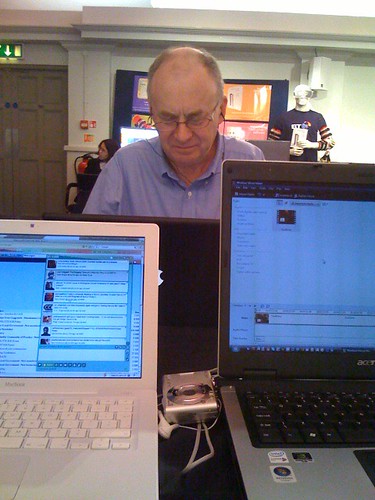
Today was most enjoyably spent at the Digital Inclusion conference, with David Wilcox, doing some video and other social web stuff on behalf of DC10plus.

Digital InclusionWe decided that, rather than drown DC10plus’s own blog with everything we produced, we would host our own blog featuring everything we did, from which people could take what they chose.

Our blog is at http://dc10plus.socialreporter.net – hosted at RuralnetOnline on their WordPressμ platform. This enables us to create minisites quickly at the socialreporter.net domain for any future events too, and maybe even building up a portfolio of work. David and I will be doing some more formal blog posts for the dc10plus blog over the next day or so, but for now the current arrangement gave us complete control over how stuff was displayed (such as embedding Qik video…) and just let us get on with the job.

We also used the blog to aggregate the bits of content around the web tagged up with dc10plus by embedding del.icio.us bookmarks in the sidebar, along with bits posted on Twitter with the dc10plus hashtag. Photos were uploaded to Flickr throughout the day and tagged, and again aggregated in the sidebar. WordPress really does make this stuff so easy.

I took my digital camera along, but didn’t use it. Much easier to take photos of the iPhone (did I mentioned I’ve got an iPhone? It’s beautiful. I am now of the opinion that you aren’t really a proper person unless you have one) and email them straight to Flickr. The quality is perfectly adequate for the web and the ease of use is something else.

The real story was in the video though, and we managed to get plenty done. I am slightly limited technologically speaking, because my camcorder hasn’t got an external microphone, meaning that I really couldn’t use it in crowded, noisy spaces. But while the conference sessions were going on, I managed to pin down some exhibitors to get the skinny on what they were up to. Hopefully the results were useful, like this with Bob Holmes of Digital Unite, who tells a nice story about how the social web can bring older family members back in contact with their families:

[youtube:http://www.youtube.com/watch?v=BWufgu3WJ5I]

I used YouTube to host my efforts, with minimal editing. One slight pain is that the Sony Camcorder doesn’t like talking to my Mac – fortunately I brought my Vista laptop along as a backup. The wifi at the location (The Brewery near the Barbican) was excellent, and th uploads took no time. Videos were online and on the blog within 20 minutes of them being taken.
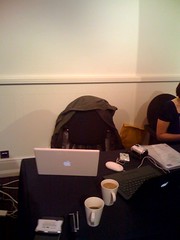
Computers and coffeeMeanwhile, David wandered about grabbing people for interviews, using both Qik and blip.tv for hosting. Using different services is good, offering slightly different things, but all can be aggregated in the blog, so it doesn’t really matter too much.

Things we learned? Organisation is important. We needed our own table, rather than sharing the DC10plus one (not that we weren’t grateful…) but the volumes of kit and wires meant we could have done with our own space. We were also still experimenting with various bits (embedding Qik in WordPress, getting hashtags to work) into the morning, which was a little too much brinkmanship, probably. But we have the basics in place, though, and the WordPress platform is the key to it all, really.

It’s definitely a two man job, though – possibly three if you want to have the actual conference sessions live-blogged too. I’m definitely up for doing some more, and it’s one of those things that you can only get better at with experience.

I’d like to thank David for letting me have a go – and to the folk at DC10plus for taking a punt on having us hang around, recording stuff. I hope the results work for them, and help get some of the messages across.

Update: Shane McCracken has blogged his thoughts on our efforts.

PermalinkA day’s reporting

Thursday, 24 April, 2008

Going local update

Thought I might post an update on my efforts at establishing a social media group in Kettering, Northants. Having been subscribed to various feeds searching for Kettering based content, which mainly produced details of various car boot sales in the area, I might finally be getting somewhere.

A couple of guys have been posting some great photos to Flickr, which have been tagged as Kettering, and with a bit of digging, it’s definitely the one near me, rather than in the States!

This is a clear issue – the tag ‘kettering’ is too vague, and maybe something like ketteringuk or ketteringnorthants needs to be used to ensure it’s unique. Of course, this sort of thing can’t be promoted until people start coming together.

So, I have sent a flickr mail to these guys seeing if they are interested in maybe a pub meet or a photo walk. Hopefully they won’t think I am being too forward 😉

PermalinkGoing local update

Tuesday, 22 April, 2008

Angel

Angel of the North

Taken as I sped by on my way to Newcastle. I wasn’t driving, honest, officer.

I remember being mesmerised by this on my first (and up ’til now, only) trip to the North East. It’s lost none of its magic for me.

PermalinkAngel

Monday, 21 April, 2008

Flat Earth News

Flat Earth NewsI am currently reading Flat Earth News by Nick Davies, which focuses on journalism and news and how the profession is failing in its duty to protect and disseminate the truth. This isn’t, Davies claims, because of a some moral failing on the part of journalists, nor out of commercial pressure, or indeed interference from proprietors. Instead, Davies points the finger at the way in which stories are promulgated across the media as a result of a lack of fact checking and a desire to cover breaking news regardless of whether or not it is actually verifiable.

The first example Davies provides is that of the millennium bug. Before the turn of the century, significant numbers of column inches were dedicated to describing the disasters and calamities that would befall society if nothing were done about it. But in truth, the actual number of systems affected by the bug were minimal:

…the problem would only occur in computers which had internal clocks (most desktop computers do, but most ’embedded’ systems, on which big organisations rely, don’t), but only if those clocks calculated time by using a calendar rather than by simply measuring the gap between two dates, and only if those calendars used only two digits to register the years, rather than four, and only if the computer was being used for programs which had to calculate time across the boundary between 1999 and 2000.

Needless to say, there weren’t many such systems around, and at the dawn of the new millennium, there were no planes falling from the sky, nor riots destroying our streets. The story had spread because the actual likely dangers were exaggerated by the various sources that the journalists were relying on, and those sources were not necessarily acting in a malicious way. Firstly, the IT security experts exaggerated the risk so that people would listen to them and take the issue seriously. From this, parties with an interest in the issue added to the noise: office managers seeking upgrades to their systems used the millennium bug as an excuse; governments overreacted so a not to appear as taking the nation’s security lightly. Then the third wave of opinion started to be voiced: those who had no clue what they were talking about at all.

This cacophony is self perpetuating, until some point where the truth becomes self-evident, and in this case that point was 1 January 2000, when nothing happened. Davies gives other examples too: the rumours around Bill Clinton in the 1990s, and the furore surrounding the prescription of heroin by British doctors. In the latter case, this can be seen to have had some serious consequences for society.

I’m interested in seeing what Davies comes up with in terms of explanations as to why journalists appear to be so compliant with this. Reviews of the book mentioned issues such as the demands of time and resources leading to a over-reliance on wire copy and a reluctance to fact-check. The rolling 24/7 news agenda must have some bearing on this with news TV channels demanding constant big stories and breaking updates and this is also true now of print journalists who provide content for news websites as well as for the print editions.

Does the use of social media tools by citizen journalists help or hinder the journalist profession in it’s pursuit of the truth? In many ways the influence is a negative one – bloggers have no requirement to meet any kind of professional standards and can publish more or less what they like – there is no Blogging Complaints Commission for example. This means that stories can get some air before they reach the traditional news media, giving them a life that they might not otherwise have got.

But that’s just one side of the coin. Citizen journalists can also get the truth out quicker, even when the mainstream media is pushing a different line. And while the authors of blogs might not necessarily always write the truth, it’s far harder for the majority of folk to falsify photographic or video social reporting (ok, so there is always Photoshop, and the equivalents for video editing, but the numbers of people who can produce convincing falsification are few and far between).

I mentioned in a previous post that perhaps a role for the professional journalist in the networked society might be in turning the fragments produced by the social reporters, the citizen journalists, into cohesive wholes, by taking a perspective a bit wider than the folk in the street with their camera phones who are providing the building blocks of the truth that in turn provide the journalists with the authenticity their stories need.

There is a Flat Earth News site with further information, extracts etc. It runs on Drupal!

Update: Just found this Guardian podcast featuring an interview with Davies. Well worth a listen.

PermalinkFlat Earth News

Thursday, 17 April, 2008

How do you measure blog success?

What sort of things do you look at to measure the ‘success’ of your blog, whether as a whole site or on a post by post process. I guess it might depend on why you are blogging as to what your actual definition of success might be.

Here’s a few basic ways that I thought of:

  • Page views
  • Number of comments
  • Saves to del.icio.us etc and other social bookmarking sites like Digg etc
  • Links to you from other blog
  • Number of RSS subscribers

I suppose even these measures aren’t definite. For example, a few comments having a quality discussion are probably more valuable than hundreds saying ‘Great post!’ or something equally rubbish.

But of course there are other things to, which might tie in more to your reason for blogging. For example, campaign blogs which have a particular cause in mind, or blog that promote a new way of doing things. You might not get many comments, but if you manage to change the way people are doing things, then you have been successful. I guess the only problem is that you won’t know about it!

The great thing about blogging, though, is that if what you are doing is useful to people, or if it is something that folk find interesting, then people will link to you, or comment, or bookmark your stuff. It’s almost inevitable.

How do you measure your blog’s success?

PermalinkHow do you measure blog success?

Skills 2.0

There are some interesting points in this PDF about the skills required in the age of web 2.0 from Harold Jarche, including:

Attitude: Accepting that we will never know everything, but that others may be able to help, is the first step in becoming a learning professional. This is an acceptance of a world in flux and that knowledge is neither constant nor fixed…

Learning: Learning professionals can no longer rest on their past accomplishments while the field changes and grows. They should be testing Web 2.0 tools so that they can develop optimal processes to support their organizations. If learning professionals are not setting the example of learning online, who is?…

Collaboration: Through sharing and exposing their work on the Web, learning professionals can connect to communities of practice and get informal peer review. There is no way to stay current with the technology, the neuroscience or the pedagogy all by ourselves.

PermalinkSkills 2.0

BBC blogging

Interesting re-post of an article that appeared in the BBC’s in-house magazine Ariel by Rory Cellan-Jones on the issues around the launch of the various blogs written by BBC journalists:

It strikes me the initial concerns were twofold – that nobody would be interested in our blogs so they would be a waste of a correspondent’s effort, and that they would threaten our impartiality. But the blogs have attracted plenty of readers – Robert Peston’s Peston’s Picks gets a million page views a month – and they’ve done that without descending to the opinionated, loudmouthed knockabout which was previously seen as the prerequisite for success in this arena.

What blogging does allow a broadcaster to do is to cover stories that would never make it onto the airwaves, and, in my case, to engage with a different and very knowledgeable audience. Mind you, that’s bound to be a minority audience and the danger is they become a distraction from the job of reaching the mass of licence-fee payers. Alf Hermida suggests that the BBC bloggers need to do even more to have a conversation with these people – I think there are risks in getting too involved.

Are these issues peculiar to the BBC, I wonder, or indeed peculiar to journalism?

PermalinkBBC blogging