
Thursday, 26 May, 2011

Online consultation and policy engagement

Neil Williams writes a great post about digital engagement on the AlphaGov blog:

On the face of it, you could say it’s a simple case of government doing something a bit whizzier and more user-friendly than publishing thousands of PDFs on hundreds of websites for people to find, comprehend and comment on by email. And it was tempting to build that whizzy something, pooling the best current practice from forward-thinking departments (like mine) as a baseline to push things further.

But scratch the surface and you quickly find yourself dealing with big issues around democracy, the delicate balance of trust between citizens and the state, the complexities of our constitution, and the culture of the civil service.

You find yourself touching on every opportunity for citizens, businesses and organisations to interface with any part of the state online, be it to give feedback, ask a question, seek help, present an argument, influence thinking or help solve a problem. And – most importantly of all – you touch on the capability and capacity of the state to process all this user feedback, to analyse, respond and interact.

A chunky quote, but there’s still more good stuff on the original post – go take a look.

There are also some slides that Neil developed in collaboration with Steph and Simon (what a dream team!). Embedded below, apologies if you can’t see them.

Steph followed up with his own post, which again is worth reading in full, though here’s a useful list he provides of things to do to get engagement right:

1. treat people with respect: if you spend time contributing constructively, that should be worth a proper acknowledgement, at least

2. treat different people differently: there’s not a ‘general public’ who have views on policy: there are service users, their relatives, people who work in public services, people who lobby about them, people who have oddly expert experience or niche specialisms. Consultation should be layered, asking people to give feedback on different aspects of the same thing, based on how much they know and care

3. combine customer and citizen roles: boost participation and improve public services by asking people for ideas when it’s relevant, connecting a public service experience with feedback on the policy behind it

It’s great to have some proper thinking done on this subject, though as Neil and Steph themselves have said, this is a start rather than the finish.

Some interesting bits came out of yesterday’s digital engagement workshop that we ran in Peterborough yesterday, and once I get my head together I’ll post them up here.

PermalinkOnline consultation and policy engagement

Wednesday, 25 May, 2011

Portfolio: sharing council comms resources

Portfolio looks an interesting idea, coming out of Nottingham City Council.

This, from an article at LGComms:

We’re launching Portfolio, a web portal that allows public sector organisations to share marketing materials. Councils and other public authorities can sign up to it for free and save money by buying ready-made, proven marketing campaigns. It also enables them to make money by uploading and selling their own designs.

Kind of an app store but for comms resources. Cool.

Right now it’s just traditional print media designs that are available, but I’m guessing it wouldn’t be too hard to include video assets, audio and so on.

Maybe even WordPress templates and the like?

PermalinkPortfolio: sharing council comms resources

Tuesday, 24 May, 2011

Innovative ways of training

I’ve been thinking about using some new ways of providing training on digital engagement stuff to those working in public services – in tandem with the traditional approach that we are taking in our workshop tomorrow.

Webinars are something I’m looking into, and I’ve written about my experiences of running them previously. What I am looking at doing is something a little more structured over a period of time.

So, how about a twelve week course on digital engagement? One webinar per week on a chosen topic, with a private discussion space so everyone can talk to each other about the topic afterwards.

Here’s a draft list of weekly topics:

  1. Introduction to digital engagement
  2. Designing your strategy
  3. Designing a policy
  4. Operational engagement plans
  5. Managing risk
  6. Developing a Facebook page
  7. Effective organisational use of Twitter
  8. Blogging for organisations
  9. Crowdsourcing and online open innovation
  10. Social media for events
  11. Social media in a crisis
  12. Community building and sustainable engagement

Would this be something you or people in your organisation would be interested in?

Also… would you (or your organisation!) be willing to pay for it? How much?

PermalinkInnovative ways of training

Monday, 23 May, 2011

Power lines

The RSA have just published a rather interesting paper that is well worth a flick through.

The paper argues that the government’s efforts to build the Big Society are too focused on citizen-led service delivery. An approach based on utilising and building people’s social networks, which largely determine our ability to create change and influence decisions that affect us, may prove more effective.

I’ve embedded it below, but if for whatever reason you can’t see it, you can download it from here (PDF warning).

RSA Power Lines

PermalinkPower lines

Engage people on their terms, not yours

I’m always going on about how, if you want people to give up their time to help you out, then you need to make it easy for them to do so, else they won’t bother.

Stefan has a lovely example, which he documents at admirable length on his blog.

I have laboured all of this probably more than the example is worth to make a point. None of this is impossibly difficult to find and use, but none of it is as straightforward as it could be and should be. If there is a serious desire to collect and respond to views, there are better ways of doing it than this.

Go read the whole thing.

PermalinkEngage people on their terms, not yours

Thursday, 19 May, 2011

Thank you, LocalGovCamp sponsors!

Since my last desperate begging funding drive, several companies and organisations have leapt to support LocalGovCamp, namely:

Many thanks to them. They join those who had already stuck their hands in their pockets:

We’re still not quite there yet though, and if anyone out there still has a bit of marketing budget they’d like to lavish on the coolest (ok, joint coolest with the FutureGov stuff…) event in local government, please do get in touch.

PermalinkThank you, LocalGovCamp sponsors!

‘Official’ local gov blogging

Simon writes a nice post celebrating the existence of the new official BIS blog, and provides a handy list of existing Whitehall “formal, properly-designated corporate ‘blogs'”.

Here they are – I’ve also added UKTI’s blog to the list, which I’m sure Simon will do too on his when he gets a moment:

I’m pleased, because as I have written on many occasions, I think blogging is a fantastic way for organisations to tell their stories, unhindered by having to go through third parties, media organisations and that sort of thing.

As Simon makes clear, these are public, official blogs, corporately branded and not the personal blogs of civil servants or politicians, which is a quite different thing. So what makes a blog an official one like this? I’d say some, not necessarily all, of these are factors:

  • Use of corporate departmental or organisational branding
  • Sitting on the official domain of that organisation
  • Linked to (reasonably) prominently on the standard corporate homepage
  • Written by a group of people rather than an individual (or a collection of individuals’ blogs, like in the FCO case)

There probably are others too – please do suggest them in the comments.

I’d like to start looking at which local councils are blogging officially, like the central government examples above. At the bottom of this post, you should find a form to complete if you have any to submit. If you can’t see it, that might be because you are looking at this in an email or your feed reader. Viewing the original post is your best bet.

[contact-form 2 “blogging survey”]

My next post on this topic will be on how we can get more blogging happening in this way, and perhaps what Kind of Digital can do to help! 😉

Permalink‘Official’ local gov blogging

Wednesday, 18 May, 2011

Bookmarks for April 28th through May 18th

I find this stuff so that you don’t have to.

You can find all my bookmarks on Delicious. There is also even more stuff on my shared Google Reader page.

You can also see all the videos I think are worth watching at my video scrapbook.

PermalinkBookmarks for April 28th through May 18th

From New Public Management to Open Governance (the back story)

I’m delighted to publish this – a guest post from Emer Coleman, Director of Digital Projects at the GLA, sharing her dissertation with us.

Anyone who has been following me on Twitter for the past year will know my struggles with “the dreaded dissertation” so it might be worth putting its origins in context.

In a previous life as Director of Strategy for Barnet Council I disagreed with a very deeply held belief in Local Government that the holy grail of resident satisfaction was how much you communicated with your residents. There was a correlation in Best Value surveys carried out every three years between “how informed” residents were and their satisfaction levels. But of course correlation does not imply causality. The simple edict went as follows Council Magazine + A to Z of Council Services + Managing Local News = Satisfied Residents.

Our corporate management team therefore wanted to do a huge communications campaign in advance of one of these surveys to ensure that residents knew exactly what their council did for them. The logic being that when they filled out their surveys on council performance they would recognize the council’s work. If only.

My Chief Executive at the time in response to my doubts said – “well if you want to change their minds you better put up a well argued case”. My dissertation is my attempt to do that.

In a nutshell it draws on the work of the German philosopher Jurgen Habermas who draws the distinction between the System and the Lifeworld. In the system where government lives we believe in these simplistic correlations but in the messy and complex Lifeworld we know that human beings don’t act in rational or predictable ways.

My belief is that open data, open government and the open conversations that take place in public in the social web offer great opportunities to move from the rational ordered public sector way of doing things to a more humanized, communicative form of governance. I tried to example that in the case study on the London Datastore and by including contributions by so many people in the open data movement that have helped me in developing my public policy work around open data.

My work and practice has been incredibly energized by the interactions that happen on the web and through my engagement with developers and innovators committed to the public realm. Mark Drapeau (@cheeky_geeky) calls them The Goverati (though my tutor didn’t like the name much) but I do. So a big thank you to all of you (you know who you are).

Download From New Public Management to Open Governance (PDF 2.3mb)

PermalinkFrom New Public Management to Open Governance (the back story)

Tuesday, 17 May, 2011

Spreading the GovCamp love

A quick cross post of something Steph put up on the MoreOpen blog, highlighting the great events funded in part by UKGC11.

At the beginning of March, we announced a small grant scheme using sponsorship from the UKGovcamp in January 2011 to help seed-fund a batch of further such events around the country. We had some great applications, and here’s the list of who we’ve funded so far:

We Are What We Tweet
8 April 2011

As part of the Social Media as Practise course as MA students of Social Media at Birmingham City University, the class staged a one day event looking examining the context of social media use and how it can bring governments and citizens together.

Recipient: Chioma Agwuegbo
Received: £300

ShropCamp
19 April 2011

Focused on communities and services. How can we use social media and open data to help service providers to work more effectively at a local level?

Recipient: Ben Proctor
Received: £600

MailCamp
12 May 2011

MailCamp is a free, one-off show & tell event on 12 May for people interested in how the public sector uses email marketing, newsletter and alerts to engage its audiences.

Recipient: Steph Gray
Received: £600

YouthWorkOnline unconference
21 May 2011

This one-day free open space event brings together practitioners from youth work, participation and voluntary youth projects with digital media developers and experts to share ideas and practice, to explore what the digital world means for young people’s lives, and for services seeking to support young people as they navigate growing up in a connected world.

Register at: http://cgen11.eventbrite.com/

Recipient: Tim Davies
Received: £600

Localgovcamp
18 June 2011

LocalGovCamp is coming back to its spiritual home, Birmingham, this June – and it’s going to be bigger and better than ever. 200 of the most innovative and creative people in the local government sector will be coming together on a Saturday to talk about making things better – sometimes with technology, sometimes not.

Register at: http://localgovcamp2011.eventbrite.com/

Recipient: Dave Briggs
Received: £1,000

LearnPod
13 July 2011

LearnPod aims to debate the use of technology and innovation in learning, predominantly in the post-16 education context.

Register at: http://learnpod11.eventbrite.com

Recipient: Kevin Campbell-Wright
Received: £500

QuangoCamp

July/August 2011 TBC

A one day pratical & sharing event for those who don’t quite fit in with central gov, are a long way from local gov and also don’t quite click with the events in higher education, museums or the charity sector. Reclaiming the word ‘quango’ for a positive, rather than a focus for scorn.

Recipient: Matt Jukes
Received: £400

ScotGovCamp
September 2011, TBC

ScotGovCamp is a self organised unconference for people who work in and around government in Scotland.

Recipient: Lesley Thomson
Received: £500

North London LocalGovCamp
TBC

A North London localgovcamp event, inviting people who are involved with related projects, focusing on North London boroughs – Camden, Islington, Haringey, Barnet, etc.

Recipient: Anke Holst
Received: £300

RuralCamp
TBC

Recipient: Dave Briggs
Received: £200

Ten spin-off projects ain’t bad going, touching maybe another 1000 people and keeping the govcamp buzz and optimism going through the year. Good luck – and thanks in advance – to the organisers above, and another big thank you to the original sponsors of UKGovcamp whose patronage helped all of these get off the ground via MoreOpen. An organiser of one of the events reported:

You were the first people to offer us sponsorship and that managed to convince other people to take us seriously. Without your help we probably wouldn’t have been able to deliver the event at all.

There’s a few quid left (really, not very much) so if you’re inspired to run your own event and would like a bit of help getting it off the ground, you know where to go.


PermalinkSpreading the GovCamp love

Monday, 16 May, 2011

More notes on mobile apps and government

I still haven’t really got my head around mobile apps and their use for government services. However, James Coltham wrote up some excellent notes from a meeting up in Scotland on the subject recently:

There is definitely a groundswell of interest, though, as well as a growing demand from the public, making for interesting times for anyone involved in making sure their services are ready to go mobile.

I wrote a few bits down last August, and if I’m honest my position hasn’t much changed from:

  1. Platform neutral mobile friendly websites are probably a better bet in an age of austerity
  2. App development is probably a job for the private sector, but I’m not convinced there’s an actual market (ie would people pay for an app to access government services?)
  3. Any app that would work for more than one organisation will need open data in a common format which doesn’t yet exist, though it might do soon (LinkedGov, KnowledgeHub, etc)

Also, what are the sorts of things people will want to do with councils or other public services on their phones? I suppose there are two elements to this:

  • Those things you might want which are suited more to a mobile device than anything else: ie, I need this information now, and here. Bus timetables are a good example, perhaps, or something else that can use location data.
  • Everything else, but delivered to a phone because that either where the owner prefers to access information and services, or because it’s their only way of accessing information and services

I think the second point is probably key to winning the argument for whether government organisations should seriously explore delivery via mobile devices. If we come to a point where a lot of people don’t bother with PCs because their phones do want they need them to, then that’s where the focus of electronic delivery probably should be pointed.

In other words, what does e-government look like in a post-PC era?

PermalinkMore notes on mobile apps and government

Thursday, 12 May, 2011

Workblogging

Euan Semple wrote a short post the other day that really caught my eye. Here it is in full (hopefully he doesn’t mind!):

A business where everyone blogs. Everyone thinks about what they are doing and writes about what they are doing. From the top to the bottom, the edges to the middle. Everyone awake and bouncing off each other intellectually as they get more and more effective at whatever they do.

Now, Euan is a great thinker, writer, speaker and doer in the world of deploying social technology in organisations to make them work better. He was one of my first inspirations when I first started getting into this stuff seven years ago or so. He’s still writing great challenging stuff and sparking new ideas.

Because, of course, while blogging – one of the oldest forms of social media – may have been overtaken by social networking, status updating and location services in the fashion stakes, it remains one of the most powerful and useful methods of online interaction that exists.

After all, there’s no way I would be sat here, running my own business, doing what I love, were it not for the fact that I started blogging however many years ago it was.

Indeed, given that we seem to have a knowledge economy these days, how does an individual promote what it is that they know to the outside world? I’m not sure there’s a better vehicle than a blog, to be honest.

But it’s not just about personal gain and career enhancement. Having employees blog, as Euan states, has a great impact on organisations. Whether the blogs are out there on the web or just run internally, having people thinking and writing about their work means they get better at their jobs, and with everyone knowing what everyone else does, collaboration, knowledge sharing and silo-busting becomes a reality.

PermalinkWorkblogging

New councillor? Get the training you need online

With the elections of May 5 2011 now complete Member Development Officers need to look at the most efficient and cost effective way to train these newly elected councillors.

Modern Councillor is the online learning and support destination for councillors, people considering standing for election, or indeed anyone with a passion for local democracy provided by my pals at Learning Pool.

The service has been designed with both new and more experienced elected members in mind. A subscription to Modern Councillor provides elected members with full access to a growing catalogue of e-learning modules, at a fraction of the cost of classroom based training as well as access to our online community.

What modules are included?

All 17 of the current e-learning modules have been created alongside subject matter experts and cover areas such as Induction, Media, Community and Legislation. Specific modules include Introduction to Local Government, Your Role as a Councillor and Getting Started with Social Media. You can view a full list of the current modules available in this PDF e-learning catalogue.

Who does the community involve?

Alongside a suite of e-learning modules, Modern Councillor will now include an online community bringing together councillors, prospective councillors, co-opted members, local government officers, activists, and residents so that they can connect, share and learn together. Join the community, for free, here.

Guest Access

If you’d like Guest Access to preview the training available through Modern Councillor or any other information, please email breda@learningpool.com.

MDO Support Webinar

Join us for our free webinar on training and supporting your elected members on Thursday, 19 May, 2011 10:00 AM – 11:00 AM BST. Register here.

PermalinkNew councillor? Get the training you need online

Wednesday, 11 May, 2011

Tuesday, 10 May, 2011

Adverts on council websites

Adrian Short picks up on some adverts that appear on a council’s website. They’re for debt management companies that encourage people to apply for bankruptcy.

Probably not a good thing – I think we’d probably rather people needing advice about that sort of thing go to the Citizens Advice Bureau, for example.

Soem folk don’t think councils should run adverts on their sites. I’m pretty indifferent personally – if they can make it work and get some revenue to help develop the website, then that’s fair enough.

Councils running adverts on their websites do need to be very careful however about the contents of those adverts. If you’re using Google Adsense then it is possible to moderate the adverts to keep inappropriate content off your site. As a reputation management issue, this is a vital activity – but also of course to protect those using the site.

Maybe an alternative is to use a more local, friendly service than Google – such as Addiply. This would offer far more control.

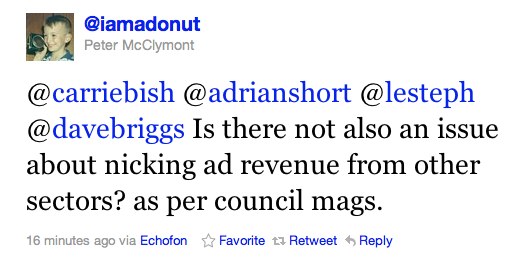
Peter McClymont raises another interesting issue:

After all, councils get plenty of web traffic because there’s nowhere else to go for that content. If I want to pay my council tax, I have to visit the council website, meaning any adverts on that site get the benefit of my eyeballs and potential clicks as a result of that monopoly position.

I doubt if anyone has done any research in those areas where councils do run ads as to whether it has affected the revenues of the local newspaper website, for example. It would be interesting though, I think.

For more information on councils running adverts, Catherine Howe wrote an excellent summary post earlier this year.

PermalinkAdverts on council websites

Monday, 9 May, 2011

Fancy sponsoring LocalGovCamp?

LocalGovCamp isn’t far away – just over a month. So far 150 tickets have gone and we have another 50 which we are looking to distribute in a new way to get a few different faces along!

So we’ll have 200 of the most innovative and creative people in local government in one place, on a Saturday, ready to talk about how we can improve the way we do things. It’s going to be ace.

One thing we do need though is money. Bringing the event out of London made finding a free venue impossible, and so we face a bigger bill than usual from the get-go. On top of that we have some extra money to find for some unexpected expenses.

So, if you would like to help this event out and ensure it’s the success it ought to be, please get in touch with any offers of cash you might have spare.

  • £250 gets your logo on the website, the ability to bring a pop up stand and some marketing literature with you, and lots of vocal thanks throughout the day.
  • £500 gets you all the above plus a logo on the t-shirt.
  • Anything substantial over the £500 mark means I’ll also give you a piggy back around for the day (or something).

Thanks go to those who have already put their hands in their pockets: the MoreOpen fund, Huddle, LGIU and Podnosh. Also Digital Birmingham who have helped massively with organising things. Oh, and Kind of Digital of course 😉

PermalinkFancy sponsoring LocalGovCamp?

Friday, 6 May, 2011

Here comes Noot – the public sector social business tool

I’ve written loads in the past about the importance of using social technology in the workplace, especially in the public sector.

It’s great for tearing down silos, sharing knowledge, making the most of talent, completing projects successfully and maybe making life a bit more interesting.

One bit of technology I have had my eye on for a while is a bit of open source loveliness called Open Atrium, which is based on the popular and powerful Drupal framework.

What really caught my attention was that it was announced recently that the White House were using it to collaborate with. This is a bit of software that means business.

So I was delighted when I started talking with my good pals Harry and Rupert at Neontribe – web developers and user experience legends from Norwich (and who are organising RewiredState Norfolk this weekend, which you really ought to get to if you can). It turns out that they live and breath Drupal, and whats more, had started to get enquiries about OpenAtrium themselves.

Noot

We put our heads together and came up with Noot. Noot is a hosted Open Atrium offering aimed squarely at the public sector here in the UK. The Neontribe gang handle all the technical stuff, while Kind of Digital provides the consultancy and training to make sure customers get the most out of their investment.

Noot provides you with:

  • Groups, allowing people across your organisation or from partner organisations to get together and collaborate.
  • Discussions, so folk can talk to one another.
  • Collaborative authoring, allowing people to jointly create and edit documents.
  • Project and task management, helping to get stuff done
  • File uploading and sharing
  • Yammer or Twitter style status updates

…and a bunch of other cool stuff. What’s more, we’re going to be actively listening to users and developing more features to provide the functionality people really need.

So whether you just want to get people in your organisation talking to each other, want to manage cross departmental projects better, or start doing some serious partnership collaboration, Noot could well be the technology that suits your people and your process.

We’re still tidying things up, getting our marketing messages right and figuring out just how much we are going to charge for this thing. In the meantime, do follow Noot on Twitter, and bookmark the homepage so you know where to go to find out more.

If you’d like a demo or an early chat about Noot, you know where I am.

PermalinkHere comes Noot – the public sector social business tool

Wednesday, 4 May, 2011

I like MyFarm!

Now, when I started writing about micro-participation, I never envisaged the possibility of micro-farming, but there we are!

MyFarm is a great initiative from the National Trust, effectively making games like Facebook’s Farmville real.

Participants pay £30 a year to be involved, and get to vote on various decisions affecting the farm. It’s a bit like an agricultural version of MyFootballClub, which saw a bunch of people from the internet buy Ebbsfleet United.

The benefits are increasing knowledge about farming and the countryside – and also to help people understand where food comes from.

It’ a great idea – and a brave one too.

PermalinkI like MyFarm!

Tuesday, 3 May, 2011