Get posts sent to your inbox:

Dave Briggs
An online notebook
Dave Briggs
An online notebook
Friday, 29 December, 2006
Thursday, 28 December, 2006
PayPerPost buys Performancing.com

PayPerPost, the people who line up advertisers to pay bloggers to write nicely about their products, have bought Performancing.com – specifically the website and the Metrics system. Performancing for FireFox and the Performancing Partners advertising programme will continue under a new banner(s).
Something along these lines has been coming for a while and it’s fair enough that the Metrics project just wasn’t producing the goods for them. They wanted out, and I’m guessing they made some money on it. Fair play to them.
But PayPerPost? There will be plenty of bloggers among the 28,000 that they have ‘purchased’ who won’t want anything more to do with the project. Tris Hussey is one. I’ll be taking Performancing Metrics from my personal blog too.
Why? Because PayPerPost, to my mind, Just Don’t Get It. The notion of influencing bloggers through cash stinks, because it puts into question the validity of the blogosphere, no matter how many disclosures you put in.
Performancing, up to this point, have been considered to be among the good guys. Let’s hope that by selling up to the likes of PayPerPost, they haven’t lose some of the credibility they’ve rightly earned.
[tags]performancing, payperpost[/tags]
Get in!!
Finally have Ubuntu talking to the internet!
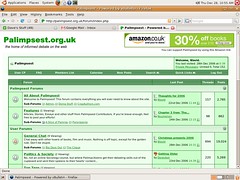
Woo-hoo!
[tags]ubuntu, linux[/tags]
Wednesday, 27 December, 2006

Tuesday, 26 December, 2006
Sunday, 24 December, 2006
Saturday, 23 December, 2006
Wikiasari
Jimmy Wales is planning a search engine with Amazon. I’ve written more over at Hyprtext.
Wikiasari : WikiSearch?

Jimmy Wales, it would appear, is planning a search engine, along with his chums at Amazon, through his for-profit venture, Wikia.
Mr Wales has begun working on a search engine that exploits the same user-based technology as his open-access encyclopaedia, which was launched in 2003.
The project has been dubbed Wikiasari — a combination of wiki, the Hawaiian word for quick, and asari, which is Japanese for “rummaging search”.
Mr Wales told The Times that he was planning to develop a commercial version of the search engine through Wikia Inc, his for-profit company, with a provisional launch date in the first quarter of next year.
Earlier this year he secured multimillion-dollar funding from amazon.com and a separate cash injection from a group of Silicon Valley financiers to finance projects at Wikia.
Interesting…
Niall Kennedy admits that he’s
skeptical. Sites such as Google, Yahoo!, and Windows Live already have the crowds clicking on search results every day, submitting bookmarks, and, in some cases, flagging spam. Wikia would need a critical mass of users to maintain a useful search index and query analyzer to supply Britney Spears’ fans, medical research, and the many many other search queries submitted every day. The same same search engine pickpockets wandering through Google’s search index will continue to target any significant source of traffic and unlike Wikipedia, you can’t just lock down a contested (or heavily profitable) area and still maintain balance.
Too true.
Ionut over at the Google Operating System blog takes up Wales’ claim that people will be more efficient at deciding whether a page is good or not than a computer:
I think the main job of a search engine is to understand how relevant a page is for a particular query. To scale, a search engine should that algorithmically. While people have a better ability to decide if a page is relevant, that doesn’t mean spammers won’t try to push their sites.
Wales and Wikia are taking on quite a bit at the moment – for example, the OpenServing site isn’t up and running yet (and I’m not yet entirely sure about what it’s meant to do) – and the introduction of a new search engine is a massive task.
And the name is really lame – ‘Google’ has become a verb. Can you imagine anyone ever saying “Can you Wikiasari this for me?” Answer: NO!
Update: In the comments, Jimbo points out that Amazon aren’t involved in the project. More here.
Update 2: Mike Arrington has a screenshot.
[tags]search, wikiasari, wikia, jimmy wales, niall kennedy[/tags]
Gmail from the Stone Ages

Why is it that NONE of the recent new functionality has hit my Gmail account yet? Even Mrs Dave’s account is up-to-date with all the cool stuff Google have been adding of late – and by her own admission, she doesn’t use it, and what’s more doesn’t LIKE IT!
So, if there are any Gmail people out there with nothing better to do over the festive period, please can they look at the poor, unloved excuse for an email account that is briggs.dave@gmail.com and maybe make it just a little bit better?
Please?
[tags]google, gmail[/tags]
What’s the best way to read a feed?

Well, it appears that everyone has much better things to do than blog at the moment, except for me, so news is very thin on the ground. So, I thought I’d empty my mind of all the thoughts I’ve had about reading RSS feeds and dump them into this post. There is, I’m afraid, rambling ahead.
I suppose it all starts from where you should read your feeds. In a standalone application (FeedDemon, er…)? With your web browser (ie using FireFox live bookmarks, or an extension, or IE7’s built in feed aggregation)? In your web browser (Bloglines, Newsgator, Google Reader)? In your email (Thunderbird, Newsgator for Outlook)?
I currently use the first option, the standalone application – to be precise, FeedDemon. One of the first problems with this approach is that you can’t read your feeds on anyone else’s computer. FeedDemon avoids this by allowing you to sync your feeds with NewsGator, a web-based reader (which is, incidently, more or less the only thing that recommends NewsGator…).
Having the standalone app allows you to do more with your feeds – saving posts in news bins, for example, or setting up watchlists so that any posts with certain keywords in them are saved in one place automatically for you. It makes blogging much easier. Actually, there is a problem with the watchlists in FeedDemon – if a post is relevant but doesn’t contain the magic words, you can’t just drop it in.
FeedDemon also helps you to make blog posts – you can click a little icon, which bungs the text and a link that belong to a post into your chosen offline blog editor. This is nice – but not so nice if you don’t have an offline blog editor. Only…I’d like to be able to do my blog posting inside the same application as I do my blog reading. It’d just be neater. I’d also like to be able to build a blog post from more than one original post and from more than one original blog. I’d like to skip around my feeds, selecting bit to quote and adding comments and links here and there as I go. A bit like Google Notebook, really, only eventually being published on a blog.
But I suppose, the more I think about it, if I’m going to combine my blog editing and blog reading software, shouldn’t I just combine my browser too? But the problem is that the browser-based feed readers are a bit on the lame side – FF’s Live Bookmarks are pretty much unusable for anyone who is subscribed to more than two blogs. I haven’t found a plug-in that I’ve liked, either, which is a shame because with Performancing for FireFox, you’ve got the blog editor there too. The built-in RSS support in IE7 isn’t too bad at all, with with the Live toolbar you can automatically blog an entry – if you use Live Writer, that is.
The web-based readers, for me, just don’t offer the functionality that FeedDemon does, especially around the grouping and saving of posts for later blogging. Bloglines and Google Reader let you produce a sort of link-blog thing, saving posts at a viewable URL for later reading. But it’s just not the same.
The closest I can think of to my ideal is Firefox with an RSS reader plug-in which mirrors the functionality of FeedDemon and which can sync with an online feed reader so I can get at my feeds when I’m away from the PC. This needs to be coupled with a blog editor plug-in, like Performancing, which allows me to build a post from multiple blogs, as I mentioned above (does PfF do this already? I don’t actually know) – I don’t want to be copying-and-pasting stuff from all over the place.
Is this too much to ask?
[tags]rss, feed readers, blog editing, blogs, feeddemon, performancing, google reader, bloglines, firefox, ie7[/tags]
Friday, 22 December, 2006
Steve Rubel Interview
Shel and Neville at the For Immediate Release podcast interview Steve Rubel. Interesting stuff.
Thursday, 21 December, 2006
hyprtext
I’ve been beavering away on a new collaborative blogging project, which is called hyprtext. It’s going to be covering web and tech news, mainly. The feed is at http://feeds.feedburner.com/hyprtext.
I’ve already signed someone up to cover copyleft and drm issues and am looking for a couple more contributors. One I need specifically is someone who can cover the open source angle a lot better than I can. We’re looking at a few posts per week, I reckon, not a huge commitment. If anyone is interested, drop me a line.
There are still a few issues to iron out with the site layout. I’m trying to get an RSS feed to publish in a sidebar using the WordPress RSS widget (just the standard one that comes supplied with the sidebar widget plug-in); and I can’t seem to get my MyBlogLog thingy looking anything other than lame. I’ll get there though, I guess.
The All New Blogger

Google have finally got round to releasing the brand spanking new Blogger. They’ve been justifiably criticised over the lack of movement on the product since acquisition, and have since been easily overtaken by the likes of WordPress.com and TypePad. Even with this release, it’s fair to say that Blogger has some way to go to truly compete.
You can also now sign into your blogger account using your Google account ID, and Google has made editing the template and posts significantly more user friendly, such as by implementing what sounds like a widget style drag and drop approach.New features include the addition of tagging, which, this being Google, is called ‘labels’ and an option to make a blog private, viewable only by people that you specificy.
This is all hardly groundbreaking stuff, and the launch blog post seems to acknowledge this, stating that the work on Blogger is “far from done”. Are Google back in the blogging game? Possibly.
One feature I’d like to see Google implement is to integrate Blogger into their Google Apps service, which desperately needs some form of dynamic web content creation, rather than the static Page Creator that’s currently in place.
Has anyone tested the ‘new’ Blogger? We’d be interested in any comments you have.
[tags]blogger, google[/tags]
The shape of GoogleOS?

Read/WriteWeb have another of their articles trying to predict what a Google-produced operating system might be like. There’s no reason to suggest that Google are even developing such a thing, but that doesn’t stop the guessing game being fun.
Their conclusion is that it will be a stripped down Linux, which literally just boots the computer into FireFox to connect with Google’s many web services, rather than a Web based OS like YouOS, or a fully functional Linux distribution.
It’s a cute idea, and one which I think has some legs – even if Google themselves don’t do it. I do believe, for example, that the future of the web is mobile – maybe a Blackberry sized device that boots into Firefox via wireless connections and then hooks up with web services like those offered by Google and of course Zoho and others.
This approach would completely knock out the need for any kind of syncing between the mobile device and a desktop workstation, because the systems and interfaces you are using are exactly the same.
One of the problem with this approach is what you do with data. Will people be happy that every file they own is stored online, with Google’s ad bots running through them picking up on everything we do with our computers? It’s obvious that business will have a problem with this although whether that is true of the average home user, I don’t know.
Another fundamental issue is over the technology that is being used to produce so many of the web apps that are out there, and specifically Ajax. Bill Thompson puts it much better than I could:
There is a massive difference between rewriting Web pages on the fly with Javascript and reengineering the network to support message passing between distributed objects, a difference that too many Web 2.0 advocates seem willing to ignore. It may have been twenty years since Sun Microsystems trademarked the phrase ‘the network is the computer’ but we’re still a decade off delivering, and if we stick with Ajax there is a real danger that we will never get there.
It’s an interesting debate though, and one that hyprtext will be keeping a close eye on.
[tags]read/writeweb, google, googleos, bill thompson[/tags]
Wednesday, 20 December, 2006
Zoho go all wiki

Zoho, one of the challengers to Google’s online office crown – and a damn good one at that – has unleashed its wiki service, to go along with the whole raft of other services they provide. The editing functionality comes from Zoho Writer, so is very easy to use with full wysiwyf functionality.
TechCrunch covers the story:
Two things make this product stand out. The first is that the Wiki supports embedded data from other Zoho products. For example, a spreadsheet from Zoho Sheet can be embedded directly into the Wiki. Any changes to the spreadsheet, whether they are made in the Wiki or in Zoho Sheet, will be synced. The Wiki product also has a single sign in with other Zoho products.
Second, the entire Zoho suite of products is on the same overall architecture, making syncronization and new feature releases much easier between applications. Contrast that to Google’s suite, including two acquired products (Writely and JotSpot) and one mostly home-grown one (Spreadsheets). It will never be as homogenous as what Zoho has created.
I agree that Zoho is a great looking suite of applications and is probably the closest thing there is right now to a workable, integrated online office platform.
But is there room for a small fish in this pool full of giant sharks? It’s a shame to say so, but maybe Zoho’s eventual best hope of success will be to be bought up by a competitor to Google.
[tags]zoho, wiki, google, online office[/tags]