Monday, 1 November, 2010

Importance of workflow in social technology

From Gartner’s Mark McDonald:

Too many people think of a wiki as another knowledge management tool. Knowledge management tools are something that is separate from your day to day workflow. That attitude will need to change along with the technology that integrates wiki technology into the workflow in order to have people say ‘put it up on the wiki’ rather than inventing an ad hoc process that takes time, resources and puts bottlenecks in the flow of information.

As I found myself writing over and over again when describing the social tools I use, it’s all about workflow.

The best software keeps out the way and just lets you do stuff. There shouldn’t be anything new to learn, and the process should be completed within one or two clicks of a mouse.

It’s also individual, of course. What fits in my workflow might not fit in yours, and learning and knowledge technology needs to be able to fit in seamlessly, nonetheless.

PermalinkImportance of workflow in social technology

No more Windows?

Well, in a decade perhaps.

If you’ve ever wondered if it were possible to write fondly about Windows, well, James Gardner (kind of) gives it a go in his recent post on the desktop upgrade about to take place at the DWP:

It feels funny, doesn’t it, thinking about Windows in the context of being irrelevent, after all these years we’ve relied on it. I guess it proves, again, that change is the only constant.

As James puts it earlier in his post:

I think this will likely be the last verion of Windows we ever widely deploy, though.

The reason? I think we’ll have fewer workloads that actually require a heavy deskop stack. Today, of course, we have all this legacy that’s coupled to the desktop, but in a decade, I really doubt that will be the case. Most of our stuff will arrive via the browser.

So it looks like Scott McNealy and Sun were right all along. The network is the computer.

PermalinkNo more Windows?

Saturday, 30 October, 2010

Bookmarks for October 3rd through October 19th

I find this stuff so that you don’t have to.

You can find all my bookmarks on Delicious. There is also even more stuff on my shared Google Reader page.

You can also see all the videos I think are worth watching at my video scrapbook.

PermalinkBookmarks for October 3rd through October 19th

Wednesday, 27 October, 2010

Saving lots of lolly with Learning Pool

Quickly grabbing some connectivity at a friend’s house, so I thought I would share this post – originally published on the Learning Pool blog – outlining just how much money the public sector has saved by working with us to deliver their training and collaboration online.

Enjoy!


Two hundred local authorities in England and Wales have made substantial savings of £36million in their HR budgets over the last three years by using an open source platform to track and monitor delivery of their internal training programmes.

Councils have saved between £46,000 and £100,000 every year by using the Dynamic Learning Environment from Learning Pool. This service was launched in September 2007 and has been bought by small, medium and large public sector organisations. Developed on Moodle, the open source Learning Management System allows organisations to deliver and manage all kinds of learning resources and to track usage while demonstrating return on investment from training spend.

Mary McKenna, Learning Pool describes how using open source software helped:
“Open source software allowed us to create a managed learning platform that we launched on a disruptive pricing model. We set out to save councils money, and we did.”

Learners benefit from built in Web2.0 features such as wikispodcastsdiscussion forums and pollswhich can be switched on as required to provide a learning experience that goes beyond the classroom or, in the case of e-learning, the solitary computer.

The business case for open source

Stories of councils paying exorbitant fees for managing their learning prompted Learning Pool to develop this system for the public service.  Prior to 2007 councils were paying anything from £40,000 for a one year LMS contract without any support or maintenance, right up to £600,000 for the platform plus another £600,000 to implement, as experienced by a large county council in the North of England.  By comparison, the average cost of a Learning Pool DLE is £4,000 per year including set up, configuration and initial training.

Collaboratively created

Moodle was the obvious choice for the technology to underpin the DLE. Created by the open source community, this technology has quickly become the world’s favourite LMS and is deployed in thousands of organisations worldwide, including the Open University. On the first day of the launch over 50 Learning Pool customers signed up to be guinea pigs, thereby demonstrating the clear need for an affordable solution.

Their feedback, critique and requirements shaped the first launch of the platform and has continued to inform its development ever since.

Since those early days not only have no customers cancelled their contracts, over 150 more have signed up and we’ve continued to develop and enhance the platform with new updates to functionality and features, many suggested by customers themselves.

Learning Pool’s Paul McElvaney says:
“We consider ourselves to be an open source success story and we’re really proud of  what we’ve achieved. The DLE we have built gives our customers flexibility and functionality. It’s completely customisable and can be configured to meet the needs of each individual organisation in the public service.”

We work hard so you don’t have to

In today’s environment of efficiency and budget cuts a Learning Pool DLE gives time pressed HR and IT managers the ability to create management information reports to quantify progress against objectives and demonstrate ROI.

And, because the platform is hosted by Learning Pool, there are no tricky firewall or security issues to contend with and no need to worry about rolling out upgrades or software extensions – this is all taken care of centrally by Learning Pool. Feedback from Learning and Development managers who are using the system is positive.

“We’ve realised just how powerful and flexible the DLE can be, compared to our limited LMS experience of just administering learning accounts. The DLE, together with the new version of the authoring tool, will add another dimension to our e-Learning modules.”
Steve Day, Rotherham MBC

“My aim is to change the mindset of staff and managers. Those who think at all about [our DLE] probably think ‘What does it do?’I want to change that to ‘This is what I need to do in my service – how can I get [our DLE] to facilitate this?’ This would be a major step forward to using the DLE as an integral part of the business, something I believe has enormous potential.”
Simon Green, Blaenau Gwent CBC

About Learning Pool

Learning Pool is the only online learning community dedicated exclusively to the public sector. From councils to central government, we provide e-learning courses, a managed learning platform and community-led social learning solutions designed to help public sector organisational change, improve service delivery and build capacity – all with increasing efficiency.

With less than 50 employees Learning Pool is a small, agile and fast paced organisation that bears little resemblance to the Local Government Improvement and Development project where it began. Independent and grown up for four years, we kept the good stuff – the total focus on the public sector, the commitment to collaborative working, not reinventing the wheel and the name and improved the rest – not least our software and customer service.

For further information on Learning Pool’s Dynamic Learning Environment, including costs, please email hello@learningpool.com or call 0207 101 9383.

PermalinkSaving lots of lolly with Learning Pool

Monday, 25 October, 2010

Mostly offline

I’ve moved house, and the new one won’t be connected to the internets until Thursday.

So I won’t be doing much until then!

Normal service resumed next week though.

PermalinkMostly offline

Thursday, 21 October, 2010

Local by Social: free online conference 3-9 November

I’m taking part in an online conference on the LGID Communities of Practice platform (registration required) that’s running between 3 and 9 November.

My bit will be on the 8th, between 1.30 and 3.30pm, and I will be talking about the movement of GovCamps across the UK, where practitioners, suppliers and interested others get together to chew the fat about improving public services.

Here’s the skinny from the Local by Social blog:

Local by Social online conference, 3 – 9 November FREE

Citizens and councils are getting online and discovering the power of the Internet to make it easier to access services, feed back for improvement, provide accountability and help people organise themselves for civic action.

The Local by Social online conference will bring together a range of practitioners, thought leaders and social entrepreneurs to look at three areas where the Internet is changing the way localities are governed and services are delivered.

Social media: citizens and councils
Social media: creating and sharing knowledge between practitioners
Open data for accountability and improvement.
This free conference will be hosted on Local Government Improvement and Development’s Communities of Practice platform.

What’s an online conference?

An online conference is just like a conference in the ‘real world’ except there are no long train journeys, no soggy sandwiches and no shame in getting up and walking out if the topic just isn’t your thing.

LG Improvement and Development has hosted many successful online conferences. You’ll hear from invited ‘speakers’ who will share materials through video, presentations or writing about their topic who will then be available to answer questions in the discussion forum. But this is also an opportunity to set your own agenda, start topics or carry on discussions.

How do I sign up?

This free online conference is already open to join. If you’re not already a member, register at www.communities.idea.gov.uk (it’s free). If you are, simply follow this link to sign up. We’ll alert you as activity kicks off and round up the hot topics, so you never miss a thing.

Confirmed speakers

  • Carrie Bishop and Dominic Campbell, FutureGov
  • Dave Briggs, Learning Pool
  • Emer Coleman, GLA/ London DataStore
  • Gary Colet, KIN
  • Hugh Flouch, Network Neighbourhoods
  • Steve Dale, Knowledge Hub
  • Paul Davidson, CIO Sedgemoor, LeGSB
  • Brendan Harris, Local Government Improvement and Development
  • Stuart Harrison, Lichfield District Council
  • Alison Hook, Coventry Council
  • Dan Slee, Walsall Council
  • Hollie Snelson, Kent
  • Julian Tait, Open Data Manchester/ Future Everything
  • Mike Thacker, Porism/ esd-toolkit
  • Richard Wallis, Talis
  • David Wilcox
PermalinkLocal by Social: free online conference 3-9 November

Friday, 15 October, 2010

Thursday, 14 October, 2010

Almost live transparency from Greater Manchester Police

GMP

A really interesting experiment is happening in Manchester today, thanks to the local police force.

Greater Manchester Police are, according to their website,

publishing details of every incident that it deals with on Twitter to allow the public to see what officers at one of the largest UK forces face on a daily basis.

This video explains more:

You can follow all the action on the GMP website, where they are aggregating together the outputs from three different Twitter streams, or just get the latest from @gmpolice.

As I said, interesting stuff, and a great use of the scale that social media tools like Twitter offer in terms of quickly publishing a lot of information. Imagine doing something like this through traditional web publishing tools!

It’s also a great example of a public service using transparency proactively and positively. It doesn’t always have to be bad news.

PermalinkAlmost live transparency from Greater Manchester Police

Wednesday, 13 October, 2010

Big and small societies

Nick BoothI had the pleasure on this lunchtime of spending time with Nick Booth – the man (the legend?) behind Podnosh, and the phenomenon that are Social Media Surgeries. What I love about Nick is that he is a connector – he knows government, and he knows communities – and he introduces them to each other all the time, on the web or in real life.

Anyway, this isn’t a post (just) about inflating Nick’s ego. We spent an hour and a half discussing business, the state of local government, where our own relevance might lie in these austere times, and that sort of thing. We naturally ended up discussing the Big Society, what it might actually mean and how it might actually work.

We probably didn’t cover much ground that others haven’t, but it was a useful discussion. I think that what I took away from it most of all was the idea that the lack of money to fund civic activity should be seen as a feature, not a bug.

In other words, don’t complain about there being no money attached to the Big Society. Make the point of it doing stuff that doesn’t need a grant to work. If your idea can’t operate without funding, maybe this is the wrong time for that idea.

* * * * *

Last night, on Twitter, my attention was grabbed by another Birmingham resident, Andy Mabbett, who posted up a couple of tweets tagged with #smallsociety. His point was:

do one small thing each day, to make the world around you better…Imagine if we all picked up one piece of litter and put it in a bin; or reported one pothole or faulty street light.

I love this idea. It also ties in beautifully with one of my favourite phrases to describe the internet, David Weinberger‘s ‘small pieces, loosely joined’.

Perhaps the big society is just lots of small societies joined together. Maybe the internet could be the adhesive.

Photo credit: Pete Ashton.

Update!

I’ve been accused of “big society romanticism” by Patrick Butler in the Guardian. I refuse to accept such a charge lying down!

I’m not saying this funding-free environment is a good thing. But it is a thing, possibly the thing and all I was doing was to point out that maybe it’s a change in mindset that’s required to get through the next few years, and make the most of the fact that the big society agenda – whatever its faults – has some serious backing in government.

Do I see a funding-free utopia ahead, where the gaps in public services are filled by willing volunteers, suddenly happy to give up their time to do the stuff they have got used to government doing for so many years? Of course not.

But I also think that dismissing attempts to think positively about the position we are in as ‘romanticism’ isn’t going to get anyone anywhere.

PermalinkBig and small societies

101 cool tools: Addictomatic

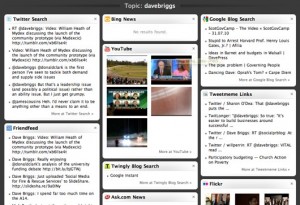
Second in my series of posts highlighting 101 cool online tools is Addictomatic.

It’s a great little service for doing instant online monitoring. Just feed the homepage with a search term, and it will quickly come back to you with a bunch of results across the web – from video sites, blogs, Twitter, photos and others.

You can then pick and choose which of the services are most useful to you, and bookmark the resulting URL, which you can return to whenever you like for an update.

If you’re wanting to do some quick online research to see what people are saying about you, or the issues that matter to you, then Addictomatic is just what you need.

Permalink101 cool tools: Addictomatic

Tuesday, 12 October, 2010

Monday, 11 October, 2010

How I use online stuff

Carl has posted a couple of interesting bits about how he uses social websites, and how this is changing:

I don’t tend to think about what I use – probably because this stuff is now completely embedded into work… but a quick scan through makes me realise that I haven’t really started to properly use any new service for about three years!

No location based services at all! I’m on the cutting edge, me.

Blogging

I use WordPress here at DavePress, which has been around in one form or another for about 5 years. I mostly write posts in MarsEdit, but use the web interface for stuff like comment moderation, updating the software, etc.

Twitter

I started tweeting in February 2007 and haven’t stopped. I ping it with blog posts from here, links to stuff I see elsewhere, the occasional question and the odd bit of ephemera. I mostly use Tweetie on the desktop, and the official Twitter apps for Android and iOS.

Delicious

I don’t really use Delicious as a bookmarking tool – in the sense that they are sites I want to visit later. Instead, it’s part of my publishing workflow – so these are sites I think my readers and followers might be interested in.

I never visit the Delicious web page, and only interact with it through the Chrome browser plugin. I automatically ping the links I save to Twitter – again, through the browser plugin.

Google Reader

I probably spend more time on this site than any other, perhaps with the exception of email. It’s where all that stuff I find so you don’t have to comes from.

Facebook

Now and again I visit the site, usually to catch up with messages I have been notified about, and while I’m there I’ll catch up with what some folk have been up to. I ping Facebook with blog entries too, which I am sure my friends are delighted about.

But I barely use Facebook, even for non-geeky social stuff – perhaps I just don’t do non-geeky social stuff?

LinkedIn

I do visit LinkedIn on a daily or perhaps every-other-day basis, usually to approve connection requests and to respond to requests for recommendations (if you feel the need to write something nice about me, my profile is here). It certainly seems like LinkedIn is a thriving community of people who perhaps don’t use Twitter quite so much.

My Twitter postings update LinkedIn automatically, which is the limit of my activity there, really.

Slideshare

My job means I do a lot of talks at conferences, and I tend to upload them to Slideshare when they change significantly. This automatically pings Twitter to say I have uploaded them. I also occasionally mark someone else’s slides as a favourite, which also pings Twitter.

Evernote

The most recent addition to my armoury. I type almost everything up in Evernote – blog post ideas, meeting notes, random things that pop into my head. I also clip web pages I want to read later here.

Tumblr

I clip interesting YouTube videos to my Tumblr site, using a bookmarklet in my browser – I never visit the actual site. It pings Twitter with every new video.

PermalinkHow I use online stuff

The pipe problem

PipesAt Public Sector Online (which Elaine did a marvellous job of writing up on the LP blog) last Monday, the question was asked – as it often is at these events – what could be done about the fact that the majority of folk working in government, access to the common social websites is blocked.

Cue nods around the room. It’s still an issue, despite the fact that almost every sensible person one talks to says that blocking isn’t the thing to do.

What are the reasons for the blocking? I think there are three main ones. The first two are straw men, to be honest. The third is more troubling and difficult to get around.

1. Staff will waste time

I don’t think I need to spend too much time on this one, as every reader of this blog surely knows that this is a management issue and not a technology one. If people want to waste time, they’ll find a way; and ever organisation already has policy and process to manage this and stop it happening.

2. Information security and risk of virus infection etc

Two parts to this. Firstly that using social web sites, whether for communication or collaboration, increases the likelihood of losing sensitive information. I’ve heard of people in councils being blocked from Slideshare for this very reason. Imagine that! Someone accidentally creating a powerpoint deck full of confidential data, and then deciding that they should publish it publicly on Slideshare!

This is unfathomably moronic, not least because of course there have been far more instances of people losing or leaking paper files, and nobody as far as I am aware has banned the use of those. It’s an education thing, innit?

Likewise the virus issue. People clicking dodgy links is the main problem here, and that’s as likely to happen via email as anything else. Nobody blocks email (shame). Instead, educate people not to click dodgy links. Easy.

3. The pipe isn’t big enough

This is the real issue I think. I have had lots of conversations with IT folk in public sector organisations who simply state that if someone in the organisation watches a video on YouTube, then that’s the network down for pretty much everyone else.

We’ve all been there – who hasn’t tried to access the web at a lunchtime, only for it to be unusably slow?

I can’t help but think that this is one of the main reasons behind organisations blocking access to interesting websites. Perhaps the other two reasons are just covering up the fact that many government organisations have infrastructure that really isn’t fit for purpose?

I honestly don’t know and I also don’t know how expensive a situation this sort of thing is to resolve, or how much of a priority it would be to fix in these austere times.

Credit: photo by Ozh.

PermalinkThe pipe problem

CityCamp London

Dominic and his team at FutureGov did a fabulous job of running CityCamp London this weekend.

Sadly I could only make Friday afternoon’s ‘stimulate’ session, which saw a roomful of people at the RSA get together to listen to some great talks about cities, technology and design.

But following the tweets over the weekend for the ‘participate’ and ‘collaborate’ sessions it seems like there was an incredible amount of energy and desire to improve things. It will be fascinating to see what projects emerge from the event.

I must say, my thoughts on Friday were focused around the idea of place, and how places work as systems. I’ve never lived in a city – except on a part time basis when at University – and so I couldn’t help but wonder how an event based around a village, or a market town, would turn out.

Cities, especially vast ones like London, are so big, and so complicated, that they are very difficult to fix, I think. However, whilst villages and towns are obviously on a smaller scale, they also lack the numbers of people wanting to be involved, and having the skills needed to make stuff happen.

This is probably something I need to think about a bit more, and will return to when I have something half-sensible to say.

Anyway, I made some notes during Matt Jones of Berg’s presentation. They are a mixture of things he said, things I wanted to look up and my own thoughts. I’ve pasted them in below the video of Matt’s talk and I will leave you to decide how useful they are.

Matt Jones, Design Director, Berg from aquila on Vimeo.

  • Networked urbanism ? Ruralism?
  • What about villagecamp or towncamp?
  • How do we improve where we live and how does the Internet as a platform support that?
  • Unintended consequences of complex system design. Build it and they come, and you didn’t build big enough.
  • Never waste a good crisis.
  • City (place?) as a system.
  • Use of a system does not equal need for the system.
  • How much is a town or a village a system? Are they multiple systems or one big one? How can the systems be plotted and improved?
  • Government is just a part of these systems.
  • Where does open government fit in? Government must be more open to be an effective part of the system.
  • Data is not truth.
  • The works, Kate ascher (book)
  • Always design a thing thinking about it in it’s next largest context.
  • Shirky – situated software. Look it up. Also the nearlynet.
  • Synecdoche. The part that represents the whole.
  • Open data makes information Hunan scale. Tom Armitage.
  • Hertzian Times (book)
  • Speedbird.wordpress.com
  • Doorway – simon unwin. Porch and doorways – interfaces between public and private.
PermalinkCityCamp London

Sunday, 10 October, 2010

Oh dear, Andrew Marr…

I don’t tend to respond to this sort of thing, but this one pressed several of my buttons.

The so-called “citizen journalists” will never offer a real replacement to newspapers and television news, he told Cheltenham Literature Festival.

He said: “Most citizen journalism strikes me as nothing to do with journalism at all.

A lot of bloggers seem to be socially inadequate, pimpled, single, slightly seedy, bald, cauliflower-nosed, young men sitting in their mother’s basements and ranting. They are very angry people.”

Sigh.

First point – the irony of Marr insulting people due to the appearance of physical features attached to their heads is hard to ignore.

Second – I’m no particular fan of journalism as a profession, especially given all the bleating about it that goes on in the mainstream media. Journalists write stuff down. There really isn’t that much that’s special about it. Lots of people can do it, and they are doing so. Get over it.

Thirdly, bloggers are angry ranters, are they? Has Marr read any of the columns that appear in newspapers every day of the week? Is he entirely unaware of the filth peddled by the likes of Jan Moir on a regular basis?

Finally, and the bit that really gets my goat: the lazy assumption that people who like computers are weird, scabby losers that hang out in their bedrooms all day long. I’ve said it before, but the fact that wearing ignorance of technology as a badge of honour is still acceptable these days is a disgrace, and it’s the sort of tosh that Marr is trotting out here that only encourages it.

“Angry rant” over.

PermalinkOh dear, Andrew Marr…

Events, dear boy…

My diary is starting to fill up a bit with events to attend, and those I have been asked to speak at. Here’s a quick run down.

FirePRO Conference – Wednesday 13th October

I’ll be speaking to the conference for public relations officers in the Fire and Rescue Services.

My session is all about “How to get the most from social media”:

Is social media a ‘nice to have’ or is it an essential part of a modern communication strategy? This session will discuss ways of integrating social media into mainstream communication and ask whether FRSs can work together to maximise the benefits of online communication.

SLCC National Conference – Saturday 16th October

I’ll be talking to local council clerks about how they can use the web to get people more involved in local democracy and the activity of parish, town and community councils.

Beyond 2010 – 20th and 21st October

I’ll be attending this great looking event in Birmingham as a punter rather than a speaker, and am really looking forward to it given the great line up. Nick wrote it up nicely here.

How to save money and influence people: Implementing behaviour change strategies – 24th November

This LGA conference is all about how councils can manage the significant changes necessary to meet the challenges facing local government – without utterly alienating staff. I’ll be talking about the role that social technology can play in this.

WLGA Member Support and Development Conference – 26th November

I’ll be talking to this Welsh LGA conference about how councillors can be supported in their use of the web to engage with residents.

PermalinkEvents, dear boy…

Tuesday, 5 October, 2010

The death of crowd control

James Gardner:

The point,  of course, is that if the central thinking is that communications are about crowd control, then organisations are really forcing the many-to-many communication outside their organisation. Although I don’t think we are about crowd control at the department, the fact that we don’t have our new communications channels yet has already resulted in crowds forming beyond the firewall. Imagine the circumstance when new channels, far being lacking, aren’t even allowed.

My conclusion, based on this, is that crowd control is pretty much dead. And that centralised command-and-control will soon follow.

PermalinkThe death of crowd control

Sunday, 3 October, 2010

Public Sector Online 2010

psonline

Tomorrow (that’s Monday, 4th October) I’ll be at The Guardian‘s Public Sector Online conference, which looks like it should be a great day.

I’m on at 15:30, for the closing panel titled “Innovation in social media”. Here’s the skinny:

As more people use social networking sites to keep informed, and organisations use them to spread information and market services, what are the best ways for public sector bodies to engage with the public?

  • The rise in the use of social networks as a line of communication
  • Twittiquette – best use of Tweets
  • Twitter as a public service: e.g. Gritterfeeds
  • Generating and monitoring content – Social media etiquette
  • Online engagement – encouraging two way usage

Joining me on the panel will be:

Which means that, even if nobody else has any fun, at least I’ll get to hang out with some cool people for an hour or so!

If you are attending, do get in touch and let’s meet up! Twitter will probably be the easiest way.

PermalinkPublic Sector Online 2010