Thursday, 22 October, 2009

Government 2010: Social Inclusion Panel

This panel, chaired by Computer Weekly‘s Tony Collins, started with a call from the stage to stop twittering; sit there, and cover our eyes and mouth. That’s the experience of digital exclusion.

According to Martha Lane Fox’s research, 10 million people (a sixth of the UK!) have never used a computer; 17 million people (nearly a third) neither own one or have access to one. Stephen Hilton of Bristol City Council pointed this out right at the start of this panel; in a room full of twitterers and bloggers and digital natives.

The panel’s completed by John Shewell from Brighton and Hove Council, Anthony Zacharzewski from the Democratic Society and IBM’s Jan Gower.

Anthony points out that the Government’s heart is in the right place. However, it’s often seen in a rather narrow mindset, couched entirely in terms of economic rationales. He argues that digital inclusion should be done because, like all social inclusion, it’s simply the right thing to do. He warns us to avoid paternalism, too: different people will want to do different things online. Not everyone is a Guardian-reading middle-class liberal!

The panel are pretty unanimous about digital inclusion being only a part of a social inclusion strategy. As Jan Gower says, you need to be very clear on what the needs of all the parts of society are – we tend to look at the process first, rather than the individual, and looking at the needs of individuals first would lead to more humane, better-designed services.

One of the risks here is, as mentioned earlier, avoiding being over-prescriptive or even paternalistic. An example raised by Anthony: Sure Start started as a very local service, which was a strength – local communities knew best what their local needs were. As it was expanded, it lost its local distinctiveness and moved towards cookie-cutter approaches, to its detriment in both effectiveness and in losing the radical thinking originally involved. John suggested that local government’s role is to enable, not to dictate: this is how councils handle adult social care.

There are technological barriers too. Dave Coplin from Microsoft talks about bandwidth: shouldn’t we do more to get fast Internet connections into peoples’ houses? Jan Gower acknowledges that it’s the elephant in the room, but the problem is that any measure to pay for it is going to look like a tax. The politics is the hard problem.

Finally, what would we like to see from the next government? Anthony wants to see an understanding that devolving power means devolving it to individual citizens. Stephen wants the Government to drive the message that digital inclusion isn’t an IT issue; it’s a better council services issue, and needs to go forward at council chief executive level. John also wants to see strong leadership, but also wider participation and more investment. He believes it’s a massive opportunity, but it has to be seized now. Jan agrees: “if it’s a priority, make it a priority.”

There’s one more session today, and it’s on my home turf: open data, chaired by 4iP‘s Ewan Mackintosh. If there’s anything you’d like me to ask, ping me on Twitter!


PermalinkGovernment 2010: Social Inclusion Panel

Government 2010: Martin Greenwood of SOCITM on the Web channel in local government

Despite being a pseudo-statistician startupper, I was fortunate enough to meet a few readers of this blog at LocalGovCamp. Martin Greenwood’s giving a long keynote – 30 minutes – on the role of websites in providing local services. Here’s my notes.


When you phone your council out-of-hours, you’ll get a phone message. In December 2007, only 21% of councils referred you to their website in their voicemail message; it was 41% by December 2008, which is an improvement, but still isn’t really good enough. The only reason not to refer people is if you don’t think your website’s good enough – so how do we fix this?

An example of an excellent website is Salford‘s. It has extensive metrics – 16m hits in September! – but lacks the one which really matters; “did you find what you were looking for?”.

According to SocITM surveys, 17% didn’t, and 22% did only partially – and that corresponds to about 16,000 visitors! hat’s more, 71% of councils don’t participate in these SocITM website takeup surveys; they don’t even know the scale of the problem. In any case, this is a lot of people. 40% of those people would then, according to surveys, prefer to phone to get the information – that’d be 6500 phonecalls a month, or well over 200 a day. Each call is frustrating and inconvenient for customers. What’s more, it takes a lot of council resources, especially in a time of budget constraints – a phone call costs over ten times more than a Web visit to deal with (£3.22 vs 27p), and face to face meetings are 20 times more expensive.

The answer has to be making Council services self-service as far as possible: but these self-service channels have to work first time. To make this happen, Martin argues that this requires:

  • Clear priorities and strong governance in Web strategy
  • Integrated management of all customer channels (Web, phone, in-person)
  • Engagement with the customer community
  • A management structure built around customer service, not communications or ICT
  • A focus on the customer journey rather than “design and applications”
  • Active management of the Web service
  • Continuous improvement in content management
  • Systematic website testing: especially a focus on the tasks people are using the website for and on hard conversion metrics for task completion

This means Web teams will have to think differently: according to Gerry McGovern, the hardest challenge is understanding how people work, not how the website technology works!

PermalinkGovernment 2010: Martin Greenwood of SOCITM on the Web channel in local government

Government 2010: Government and the Internet

This session’s chaired by Dominique Lazanski, alongside Hamish Nicklin from Google, Nominet‘s Phil Kingsland, Jim Killock of the Open Rights Group and Phillip Virgo from EURIM.

They start with a question from the chair:

How does Government regulation help, or hinder, the growth of the digital economy in the UK?

Phil Kingsland replies first, with the observation that trying to regulate something inherently international like the Internet is intrinsically difficult. Thus far we’ve had self-regulation, and much of the contentious activity on the Internet isn’t in itself new behaviour – it’s been happening offline before too, and there are already laws which cover it.

‘Sometimes, bad things happen on the Net’, says Jim Killock, but like Phil he observes that what you do on the Internet is already subject to national law. What’s more, people self-police bad behaviour: just ask Jan Moir. From there, he goes straight to net neutrality, citing Skype as an example. Next up: digital music and price gouging by the established record labels, as a bridge to making the case for copyright reform, and from there to a generalised call for IP reform. We’re hitting all of the ORG talking points in order, and that’s his five minutes.

Hamish from Google has to follow that. He argues that the Internet has been so successful because it’s been free and open; he believes regulation can be a good thing as long as it accords with those principles. Very short and sweet!

Philip Virgo starts with a confession: he was one of the original architects of software copyrights in the UK. He then says he believes that they outlived their usefulness ten to fifteen years ago, which is quite a statement! He then talks a bit about global commerce – he transition from physical to electronic trading actually happened 30 to 40 years ago, and more recently it moved to the Internet. But, then, what is the Internet?

The man’s a quotemaster:

What’s the colour of the underpants of this wonderful emperor we’re talking about?

Anyway, he says it’s impressive engineering, overlaid with governance principles imbued with the spirit of Haight-Asbury circa 1967, overlaid with lots and lots and lots of lawyerese. (Sounds about right to me.) It’s also the latest evolution of the world’s most complex machine in the world – the global telecoms system.

We’re surfing the cyber-crud…

says Phillip. Apparently 22-player online football games are huge in Korea, but the Internet connections aren’t good enough here to support that – so instead, all they can do is download pirated music… (That’s a new argument for net neutrality, I reckon.). He’s worried about the way we’re ceding the lead – particularly in IPV6 – to China; he’s come back to that twice.

Jim Killock really doesn’t like the music industry very much. That’s probably not a surprise!

We’re moving onto the Digital Britain report now. Jim starts; on mandatory disconnections for illegal filesharing, which cropped up in EU legislation:

If you caught someone littering, you wouldn’t ban them from the street, would you?

Quality rhetoric, and he’s understandably riled by the lack of due process. Hamish from Google brings up technological solutions – can you prevent rights violations from happening? YouTube’s rights-detection software is an example here, letting rights holders dictate how their IP is used. Jim’s okay with that within a bounded service, but uneasy with that on a global scale: he calls it mass surveillance of the Internet for copyright enforcement. Spotify comes up; apparently it’s, singlehandedly, drastically cut P2P traffic.

And Twitter intrudes! Hello out there. @glynwintle asks about three strikes: everyone immediately dismisses it. Phillip Virgo now brings up teenagers in Lambeth eking out their money by getting songs from cheaper Chinese music download sites (which he claims may or may not be legal).

Phil brings up the Internet Watch Foundation, and the way they’ve managed to eradicate child abuse images from UK hosting, as a success for self-regulation. In general, in fact. he thinks the public interest is best represented by self-regulation.

Jim is worried that the government doesn’t get to the public interest because they’re too busy listening to industry lobby groups; Hamish wants to see the Internet stay open and free because that’s best for commerce.

And Phillip gets the last word. He talks about the children’s session at the Internet Governance Federation, saying they grasped the issues by the throat:

No-one over the age of thirteen should be allowed to vote on any Internet regulation.

And that’s that! Fascinating session.

PermalinkGovernment 2010: Government and the Internet

Government 2010: Tom Steinberg, mySociety

Tom Steinberg of mySociety follows Adam Afriyie with the last keynote of the morning session. He starts with an announcement – that, with the Open Society Institute, mySociety are seeding similar organisations in Central and Eastern Europe – and a disclaimer: that his new advisory position with the Conservatives will not influence mySociety. After that, he tells us that he’s going to talk about two of mySociety’s projects: Fix My Street and What Do They Know?

Fix My Street makes it easy to report potholes, smashed phone boxes, broken streetlights and the like. It creates transparency – for example, because it asks people if the problems they report got solved, we know that the fix-rate for reported problems are about 50%. (And if the problem’s not fixed, it tells you which councillors you need to go and speak to!)

It was originally funded by the Ministry of Justice, but that money’s long run out: it’s now paid for out of mySociety’s own pocket. It also, though you might not expect this, has a pretty good relationship with councils, which is a lesson in itself: these kinds of things won’t necessarily be rejected out of hand.

What Do They Know? (funded by the Joseph Rowntree Trust) makes it really easy for members of the public to make Freedom of Information requests. That’s important because it empowers people, particularly if they don’t have the might of a full-on newsgathering organisation behind them.

One question he poses is where to take these services in the future. Tom suggests that they need to do a better job of explaining the compromises of government: for instance, in the case of Fix My Street, actually telling people when “we haven’t fixed this yet because we’re doing all of these other important things first”.

Finally, he proposes three conclusions:

  • Firstly, that it can be cheaper and more effective to create transparency by putting a nice user interface on top of an existing process rather than re-engineering the entire process. What Do They Know? works on top of the existing FoI infrastructure, so FoI officers don’t have to learn a new system – they can work the same way they always have.
  • Public data isn’t a good in its own right: it must have a social impact to have an effect. Almost all the websites mySociety operate need data which is under (trading fund) licenses, so even though the software’s open, you can’t run your own copy of mySociety software without buying copies the data.
  • Good sites are made by good people. Matthew Somerville and Francis Irving get name-checks here: Tom argues that until Government can attract really good developers, it won’t have great systems.

And, with that, lunch!

PermalinkGovernment 2010: Tom Steinberg, mySociety

Government 2010: Adam Afriyie

Onto the last two talks before lunch! First up, Shadow Minister for Science and Innovation, Adam Afriyie. He confesses straight away that he would keep closely to his notes — for fear of getting the sack.

Of course, this is a campaign speech, and the opening is an attack on Labour’s record on government IT projects:

Labour “slapped an ‘e-‘ in front of everything that moved”.

He argues that the Labour government has moved too slowly in response to upheaval in the computing landscape, and puts forward three Tory principles for IT policy. The power-word he’s using here is “openness” – he used it in every other sentence! Those principles are:

  • Big is not always better, especially because budgets are tight. If you run multiple cheap early-stage pilots and pick up the winners and scale those up nationally, it could make it easier for small companies (now I’m listening!) get access to Government contracts.
  • Open procurement, and smaller, more flexible projects and systems – which opens the market for open source. Claims £600m potential savings a year; and government look to the market for solutions. Dictate outcomes, not technologies. The Conservatives are, apparently, into cloud computing (arguing that it’s cheaper and greener).
  • Empowerment: for instance, the Conservatives are reporting their expenses claims, in real time, through Google Docs. Obviously Boris Johnson’s crime maps are a key talking point: Adam brings them back up, and Craig Elder (also of the Conservatives) was mentioning them earlier. In that vein, David Cameron has proposed a “right to data” – if Government data is not personally/diplomatically sensitive, it should be freely available online.

On the right to data:

This is the unfinished business of the Freedom of Information Act

This, and another buzz-phrase – “the post-bureaucratic age” – are soundbites which we’ll be hearing often between now and the general election.

Next – Tom Steinberg of mySociety.

PermalinkGovernment 2010: Adam Afriyie

Government 2010: the blogger panel

Iain Dale, Mick Fealty, Stephen Tall, Craig Elder from the Conservative Party and Adam Parker from Realwire kicked off the blogger session at Government 2010 with five minutes each. Here’s something on each of those! Mick went first:

To state the bleedin’ obvious, there is a sea-change ahead.

Mick observed that, thus far, the Internet has been very poor at generating nuanced, useful thinking or innovation: online consultancy is viewed as a box to tick rather than as something which helps better decisions get made. However, what blogs and social media have done well is quick, light response – agile responses to changing circumstances.

What he’d like to see is a move from ‘closed-source’ to ‘open-source’ analysis of policy. A lot of policy at Westminster level gets made in think-tanks, but that approach is just too expensive to work for local and devolved governments. Furthermore, think-tanks work in seclusion: they have no room for consultation with, or contention from, the public. He suggest that if that process could take place in fluid, moderated communities in public, then that could change how policy is made for the better.

Next up was Craig Elder, online communities manager for the Conservatives. He says that what’s going on now is “old politics on new media”. There’s a worrying feeling that what’s said on new media is not going to be taken seriously: with, for example, Number 10 e-petitions, everyone points at the Jeremy Clarkson for PM campaign, but that happens because of cynicism about whether anyone’s listening.

He thinks that we can change that through creating the sense that citizens are empowered, particularly through data – for example, online crime maps which let the public see whether the money spent is working. On the other hand, does the number of Ministers on Twitter herald a new age of engagement? Not really – in a sense, it’s “Twittering while Rome burns”. Is this really the best thing that ministers can do?

Trafigura, though is a testament to the interrogrative powers of the blogosphere: proof that there’s potential here, but it’s very early days yet.

Stephen Tall, of Lib Dem Voice, then spoke on the power of unofficial consultations – they get to different audiences from official ones, and some (like Facebook groups) have the potential to convert “slacktivists” to activists. Steve Webb’s been holding surgeries – with 200 participants! – on Facebook, and:

Official council consultations are crap, and no-one responds to them anyway.

Apparently. (He later pointed out that Whitehall publishing only the data it wants published won’t empower people: to do that you have to go local, go in depth, and publish all the data.)

Inevitably, Twitter came up again – the first Twitterer during Prime Minister’s Questions was Jo Swinson, who got flak for abuse of Parliamentary privilege. It’s subsequently taken off, though: there were 96 tweets from MPs during the last PMQs. Still: is this really a worthwhile use of MPs’ time?

Finally, he proposed three tests for whether social media projects are worthwhile. Are you able to get more information out to people in a digestible form? Are you genuinely engaging with them? Are you empowering them? That’s what really works.

And, lastly, Adam Parker, of Realwire, introduced himself as “Jarvis Cocker on Question Time, only without the talent”. Way harsh, especially after his first point: that it’s not social media’s fault if the conversations are dull! If we want people to be engaged, we have to first be interesting. What’s more, not everyone’s on the Internet, not that many people are on Twitter or read Iain Dale’s blog. So, social media’s biggest impact in the short to medium term is going to be where it influences, or sets, the mainstream media agenda.

In particular, when it comes to politicians and parties engaging directly with the electorate, he’s not convinced. Retail brands are being forced to participate in social media in order to defend their market position and brand image. In other words, they’ve got an economic incentive; will social media ever be a real force in politics until it hits politicians at the ballot box?

PermalinkGovernment 2010: the blogger panel

Government 2010: Peter Kellner from YouGov, eConsultation panel

Here’s some notes from the first two sessions at Government 2010! If, in haste, I’ve accidentally misquoted/misparaphrased, I apologise in advance: there’s a lot more on Twitter, and you can watch the conference live online here.


The first speaker of the day, Peter Keller of Internet-based pollsters, YouGov, gave the opening keynote.

We all need bullshit detectors; we need to teach our children how to detect bullshit…

— Peter Kellner, YouGov

His speech was part call-to-arms, part cautionary tale; he argues that the Internet has fundamentally changed the relationship between citizens and Government, largely through unprecedentedly rich access to the information used to make decisions in Government — and that this is both opportunity and threat.

He started by suggesting that the ways we use the Internet are analogous to the early days of cinema; we’re largely just using technology to do things we’ve done before. Cinema grew out of its theatrical roots to, eventually, developing its own techniques – real locations, cuts, and so forth and so on. In his view, we haven’t worked out what the interesting new techniques, and new methods, are yet; to paraphrase, “we are now exploring ways of interacting with the public which simply weren’t available ten years ago.”

Taking journalism as an example, the economics of print and the scarcity of spectrum space for broadcasters enforced a technical monopoly over the transmission of information. This meant you couldn’t compete even if you wanted to. It’s only now that the Internet has removed many of the barriers to entry. The result of this upheaval is that none of us really knows what the transmission of information is going to look like in 20 years’ time. Cases like the Trafigura/Carter-Ruck injunction farrago just demonstrate how the Internet has completely changed the rules of the game – both the business rules and the nature of reporting. In particular, he talked about accountability: Yougov is held to account by a small number of bloggers who follow polling in great detail. The effect is that YouGov, and other pollsters are more careful than would have been 20 years ago as a result; they know they’ll get called on it if they screw up!

In government, however the same technical forces have had much less impact. (That set up a fantastic quote – another early leader for soundbite of the day, in fact! – that “Going back to Ancient Greece, representative democracy has had a very long run.”). He then made a fascinating argument: that this is, in part, because elected representatives have had a technical monopoly on access to the data government’s based on. Before now, if you want the statistics which inform the Budget, you had to traipse out to your nearest HMSO, put down £50, and buy the Red Book. Nowadays, anyone can get that data online: like journalism, the barrier to participation in decision-making has been flattened.

That’s an opportunity, but also a threat. In Peter’s view, the political parties haven’t yet got the message that access to information is fundamentally changing how people interact with public services and how people approach politics. For example, we’re getting more choice in public services, but now we can know much more than we used to, and make more informed decisions, thanks to the availability of things like school inspectors’ reports on the web.

To challenge the threat that this poses, we need to fundamentally change how government operates. Government needs to be more candid; to interact genuinely; and we need to be careful not to throw out the baby with the bathwater by forgetting the important social roles institutions currently play, which is something you can’t really replace with purely online interaction.

In particular, not all the information online is accurate or fair; Google helps us viscerally experience Gresham’s Law: bad money, or bad ideas, drive out good. We need to be wary that the Internet can be used to spread malice, so we need to equip kids with the critical faculties to find what they need and test what they find – and here’s where Peter Kellner, quote machine, struck again with the line up the top.

There was a lot to chew on in this speech, and I’m certain I’ve missed a lot! I’ll be going back to watch it again later.


Peter Kellner was followed by a panel on eConsultation chaired by Harry Metcalfe from The Dextrous Web (and, notoriously, Ernest Marples. Unfortunately, Tom Watson couldn’t make it (detained on constituency business), but he was deputised for by a representative of YouGov (who, right now, I’ve got a lot of sympathy for).

We’re sticking PDFs online and asking people to email us. There has to be a better way.

— Harry Metcalfe, The Dextrous Web

One of the prevailing themes here was summed up by a question from Emer Coleman of the GLA; if the Government gets to choose the questions asked, is it really consultation at all? Harry Metcalfe had already argued that you need to consult before publishing a Green Paper, in order to frame the debate; Ewan McIntosh of 4iP pointed out that just because papers are commented on, it doesn’t mean real consultation is happening. Neil Williams of Debategraph went further: with the audience of consultations being largely self-selecting, noisy and vocal minorities will loom large in online debate.

Next up, the bloggers: a panel chaired by Iain Dale, featuring Mick Fealty (Slugger O’Toole), Stephen Tall of Lib Dem Voice, Craig Elder from the Conservative Party, and Adam Parker of Realwire. That should be interesting — more soon!

PermalinkGovernment 2010: Peter Kellner from YouGov, eConsultation panel

Government 2010: agenda

Government 2010 kicks off in London in a couple of hours, and it’s going to be all-liveblogging, courtesy of Davepress and Timetric, all the time this morning.

Here’s the agenda:

  • 9.00am – 9.15am Opening Remarks: Jeffrey Peel, Government 2010
  • 9.15am – 9.30am Keynote Address: Peter Kellner, President, YouGov
  • 9.30am – 10.15am Panel Discussion: Digital Engagement is Everyone’s Job: Formal and Informal Consultation on the Web: Chair: Harry Metcalfe; Panel: Tom Watson MP; David Price, Debategraph; Neil Williams, DBIS
  • 10.30am – 11.15am Panel Discussion: Blogging, Social Media and New Media; Chair: Iain Dale, Panel: Mick Fealty, Daily Telegraph Blogger and Slugger O’Toole; Stephen Tall, LibDem Voice; Craig Elder, Conservative Party; Adam Parker, CEO, Realwire
  • 11.15am – 12.00 Panel Discussion: Government Service in a Web 2.0 Era: Chair: Jeffrey Peel, Government 2010; Panel: Gordon McKenzie, Microsoft; Tanya Oliver, Kent County Council; Michael Juer, Northamptonshire County Council
  • 12.00pm – 12.15pm Government and Innovation, Adam Afriyie MP
  • 12.15pm – 12.30pm Technology and Citizens, Tom Steinberg mySociety.org
  • 1:15pm – 2.00pm Identity Management, William Heath/Q&A, Founder, Ctrl-Shift
  • 2.00pm – 2.45pm Panel Discussion: Government & The Internet, Chair: Dominique Lazanski; Panel: Jim Killock, Executive Director, Open Rights Group; Philip Virgo, Secretary General, EURIM; Phil Kingsland from Nominet (TBC); Speaker from Google (TBC)
  • 3.00 – 3.30pm SOCITM – The Web Channel and Local Government – Martin Greenwood
  • 3.30 pm – 4.15 pm Panel Discussion: The Internet and Social Inclusion Chair: Tony Collins; Panel: Stephen Hilton, Bristol City Council; John Shewell, Brighton & Hove City Council; Anthony Zacharzewski, Democratic Society
  • 4.15pm – 5.15pm Panel Discussion: Open Data, Mash-Ups and Government Web, Chair: Ewan McIntosh, Channel 4/4ip; Panel: Chris Taggart, OpenlyLocal; Stuart McRae, IBM; Paul Canning, Consultant, SOCITM; Colm Hayden, Anaeko

    So it’s going to be a pretty full day. But I could use your help! If you’ve got any questions you want to pass on to the speakers, or anything in particular you want covered, let me know in the comments or over on Twitter and I’ll do my best to find out for you.

PermalinkGovernment 2010: agenda

Wednesday, 21 October, 2009

Bookmarks for October 18th through October 21st

Awesomeness off of the internet for October 18th to October 21st:

  • Soup – Publish, collect, share. – "Soup is a tumblelog, a super-easy blog that can do more than just text: post links, quotes, videos, audio, files, reviews and events."
  • The power of social innovation: interview with Director of Social Innovation Camp, Anna Maybank – "While gov20, transparency and campaigning are all beginning to revolutionise the relationship between government and its citizens in profound ways, the fantastic work of organisations such as the Sunlight Foundation and MySociety is very much focused on improving the status quo, a much maligned and mistrusted status quo."
  • FutureGov » Features » ePetitions data standards – get involved! – "Are you interested in ePetitions? Perhaps you run electronic petitioning tools for a local council, or are involved in analysing the results? Do you build tools for governments to use to help citizens petition it more effectively? Or maybe you’re a keen hacker who wants to see these tools built in transparent and effective ways?"
  • Local Electronic Petitions Set To Become Mandatory – "A Bill requiring councils in England and Wales to provide local residents with a facility to lodge electronic petitions, and to respond to such petitions, is set to be passed into law after moving to what is likely to become its final Parliamentary stage last week."
  • A post bureaucratic Barnet? : Matthew Taylor’s blog – "The council aims to develop a much deeper and more nuanced understanding not only through conventional methods of public engagement such as a citizens’ panel and customer forums, but through ethnographic research into the day to day lives of its most needy citizens. "
  • County Hall’s credit union to see off loan sharks – "Established by Kent County Council, the Kent Savers service will provide an alternative to unscrupulous loan sharks and lenders who take advantage of desperate residents by charging exorbitant interest rates."
PermalinkBookmarks for October 18th through October 21st

Kindling

My Kindle arrived today.

I can haz Kindle

For those that don’t know, it’s Amazon’s own e-reader, a portable device that can hold around 1,500 books in its memory which can be read by turning pages using the buttons.

Even though I knew the screen was 6 inches, it still seemed smaller than I was expecting. The device is also a lot thinner than I thought it would be:

Thindle

The screen is really weird, it’s like nothing you’ve looked at before – other than the page of a book. Very odd.

Another interesting thing is the wireless – the Kindle uses the cell network, the cost of which is covered by Amazon and is presumably a part of the cost of the device.

Anyway, I can buy and download books from Amazon.com – not from the UK store yet (which may mean spelling issues…), or add books or documents from my computer. This can be done either by plugging the Kindle into my computer with the supplied USB cable (also my only way of charging it, since the plug supplied is US only too), or by sending a file by email to a special address, which is pretty neat.

You can also use the keyboard to add annotations to documents or books, so this could be really useful for students.

As well as established e-readers like the Sony Reader, the Kindle also has competition from Barnes and Nobles’ new Nook. Crunchgear has a useful comparison chart.

PermalinkKindling

Government 2010: “I’m afraid, Dave, you can’t do that.”

Hello! I’m Andrew Walkingshaw, and I’m going to be deputising for Dave at the Government 2010 conference tomorrow. I’ll be liveblogging the event for you all, both here and as @walkingshaw on Twitter.

I’m the business guy at Timetric. We’re on a mission to get the world’s statistics to you in a form which you can use, and a lot of those numbers start their lives in local and national governments. So, I’m especially looking forward to the Open Data session, chaired by 4iP‘s Ewan Mackintosh, towards the end of the conference. (On that note, if you’re in the business of making data available, we’d love to hear from you. Okay, enough of the sales pitch!). The entire conference looks fantastic, though: I’ll do my best to keep you in touch with what’s going on if you’re not able to follow the live stream.

Anyhow, keep in touch with me throughout the day on Twitter and on here. See you all tomorrow!

PermalinkGovernment 2010: “I’m afraid, Dave, you can’t do that.”

Local e-petitions

Headstar reported the other day about the progress of the piece of legislation that will mandate local authorities to set up systems allowing residents to create e-petitions, and to respond to such petitions.

Under the ‘Local democracy, economic development and construction Bill’ (http://bit.ly/1nEC4Z), councils will be obliged to provide an e-petition facility and publish schemes for both electronic and traditional petitions, to acknowledge any petition to its organiser, and to offer a response, all of which should be published online.

I’ve got quite a bit of interest in e-petitions, not least as a result of spending time helping moderate them for Number 10 during my time there. I’ve seen how these things can work, and how they can be frustrating.

Learning Pool have been keeping an eye on the development of the need for e-petitioning by councils, and already have an e-petitions platform in development which we will soon be looking to engage local authorities in testing. As always with Learning Pool’s stuff, it will be based on open source technology and will be easy to use and very cost effective. If you’re interested, please do get in touch.

In a related development, Andy Gibson is going to be working with Dominic and Fraser to develop a data standard for e-petitions.

From next year, it’s probable that all local councils will be required to provide electronic petitioning tools to their citizens, and we want to make sure they all do it the right way, and in a form that means they can all talk to each other.

I’ve put my name down to get involved, and will ensure that Learning Pool’s e-petitions system fits in with any agreed open standards.

PermalinkLocal e-petitions

Tuesday, 20 October, 2009

SEO for non-experts: what you need to know

Why do so many councils have such a poor online presence? I’ve written before about some of the missed opportunities, such as here, but for me the puzzle is as much “what should a council do?” as “why don’t more of them do it?”

Part of the explanation, at least from the councillor side, is average age. Councillors are on average near retirement (58.3 in 2006), which means not many have either grown up with the modern internet age or worked in firms created by it.

The challenge then for the typical older councillor is to have enough knowledge to know what their council could or should be doing and to have some idea of whether or not its staff and contractors are doing a good job.

In some areas councillors are usually good at this; for example, councillors are often intensive email users and well placed to tell whether or not an email system is up to scratch.

Search engine optimisation is an area at the other end of the spectrum – often over-looked by councillors and often not done well by councils. So what does a councillor need to know?

What is search engine optimisation (SEO)?

SEO means a bundle of work in order to make a particular website come out near or at the top of search results when someone is using Google or another search engine.

Why does SEO matter?

For councils, it matters for two primary reasons. First, people often use Google as their jumping off point to find information. With search results, almost no-one clicks on results that don’t come up on the first page, and even on the first page the number of people who click on a search result declines rapidly as you move down the page. So if you’re not on the first page you miss out on getting people coming to your website.

Second, councils often provide information that the public don’t immediately associate with the council. Tips on how to live a greener lifestyle are a good example, Many councils put a lot of effort in to publicising this sort of information, but most online members of the public won’t think, “I’ll see what the council has to say about saving on my electricity bills”. Instead, they go to Google and look for information generally. If you want the council information to be found and used, it has to come up high in the search results.

What does SEO involve?

Most SEO work falls into a research phase and then three areas of activity.

The research phase involves working out what the key information is that the website wants to get over (e.g. recycling information) and then the phrases that the public use when searching for such information (e.g. do people talk about “waste” or “rubbish” or “refuse” when looking for such information?). Firms such as Google provide very detailed information about people’s aggregate search habits for free, so the end result of this search should be a specific list of topics and terms which the website needs to perform well on.

Tip one for councillors: ask to see the list of terms the site is being optimised for. If it doesn’t exist, then either the website team is neglecting SEO or they are doing it poorly. The list may be informally in several people’s heads, on a post-it note or in an email somewhere. So you may need to add some extra judgement about how methodical the work has been and whether that suits the size of council and the budget given to online matters.

The three areas of work then are technical, copy and outreach.

Technical works means the way web pages are coded and the content on them marked up. Some ways of producing web pages are liked by search engines, other ways hide their content from them. This is perhaps the hardest area for a non-technical person to judge. My to three tips, based on what is most often got wrong if people aren’t thinking SEO, are:

  1. Look at the photos and see whether they have any “alt” text set (this is the text that appears if you hover over the photo or right click on it, depending on your web browser)
  2. Are the headlines on the page marked up with H1 HTML tags? Don’t worry if you don’t know how to check this; it’s pretty easy to do, so just ask someone who is a bit familiar with creating websites!
  3. Do the web addresses for individual pages contain real words or are they long technical strings? E.g. www.MyCouncil.org.uk/655804231 will do less well in searches for recycling than www.MyCouncil.org.uk/recycling-news/update

The next area of SEO work is copy: does the text on the site regularly and prominently use the key words and phrases identified from the research? Pages should still read naturally, but they can be written in a way that uses the key terms more rather than less.

The third area is outreach, or “link building”, i.e. getting other websites to link through to yours. The more links you have, the better the site does in searches – though to stop abuse, search engines give more importance to links from well respected other sites. External tools can be a bit hit and miss in the number of links they list, but try going to Google and search for link:www.Islington.gov.uk changing “Islington” to your council. You can then do this for several other similar councils and see how the total number of links Google lists compares.

Improving SEO

Checking these areas should give a councillor a good idea of whether their website team is on the ball at SEO, doing it poorly or just ignoring it. Based on that, an appropriate follow-up at the senior level with council staff can be made.

Senior council staff may or may not understand SEO too! But with these answers both sides of that conversation will know whether more detailed follow up is needed down through the organisation – and how to judge whether any follow up really produces results.

Good luck!

Mark Pack worked for the Liberal Democrats 2000-2009, ending up as their Head of Innovations. During that time he often trained councillors on how to make better use of the internet. He’s now at Mandate Communications (www.YourMandate.com) and blogs about politics, history and technology at www.MarkPack.org.uk. He’s on Twitter at @markpack.
PermalinkSEO for non-experts: what you need to know

Monday, 19 October, 2009

Government 2010

gov2010

Government 2010 looks like it will be a lot of fun.

It’s a conference about the future of government:

Government 2010 is about improved government communications and more rapid delivery of services to citizens via the web, and web-enabled channels.

It also features some people I really respect on the speaker list:

…amongst a host of others.

Another great thing about this conference is the lengths they are going to to make it accessible – including the live streaming. Having a company like Switch New Media involved certainly helps – their streaming of Aprils Digital Inclusion conference was superb. As I can’t make it, I will certainly be making the most of this live feed.

PermalinkGovernment 2010

Sunday, 18 October, 2009

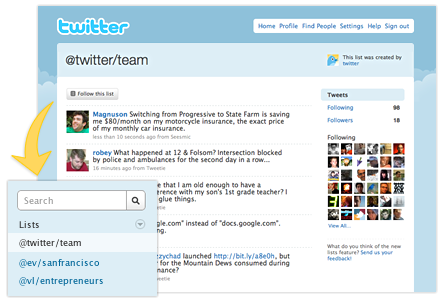
Twitter lists

Neville writes a post about Twitter lists, some new functionality recently released to users. An official blog post trailed it last month.

Twitter lists

Neville’s quite positive about it, and indeed it may well work for a lot of people. My view is more… meh.

If you follow lots of people it’s true that it is hard to keep up with everything that is said. I follow just under 1,500 accounts and reading everything is impossible. So I don’t.

TweetDeck, my desktop Twitter client of choice, has had groups – the ability to track a group of twitterers in a single, separate stream – for ages, and I’ve never used it.

After all, Twitter isn’t email. You don’t have to read it all.

I’m happy to dip in and out of my Twitter stream as I have time, and as I have something to say.

Anything that is directly pointed for my attention – ie by including @davebriggs in the tweet – is already highlighted for me. Likewise with the issues I am interested in – I monitor various keywords for mentions of those.

But other than that, I’m comfortable with the fact that I’ll miss the occasional gem – but know that if it’s really good, I’ll pick up on it later, anyway. The thought of spending a load of time managing a bunch of extra lists doesn’t really do it for me, at all – just as I don’t tend to put feeds in folders in Google Reader.

I guess I’m happy to rely on serendipity over organisation.

PermalinkTwitter lists

Bookmarks for October 14th through October 18th

Awesomeness off of the internet for October 14th to October 18th:

PermalinkBookmarks for October 14th through October 18th

Saturday, 17 October, 2009

Thursday, 15 October, 2009

The myth of engaging with everyone

When I talk to people about the possibilities of engaging with people online, using social technology, I often get questioned about the numbers issue. Stuff like:

  • How many people in our area actually use Twitter?
  • What about people who don’t have web access?
  • What do we do about people who don’t like using the internet to communicate?

…and so on.

It’s night on impossible to give the people who ask these questions the answers that they want. Really, they’re asking the wrong questions.

That’s because they are assuming that what they are doing now already covers all the bases. The fact is, that it doesn’t.

  • Meetings usually exclude anyone with a job, because even when they are in the evening, most people are too knackered to attend or have other stuff to do
  • Printed media usually goes straight into the recycling bin
  • Few people pay attention to the Council stuff in the local paper

The first thing to be clear on is that no one engagement method will reach, or suit, everyone.

The second thing to be clear on, is that you don’t necessarily want to reach everyone, anyway.

The latter point is true of the people within organisations as much as it is people outside. A small percentage of employees couldn’t give a toss about their jobs and are generally quite bad at them. The majority are perfectly competent but aren’t so into their work that they are constantly thinking of ways that things could be done better. Then there are the small number left, the committed, enthusiastic and innovative folk who care about what they do and will put effort into improving things.

My argument would always be to focus on the small number of active, enthusiastic people first.

Likewise, when engaging with citizens, most won’t be too fussed about knowing how their council does things in too much detail, for example. They might like to know that it is being done reasonably well, and cost effectively, but in terms of getting too involved, they’d rather not. But there will be a smaller group of people, those with some social capital to burn up, who want to get involved, who actively think about making things better, and who’ll give up their time to help.

Those are the people you should go after. Don’t waste time convincing people who aren’t and never will be interested to do something they don’t want to do. It’ll make everyone, including them and you, unhappy.

So when people ask about whether 100% of the people in your organisation, or who live in the area, will be involved with a digital engagement project just be honest and say no. But add that you’ll probably get more interest than through current methods, and that they’ll be different people, and people who care.

PermalinkThe myth of engaging with everyone

Wednesday, 14 October, 2009

OpenSocitm

Socitm

I had an interesting time at Socitm09 – a lot of the conversations I had were useful, and others fruitful. I won’t lie to you, though, a lot of what I saw and heard I found pretty painful. My Twitter followers will no doubt know the exact point at which my frustration boiled over somewhat.

One of the highlights for me, though, was the twenty minutes Mary and I spent with Adrian Hancock, MD of Socitm, and a forward thinking chap if ever there was one. His plans for the organisation are certainly going to lead it in the right direction.

We’ve already put one of the things we talked about into action, and that’s OpenSocitm. This is a simple Ning based online community for Socitm members and non-members to talk about the organisation and what they would like to get out of it. At Learning Pool, we understand community and its importance, and we’re eager to share that with other organisations that would like to work with us.

We hope it will become a space for the more forward thinking among Socitm’s ranks to get together and contribute to the ongoing discussions about what Socitm should look like in the future.

Because Socitm, like any other membership organisations, faces massive challenges in this age of self-organising and free and simple social networks. Put simply: why should I pay a subscription to Socitm when I can create a Facebook group and talk to people that way?

This is picking up on the pioneering work started by David Wilcox with the RSA (I’m a fellow of the RSA and was involved in David’s work here), which has developed in various directions, some official, some less so, based around the OpenRSA concept. Basically: identify the enthusiastic, the innovative and the people with ideas and put them in a space together – and watch and act on what happens.

My view – which David shares, I’m sure – is that for membership bodies to remain relevant in the networked society, they must learn to start listening to their membership like never before. Develop services around the explicit needs as expressed by members in social online spaces. Accept messiness. Acknowledge the fact that membership might mean different things to different people, and that just because someone doesn’t hold a card, it doesn’t mean they have nothing valuable to contribute.

I’ve no doubt that Adrian gets this, and that OpenSocitm will provide a useful channel of ideas and suggestions for the future of Socitm for him and his colleagues to act upon. He’s already started blogging about it.

PermalinkOpenSocitm