Monday, 22 February, 2010

Movements this week

Another busy week this.

Tomorrow I am speaking at 4Children’s 18th Annual Policy Conference, on the subject of engaging young people with social media. I understand Tim Davies was unavailable πŸ˜‰

On Thursday Mary and I will be traveling down to Devon to hang out in Exeter for a couple of days. The Thursday itself will feature a networking event and lunch sponsored by Learning Pool, where anyone with any connection to the public and third sectors can come and meet other interesting folk – as well as Carl Haggerty. There are still one or two spaces left, so let me know if you’d like to come along.

On Friday we will be attending the Likeminds conference, which is shaping up to be an excellent day – I’m really looking forward to it. The speaker lineup is fabulous.

#Movements this week

JFDI vs Being Boring

Light blogging recently, I’ve been gadding about talking at a load of events – which is fun and rewarding in its own way, but doesn’t really help with getting any work done, nor with writing here.

Last Wednesday I was at the LGComms seminar on digital communications, and had the opening slot explaining why all this stuff matters. I was on slightly shaky ground as I don’t really know all that much about digital comms, just the social bit. I’ve no idea how to run a proper corporate website, for example. Anyway.

My slides were the usual concoction, and they’re on Slideshare if you want them. My general message was that while the internet is undoubtedly important for communications, it’s a mistake to put all of this stuff in a box marked comms and assume it doesn’t affect or benefit other parts of the organisation and the way they work.

One slide I included was pretty new, and it featured a pretty crappy graph I threw together in Powerpoint:

JFDI vs Being Boring

Click it for a bigger version. The point here is that by taking a JFDI approach – to any innovative behaviour, not just social media use – you get a lot done quickly. The trouble is that it isn’t terribly sustainable, because it is often the work of one or two enlightened individuals and it isn’t terribly well embedded in corporate process, systems or structures.

The alternative is to be boring, and go down the route of getting the strategy and procedure sorted early, and developing activity in line with that. This is a lot more sustainable, as everyone knows what they are doing and what they are responsible for. There is a problem though, and that is that being boring is slower than JFDIing – your innovators might get fed up and leave, and your organisation might be perceived as doing nothing, when in fact it’s just moving rather slowly.

My take is this: it isn’t an either/or choice – do both. Just get on with it, choosing some small projects to prototype and feed the findings from that activity into the longer term process and system building approach. Keep the innovators happy by giving them some space to experiment, whilst building the foundations that will help the rest of the organisation understand and feel comfortable with.

Don’t let strategy and process get in the way of doing good stuff. At the same time, don’t JFDI and find yourself exposed.

#JFDI vs Being Boring

Podcasting

I had the pleasure of being asked to be a part of Gov 2.0 radio, a live phone-in podcast about government and the web based in the States. Due to timezone stuff it meant I had to stay up til 2am to take part, but it was well worth it.

Adriel Hampton wrote it up like this:

Collaboration, Innovation and Social Media in Government: Join a great discussion of the Open Government Directive and Twitter, collaboration and ideation in government, with guests Jenn Gustetic from Phase One Consulting Group, Dave Briggs of Learning Pool, and Swimfish CIO John F. Moore and hosts Adriel Hampton, Steve Lunceford and Steve Ressler. More background here.

You can listen to the recording below – I won’t tell you when I’m on because that would spoil the surprise. Besides, I wasn’t particularly coherent, so you’ll no doubt enjoy the other participant’s contributions much more.

[audio:http://davepress.net/wp-content/2010/02/gov2radio.mp3]

I really enjoyed doing this, and I think there is something really valuable in audio work. As Roo Reynold’s excellent post proves, it doesn’t need to be hard to produce a decent podcast. I’m tempted to start doing some planning around something similar to Gov 2.0 radio for the UK – if you’d like to be involved, let me know.

#Podcasting

Saturday, 20 February, 2010

Bookmarks for February 10th through February 20th

I find this stuff so that you don’t have to.

You can find all my bookmarks on Delicious.

You can also see all the videos I think are worth watching at my video scrapbook.

#Bookmarks for February 10th through February 20th

Wednesday, 10 February, 2010

Bookmarks for February 9th through February 10th

I find this stuff so that you don’t have to.

You can find all my bookmarks on Delicious.

You can also see all the videos I think are worth watching at my video scrapbook.

#Bookmarks for February 9th through February 10th

Buzzin’ enterprise

Two interesting viewpoints on Google Buzz and its potential application behind the firewall, within organisations.

Firstly, Larry Dignan on ZDNet’s Between the Lines blog points out that perhaps Google has Sharepoint, not Twitter, in its sights:

The Google Buzz playbook will resemble the current Apps and Docs strategy. Aim Buzz at the smaller companies first since they are the low-hanging fruit. Large enterprises will stick with SharePoint for now until Google makes the ROI case over time like the company currently does with Exchange.

If Google Buzz becomes Google corporate Buzz it could be disruptive. Enterprises could potentially use it to save on Sharepoint licenses. It’s all about the collaboration.

But ReadWriteEnterprise questions how suitable Buzz will be in big organisations:

Google Apps has it own faults to work out, before Google Buzz can even be considered a viable service for the enterprise. The Google Buzz open architecture may be the difference though, creating real opportunities for customers to pull external data into its real-time environment.

It will certainly be interesting to see how this plays out.

#Buzzin’ enterprise

Tuesday, 9 February, 2010

Google goes for Twitter

Google Buzz is the search engine giant’s latest attempt to get social to work within its suite of applications. Strangely, while we use Google’s stuff for all sorts of things, from searching to email to RSS aggregation to document editing, we don’t tend to use their services much for sharing. Instead, we go to Twitter, or maybe Facebook.

Perhaps all that will now change.

Here’s a video explaining Buzz and how it will work:

It may seem crazy to attempt to take Twitter on in its own territory, but Google have a couple of real strengths which mean they end up winning the status update battle.

For a start, Google have been quietly building up a range of services based on your Google account. You may have started this account to access Gmail, or maybe Google Reader.

But did you know you also have a public profile on Google, which you can fill up with all sorts of information about you and the sites and services you use? Here’s mine.

Or how about the way Google has a really cool service that manages all of your contacts?

What about the social circle search, which lets you look for content created by your friends, or friends of friends?

In some ways it’s kinda scary the way Google collects all this information, and the way it puts it all together like this. But it’s also a reason why Buzz might succeed where all other Twitter-killers have failed.

What’s one of the things that puts people off Twitter the first time they use it? The fact that you don’t know anyone, and have nobody to talk to. But the way Buzz will tap into your existing networks, you might not have that problem on Google’s service. The user base already exists, and it is already massive.

There is also masses of potential for organisations using Google Apps, where having Buzz as part of the mix will bring masses of value, and possibly kill off Yammer in the process.

There’s another reason why Buzz might well beat Twitter, and that is the money thing. Google has a business model, and a very successful one. It isn’t hard seeing how Buzz can slot into that model, and make a contribution. At some point, though, Twitter is going to have to start earning money. How it does that, and whether it manages to do so without annoying the hell out of its users – for whom revenue generation will necessitate a change – will determine whether Twitter survives.

Another thing that is in Buzz’s favour is that it sits inside Gmail. In your inbox. Despite the massive growth in social networking over the last few years, email is still the internet’s killer app, and most people spend a hell of a lot of time looking at their inboxes.

As an example of this, I use Google Talk a lot as an instant messaging service, but I use it entirely from within Gmail. I usually can’t be faffed loading up a separate client for IM, but if someone’s name pops up in Gmail saying they’re online, I’ll often grab them for a quick chat.

Having a status update, Twitter-like facility sat there too means that I’m going to use it, to the point where I might stop visiting other locations to do similar stuff. Bye, bye Twitter, maybe.

Of course lots of similar stuff was said about Wave, and while that wasn’t exactly a dud, it did strike me as a solution looking for a problem. A great bit of technology that felt a bit like a square peg. Buzz, though, isn’t looking to revolutionise the way we use the web, just to make an existing activity easier, and nearer – and that might be enough to make it work.

Having written all this, I of course don’t have access to Buzz yet. If you are one of the lucky ones, do please tell us all about it in the comments.

Update: Not sure how I missed it, but there is an API for Buzz, allowing for developers to hook it up to all sorts of other services, whether “Atom, AtomPub, Activity Streams, PubSubHubbub, OAuth, MediaRSS, Salmon, the Social Graph API, PortableContacts, WebFinger, and much, much more” according to the Google Social Web blog.

Elsewhere:

#Google goes for Twitter

Monday, 8 February, 2010

Bookmarks for February 3rd through February 8th

I find this stuff so that you don’t have to.

You can find all my bookmarks on Delicious.

You can also see all the videos I think are worth watching at my video scrapbook.

#Bookmarks for February 3rd through February 8th

The public sector learning conference

Learning Pool

Learning Pool‘s public sector learning conference takes place on 12th May – the day after my birthday, fact fans – and is already looking like it will be an utterly awesome event.

Find out more and book your place – if you do it by the end of this week, you’ll get a ticket for 20% cheaper than everyone else!

Whether you are attending or not, make sure you sign up for the conference network, where you can connect and share experience and knowledge with the finest minds in public sector learning and collaboration.

#The public sector learning conference

Sunday, 7 February, 2010

On leadership

Light blogging recently, mainly because I’ve been busy talking to people and haven’t had much spare time to write here. Apologies.

One of those talky things was at the Cllr 10 event, organised by the Local Government Innovation Unit, expertly led by Andy Sawford.

My session was somewhat pompously titled: Leadership 2.0: why local authorities need to become learning organisations. It was my usual hotch potch of ideas, snatched magpie-like from thinkers far more original than myself.

Big props go to Jemima Gibbons whose book, Monkeys with Typewriters informed a lot of what I said and is a very worthwhile read – as is her blog. David Wilcox has extensively covered Jemima’s work.

Here are my slides, for what they are worth:

Many thanks to Carl Haggerty for providing a screenshot from the internal business networking tool currently being piloted by Devon County Council.

Broadly speaking: the new online social technology changes the way we behave, and makes open, collaborative working methods much more likely to work. It’s also probably true that organisations need to be able to have proper grown up conversations internally before they can converse effectively with external people. New ways of working means new ways of leading, and in the local government context councillors can provide that leadership.

This is still half baked thinking on my part, and the bits that work are the bits I have stolen from others. But I’d welcome any feedback.

#On leadership

Thursday, 4 February, 2010

Wednesday, 3 February, 2010

Bookmarks for January 26th through February 3rd

I find this stuff so that you don’t have to.

  • A Policy Dialogue Platform | Promoting Better Governance – "As part of the CIO Series 2009-10, Dave Mansfield answered questions on role of ICT in local government- the benefits, the challenges as well as what the future holds."
  • Repping the UK Scene | Huddle Up – Huddle.net’s Official Collaboration Blog – Interesting! "Our entry was an over-ambitious and unwieldy affair: we wanted to synchronise content between different instances of Sharepoint, each behind their own corporate firewall, using the collaboration features of Huddle to provide the heavy lifting and identity federation."
  • 500 Internal Server Error – 500 Internal Server Error
  • Newspapers v councils « Tom Calver’s musings – "And behind the whole local paper argument though there seems to be a staggering arrogance. These owners and their journalists apparently believe that their papers have a right to exist that is independent of their readers. Even if nobody reads it, the very existence of the paper is a Good Thing."
  • eLearn: Best Practices – Tips for Effective Webinars – "Giving an effective webinar requires some presentation redesign and technology skills that you don't necessarily need in a face-to-face presentation. A great speaker in a face-to-face environment can easily crash and burn in a webinar setting if he or she isn't prepared for the unique challenges and needs of that environment."
  • SOCIAL MEDIA: Your EIGHT step guide to getting started… « The Dan Slee Blog – Dan Slee is a credit to Walsall Council. "Here’s some thoughts on how to go about turning your organisation into something fit for the 21st century."
  • Google Reader (1000+) – The event is about bringing local innovators together for a day to develop prototypes of online tools that tackle challenges about accessing local public sector services online – basically looking to make local residents’ lives easier through better online tools. And the things the event creates should be easily reused in other local areas throughout the UK.
  • Jailbrake – "Jailbrake is a competition to find and support great ideas that could break the cycle of youth offending using simple web and mobile tools."
  • Rocketbox – Powerful e-mail search for Apple Mail – "Rocketbox is a powerful, new way of searching your e-mail in Apple Mail.app. It's never been faster or easier to find what you need."
  • HipChat – Private chat for your company or team – "HipChat brings better-than-enterprise instant messaging to your organization. Get more done with chat rooms, file sharing, and searchable chat history. It’s a more productive and fun way to work."

You can find all my bookmarks on Delicious.

You can also see all the videos I think are worth watching at my video scrapbook.

#Bookmarks for January 26th through February 3rd

Saturday, 30 January, 2010

Ideas, conversations and artists

As a follow up to my post on the UK .gov blogosphere, a small session was run at the recent govcamp on the state of blogging in the public sector in the UK.

The discussion was an interesting one and Al Reid took down some great notes that cover most of what was said. Pubstrat wrote a great post before the event which summed up most of the stuff we talked about anyway.

Here’s my take: I was wrong to mention blogs. A lot of the resultant discussion in the comments of that post and other chats have focused on blogging, which is of course just the medium. It’s the content I am interested in.

What we seem to lack is an ecosystem of ideas in public services. Discussions about new ways of doing things, how to change the way things are, how ideas get progressed into prototypes and then into actual delivered services or ways of working. Whether this happens on a blog, in a social network, on a wiki or over a cup of tea is neither here nor there.

This ties in with the discussion sparked by Dom on Twitter about the lack of challenge in evidence at the govcamp, and that it was a pretty homogenous group of people in attendance. The question was posed, how do we get everyone else to these events, or at least having these sorts of conversations?

I’ve no idea, frankly.

I believe a couple of things are pretty evident though:

  • Government at all levels has to improve its attitiude to ideas and thus to innovation
  • Structures and processes will help the behaviour required for an ideas ecosystem become embedded and accepted
  • People within organisations have to start getting better at talking to each other for any of this to actually work

The unconference format works very nicely in providing the space for people to have conversations about stuff. The blank canvas that is the agenda can be daunting, but with the right preparation, everyone can arrive at the event primed and ready to say things. I’m having chats with Jeremy and others about how this might be applied to individual organisations. Watch this space.

All of this ties in with what I started to think about in several post over the last couple of months, which seems to be coalescing in my mind around the notion of learning organisations – familiar to anyone that has read the work of Peter Senge but which for me focuses on the ability for organisations to have meaningful conversations, both internally and externally, and to have a grown up attitude to change and new ideas.

I’ll be talking about this on Thursday at the Cllr.10 event, with some focus on the shift in leadership that this stuff necessitates.

Also worth reading around these ideas is the work Lloyd Davis is doing, as social artist in residence at the Centre for Creative Collaboration. David Wilcox has covered social artistry before too. I’m not sure we’ll ever see civil servants or local government officers with that job title anytime soon, but the skills of convening and facilitation are vital for anyone who wants to succeed within a learning organisation.

The web is fundamental to the development of this thinking and the conversations around it. Firstly, because the web is the domain where the ideas are being kicked about and refined. Secondly, because these ideas are the by-products of using the web and social tools. As I keep saying these days, what makes social software interesting is not the software, but the implications of using it.

#Ideas, conversations and artists

Thursday, 28 January, 2010

Moronic reporting of non issues

Take a look at this story, excitingly titled on the BBC News site “Council Twitter users face rebuke“.

Councillors in Cornwall could face being reported to the authority’s standards committee for using social networking sites.

The trouble is, no they’re not.

Later in the article:

It follows claims that a number of councillors used Twitter during a meeting and mocked other members.

If a councillor is found to breach the code of conduct for inappropriate comments, they could be suspended.

So this is about councillors saying naughty things, and not about them using Twitter, or whatever.

Another example of the easy fixation on technology as being the story, when it isn’t. The story is behaviour: people and the relationships they have with others.

We really don’t need anymore Twitter scare stories, it isn’t productive and it helps nobody.

#Moronic reporting of non issues

Wednesday, 27 January, 2010

Meeting with Microsoft

Microsoft public sector uk

I had a very interesting hour today, chatting with James Brown and Dave Coplin at Microsoft. James works with the public sector all over the world, while Dave concentrates his effort on the UK. Dave also came along to last weekend’s govcamp – good man!

We had a great discussion about the state of public sector IT and the big issues, like open data, innovation and collaboration in government.

No one once claimed that Windows 7 was their idea.

I think it’s important that big vendors like Microsoft – and Google, IBM, SAP and others – are involved in these discussions. Here’s a few reasons why:

  • These guys know a lot of stuff, and they aren’t afraid to share it
  • Like it or not, a lot of public sector organisations buy their IT from bigco. If we – by which I mean the community of people interested in open and effective government – want real change to happen, these guys need to be involved in the conversations
  • Further, for long term technology enabled change to be sustainable within the huge – and not so huge – organisations that make up the public sector, the big boys have to be involved
  • Finally, and perhaps most importantly, the issues we are all talking about are platform neutral. It’s in everyone’s interest that government becomes more innovative and collaborative, whether you are a civil servant, a one man govweb revolution, or a multinational supplier

Both James and Dave are keen to be a part of the conversation and the discussion around open government and the use of technology in organisations to drive improvement and efficiency. Dave even volunteered to write something for this blog in the near future – and now I’ve written it here, it looks like he’ll have to.

#Meeting with Microsoft

Tuesday, 26 January, 2010

Misplaced self belief

Great quote, from Chris Collison:

How often in an organisational situation do we get carried away with misplaced self-belief, a little (but not enough) knowledge, a little too much ego and an eager desire to just roll up our sleeves and get on with it – and create something that looks roughly right, but doesn’t withstand the test of time.

#Misplaced self belief

More ukgc10 stuff

UKGC10 Wordle

Thanks to Graham for putting together this Wordle produced from the text of all the tweets at Saturday’s govcamp. I like that ‘people’ is the second biggest word, and that ‘good’ is nicely central.

He has also made this spreadsheet available so you can follow all the tweets from the day – it’s like you’re there all over again. you’ll need access to Google Docs to be able to see it.

A quick reminder that content from the various sessions is being put together at http://ukgc.wikispaces.com/ – check to see if sessions you ran or attended have notes – if not, add them!

Where next with all this? Anthony at the Democratic Society has some ideas.

Update: great post from Pubstrat.

#More ukgc10 stuff

Bookmarks for January 20th through January 26th

I find this stuff so that you don’t have to.

You can find all my bookmarks on Delicious.

You can also see all the videos I think are worth watching at my video scrapbook.

#Bookmarks for January 20th through January 26th

Sunday, 24 January, 2010

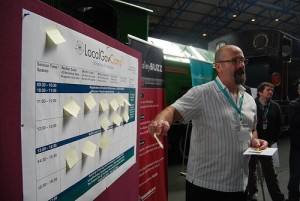
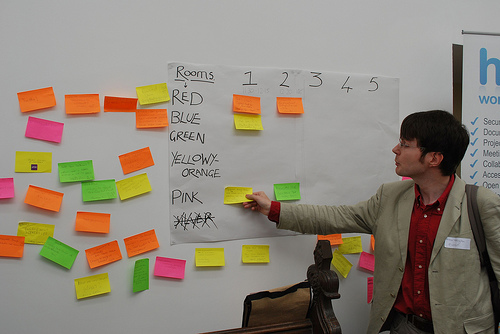
That was the ukgc10 that was

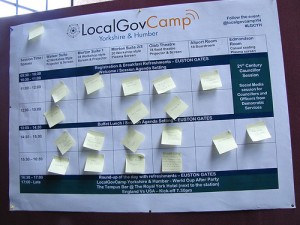
The agenda
Flickr photo credit: Paul Clarke

Blimey.

The third annual unconference, or GovCamp, for government types went pretty well. Two main factors, marvellous and generous hosting by Google, and a terrific level of participation from pretty much everyone who attended. What’s more, nearly everyone stayed til the end!

Massive thanks to the other sponsors, including Huddle, Opportunity Links, Learning Pool, Boilerhouse, IDeA, Polywonk, Timetric, the Dextrous Web and probably others.

Huge props too to Tim Davies and Lloyd Davis for organising the agenda setting bit of the day – it really helped everything go smoothly.

Highlights for me were the sessions of getting internal communication and collaboration right – which resulted in the prospect of a spinoff event dedicated to these issues – and a session on discussing innovation in public services.

As always, how do we follow up on all this goodwill and enthusiasm? Let’s try by:

  • sticking around the online community set up mainly for the event, but which has pretty much everyone signed up to it.
  • Don’t forget that there is also the Teacamps – afternoon meetups in central london for government types. The next one is on the 3rd February in the cafe at the top of the House of Fraser on Victoria Street.
  • A simple wiki is available for people to add content from the sessions they ran and attended, so those that missed them (or indeed the whole event) can still find out what went on
  • Finally – the growing movement of ‘camps in and around government just goes to show that organising events that are useful, interesting and fun doesn’t need to be expensive or difficult. There’s nothing at all stopping you from organising your own, and there are plenty of people willing to help.

There’s lots of coverage online already, and will be more, I’m sure. I’ll keep the following list as up to date as I can:

David Wilcox grabbed Jeremy Gould and I before we left. It was Jeremy who kicked off this whole thing two years ago, and it’s been a privilege – as well as a pain in the arse – to have picked things up this year. Had Jeremy not stuck his neck out back then, we wouldn’t be where we are today. Anyway, enough brown nosing, here’s David’s video:

#That was the ukgc10 that was

Wednesday, 20 January, 2010

Bookmarks for January 17th through January 20th

I find this stuff so that you don’t have to.

  • The Governance Ladder « Carl’s Notepad – "The key thing for me in thinking this way is that i don’t believe that Governance should be seen as something which is rigid and fixed in an organisation. I believe that we need to start adapting our Governance to the circumstances and providing a greater level of education, awareness and information so that people (not the processes) can make better decisions in the first place."
  • REWORK: The new business book from 37signals. – The new business book from 37signals.
  • Defra, UK – UK Location – Nice new WordPress microsite for Defra by Simon Dickson
  • co-operative News – Co-ops can help transform public services – report – "The Innovation Unit, a London-based independent social enterprise dedicated to supporting the third sector, has published an independent ‘think piece’ — The Engagement Ethic — outlining the potential for co-operatives and mutuals to help transform public services. "
  • Gov 2.0: Gov 2.0 Hero: Dominic Campbell – Much like in the US, the majority of digital engagement in the UK has been about a race to develop shiny new websites and get government agencies on Twitter and the whole spectrum of social tools. The focus has predominantly been on better PR and communications which has indeed led to some improvements, but even then nowhere near as rapidly as you might hope.
  • NESTA Connect: The internal challenge of open innovation – "The open innovation professionals whom i've worked with who are most successful work just as hard, if not even harder, to network within their organisations to find the right people to be able to make a deal happen once they've sourced one externally. And tools like twitter are, in part, so exciting to me because they form a wonderful shortcut into organisations bypassing existing channels or opening up entirely new channels of communication that didn't exist previously. "
  • Showing a better way – honestlyreal – "And as far as I’m aware, the fundamental problem with innovation in public services is this confusion between what constitutes ideas, and what constitutes service implementation."
  • Backupify :: Secure Online Backup and Archiving for Gmail, Facebook, Twitter, and WordPress – "Your online accounts contain important information. Don’t risk losing any of it. Sign up for our online account backup and you will never have to worry about losing a thing."
  • How to crowd source an IT strategy – BankerVision – "Big organisations are challenged when you ask them for quick decisions."
  • How To Build An Online Community: The Ultimate List Of Resources – FeverBee – "This is a collection of my favourite and most popular posts from the last two years. It should give you a great overview about both the strategy any the process of creating an online community from scratch." Fabulous.
  • Cisco’s Top 10 Predictions for 2010 – "Some leadership teams will view 2010 as an opportunity to pull ahead of their competition by investing in a collaboration architecture that will further improve their team’s productivity"

You can find all my bookmarks on Delicious.

You can also see all the videos I think are worth watching at my video scrapbook.

#Bookmarks for January 17th through January 20th