Get posts by weekly email:
An online notebook
An online notebook
Saturday, 10 May, 2008
Friday, 9 May, 2008
Some stats
Inspired a little by Jeremy’s post on his blog’s first birthday, I thought I might have a little dig into the numbers for this blog. It’s only been going since November 2006, so about six months and frankly was going nowhere until barcampukgovweb mania gave it a bit of a bigger profile, which then was further extended in the wake of the Civil Surf affair. Anyhow, here’s the facts:
- Feedburner says I have 122 susbcribers here
- The site itself has seen 8,422 hits
- Best day ever was March 11th with 423 hits
- Best referrer (ie the place that people come to DavePress from) is Twitter (298 referrals) followed by Civil Surf (thanks Simon – 297 referrals)
- My top posts in terms of visits are 8 Tips for Beginner Bloggers, Public servants must blog and my About page
Connecting through communities
I love the way that the social web creates connections between people, and allows us to pass those connections on to those that we think might be interested.
I had a great chat today with a guy called Peter Haine (note the ‘e’ – it’s not him). I first came across Peter because he had posted in the forum on the Improvement & Development Agency‘s website, asking for feedback from people about how they have found success or otherwise in online communities. A fascinating topic, and even better, Peter is based at the Techno Centre in Coventry, just round the corner from where I work.
Peter works at the Applied Research Centre for eWorking, part of Coventry University, and as a result the office in which he works is chock full of neat little gadgets to make working outside the office easier: digital pens, laser keyboard things, ludicrously tiny keyboards. As a gadget-freak, it was a kind of heaven for me.
The research project into online communities that Peter is currently engaged in is funded by JISC, through their Emerge programme. The report is coming through shortly, and I am really looking forward to reading it. Whilst there is a real determination in both the private and public sectors to try and engage with communities and to take a community based approach to increasing participation, engagement and brand loyalty, there isn’t, as far as I am aware, much in the way of research into both how effective it actually and and how that effectiveness can be achieved. Hopefully this work will help start this process develop.
Peter did let me into a couple of points that he had discovered from his research. He did admit that some of it might seem obvious – but of course that doesn’t make it invalid nor does it mean people always remember to do it!
- Purely online communities are unlikely to succeed – you need some kind of face-to-face meetings to build a sense of belonging and trust in other community members
- Communities need a defined sense of purpose and a way of measuring achievement of that purpose
- Active facilitation is required in seeding discussions, getting folk involved and keeping things on the right track
- Nobody is satisfied with the tools they have available!
- Barriers to entry must be as low as possible. Choose the most basic tool you can get away with – people may be happy to give up their time to take part in a community, but not if they have to spend hours learning the platform
- Payback – what’s in it for the community members? Whether financial, reputational or whatever, there needs to be something positive that those involved can get – even if it’s just a warm fuzzy feeling inside
So, Peter gave me plenty of useful, interesting information. What I gave him, hopefully, was the benefit of some of my connections, most notably Steve Dale and Ed Mitchell, who I later introduced to Peter in a couple of emails. Hopefully they can help Peter, and him them, in the future.

OrgLite – an open presentation
The Online Information conference is coming up again in December, and having attended it last year, I was determined to actually present something this time around.
David Wilcox and I have been talking a great deal in recent times about the ideas around ‘organisation lite’ – using social tools, whether on or offline, to help organisations get it right in terms of platforms, roles and worldviews. We thought this would make an excellent topic for a joint presentation.
So, we’ll be talking Shirky, Leadbeater et al, with plenty of real life examples and case studies.
So far, so pretty normal. But we want to try and walk the talk ourselves, and so we are developing our submission, paper and presentation out in the open on a blog. We’ve been doing bits and pieces on there already, but with a week to go till the submissions have to be in, we need to get this out and get others involved.
So, please visit the blog and leave feedback, suggestions and examples of stuff we might be able to use. As we write bits of the paper and develop the presentation, we will be publishing them on the blog for folk to comment on and, hopefully, improve. Everyone involved will, of course, get credit, and we’ll be publishing the finished stuff under Creative Commons, so hopefully everyone will be able to benefit.
Shine Unconference 2008
This weekend there is a really exciting event going on at the Bargehouse in London – it’s simply called Shine.
For three days, The Bargehouse at the heart of London’s Southbank will host a mash-up gathering, an ‘Un’Conference that will invigorate your thinking and give you the practical help to advance your business, whatever stage you’re at.
Long presentations, boring speeches and being trapped in closed rooms are out. Peer-to-peer exchanges, info-snacking and flexible sessions are in.
The content is contributed by participants, and there is no compulsory programme. Make your own event.
Sounds good to me.
Sadly I won’t be able to make it though – I already had a load of fun stuff planned as it’s my birthday on Sunday – but I’ll be getting involved at a distance through the social reporting blog that has been set up by David Wilcox, Nick Temple and Paul Henderson.
They will be posting blog entries, videos, photos and other media on the site, which also aggregates bits on content in the sidebar, like del.icio.us links and twitter posts via hashtags.
All of this can only be brought together with a bit of forward planning with regard to agreeing on a common tag, which for this event is shine2008, perhaps unsurprisingly.
There is also a Qik event page, where you can have the chance to watch some live video streaming from a mobile phone.
Thursday, 8 May, 2008
Get satisfaction with your council
Jon Bounds has come up with another brilliant idea – using the ‘people powered customer support’ site GetSatisfaction to create a community around the services provided by Birmingham City Council.
So, I thought, could this work for a local council? Imagine time saved by council officials if knowledgeable citizens helped answer questions, imagine the resources available (once someone had explained how to apply for a licence, the information would be there for everyone), imagine a monolithic body “joining the conversation”.
Rather than deciding to attempt to persuade my local council (Birmingham City Council – one of the largest in the UK) that this would be a good idea, I discovered that – as the site is “a space for an open conversation between you and other people with interests and passions in this organization.” – anyone can set a company page up. So I have.
It ill be interesting to see whether the City Council gets involved. I guess it is like a Fix My Street but for all Council services. Might just have to make one for my local council in Kettering…
‘It’s not just video’ at DC10plus
My second post has appeared at the DC10plus blog, on some of the other, non-video elements of our social reporting experiment at the Digital Inclusion conference:
By using tags in this way, it means that anyone can publish content and have it associated with an event or organisation. An alternative would be to create an account to upload content to on each service, but that limits participation only to those with access to that account. By using tags, everyone can get involved…
So, we have put these building blocks in place for the conference, but they are now there to be used forever. Let’s see what the community can make of them.
links for 2008-05-07
-
“evoice intends to enhance the interest and the engagement of European citizens in general political issues within a representative democracy.”
Wednesday, 7 May, 2008
Youth Engagement Barcamp Postponed
Sadly the UK Youth Engagement Barcamp, planned for the 17th May, has been postponed, due to a lack of venue. This is a shame as I was really looking forward to what was bound to be a cracking event, but with a bit more time to plan and figure things out, it should be even better.
The other upshot of this is that with the 17th now free, I could make MediaCamp Bucks, being held at New University Buckinghamshire, which looks pretty exciting. Thanks to Paul Henderson for pointing it out.
Nick Davies at Wolfson College
John Naughton links to an event taking place in Cambridge on 19th May:
Nick Davies, a well-known and award-winning investigative journalist, has recently published Flat Earth News, a controversial and highly-critical analysis of the British news media in which he argues that the business of truth has been “slowly subverted by the mass production of ignorance”. The book examines national news stories which, Davies argues, “turn out to be pseudo events manufactured by the PR industry and the global news stories which prove to be fiction generated by a new machinery of international propaganda.” With the help of researchers from Cardiff University, who ran a detailed analysis of the contents and sources for our daily news, Davies found that “most reporters most of the time are not allowed to dig up stories or check their facts”, leading him to describe UK journalism as “a profession corrupted at the core”. In the book, he also presents a new model for understanding news.
I’ll be there – anyone else?
Tuesday, 6 May, 2008
The real value of Flickr
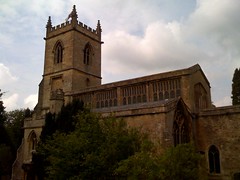
Having an iPhone has really liberated me in term of the way that I use Flickr. This would be true of any phone with decent internet connectivity, and indeed there are plenty of handsets out there with better camera functionality than the iPhone. But the ability to easily take a picture and upload it to Flickr via email in a matter of seconds is fantastic – like this, which I took in Chipping Norton yesterday:
This has led me to have a bit of a wonder about Flickr and where the value of it lies. One thing Flickr does brilliantly is to create a community of photographers, from amateurs through to seasoned professionals, who discuss one another’s photos and chat about lenses, resolutions and whatnot.
But Flickr has another community too – people out on the streets with cameraphones, who don’t really care about the angles of the shots they are taking, wh just want to capture the moment and share it online. Such users can easily find themselves at the forefront of important events, thrust into the role of citizen journalist.
These two communities exist side-by-side rather well, despite the fact that they are using the same service for quite different purposes. Which is more important to Flickr, I wonder – and which to society?
Telling stories at DC10plus
As part of our work social reporting the Digital Inclusion conference last week, David and I agreed to write some posts building on what we had done on DC10plus’ own blog, which is hosted at WordPress.com .
The first of my posts has now gone up – do subscribe to the blog for some interesting reflections on technology and local government service delivery.
Monday, 5 May, 2008
links for 2008-05-04
-
James Cridland on getting Ubuntu working efficiently on an Eeepc
-
Charlie Beckett on a recent discussion on the role of citizen journalists.
-
Pete Ashton on getting organised
-
Some nice wordpress themes
-
Great resource for WordPressMUing
Sunday, 4 May, 2008
Backburner
Things have been relatively quiet here on DavePress, but don’t worry, I have been busy. I’ve been working on a few projects – as well as the social reporting stuff with David – which I will hopefully be able to report on soon.
In the meantime I have been trying to bookmark the interesting stuff I have been seeing recently, so they pop up in the blog every evening.
Normal service to be resumed shortly!
Saturday, 3 May, 2008
links for 2008-05-02
-
David’s writeup of our experience social reporting at the Digital Inclusion Conference
Thursday, 1 May, 2008
links for 2008-04-30
-
This is a wordpress blog by those guys at Dlib on edemocracy stuff they have spotted. Subscribed.
Wednesday, 30 April, 2008
Public sector blogging in the Guardian
I had the pleasure of talking to Patrick Butler of the Guardian the other day on the subject of public sector types blogging. He did a jolly good job of editing down everything I said into one paragraph in his article:
There are still few blogging bosses out there, but as Dave Briggs, a blogger and full-time public servant, notes, chief executives are rapidly running out of arguments not to go online. When blogging is this easy, this cheap, and the potential benefits so great, he says, the question is not so much why blog, but why not?
links for 2008-04-29
-
Interesting stats on Twitter take-up – growing but still pretty limited
-
Think I will only be able to make the Saturday 🙁
Tuesday, 29 April, 2008
A day’s reporting
Today was most enjoyably spent at the Digital Inclusion conference, with David Wilcox, doing some video and other social web stuff on behalf of DC10plus.
We decided that, rather than drown DC10plus’s own blog with everything we produced, we would host our own blog featuring everything we did, from which people could take what they chose.
Our blog is at http://dc10plus.socialreporter.net – hosted at RuralnetOnline on their WordPressμ platform. This enables us to create minisites quickly at the socialreporter.net domain for any future events too, and maybe even building up a portfolio of work. David and I will be doing some more formal blog posts for the dc10plus blog over the next day or so, but for now the current arrangement gave us complete control over how stuff was displayed (such as embedding Qik video…) and just let us get on with the job.
We also used the blog to aggregate the bits of content around the web tagged up with dc10plus by embedding del.icio.us bookmarks in the sidebar, along with bits posted on Twitter with the dc10plus hashtag. Photos were uploaded to Flickr throughout the day and tagged, and again aggregated in the sidebar. WordPress really does make this stuff so easy.
I took my digital camera along, but didn’t use it. Much easier to take photos of the iPhone (did I mentioned I’ve got an iPhone? It’s beautiful. I am now of the opinion that you aren’t really a proper person unless you have one) and email them straight to Flickr. The quality is perfectly adequate for the web and the ease of use is something else.
The real story was in the video though, and we managed to get plenty done. I am slightly limited technologically speaking, because my camcorder hasn’t got an external microphone, meaning that I really couldn’t use it in crowded, noisy spaces. But while the conference sessions were going on, I managed to pin down some exhibitors to get the skinny on what they were up to. Hopefully the results were useful, like this with Bob Holmes of Digital Unite, who tells a nice story about how the social web can bring older family members back in contact with their families:
[youtube:http://www.youtube.com/watch?v=BWufgu3WJ5I]
I used YouTube to host my efforts, with minimal editing. One slight pain is that the Sony Camcorder doesn’t like talking to my Mac – fortunately I brought my Vista laptop along as a backup. The wifi at the location (The Brewery near the Barbican) was excellent, and th uploads took no time. Videos were online and on the blog within 20 minutes of them being taken.
Meanwhile, David wandered about grabbing people for interviews, using both Qik and blip.tv for hosting. Using different services is good, offering slightly different things, but all can be aggregated in the blog, so it doesn’t really matter too much.
Things we learned? Organisation is important. We needed our own table, rather than sharing the DC10plus one (not that we weren’t grateful…) but the volumes of kit and wires meant we could have done with our own space. We were also still experimenting with various bits (embedding Qik in WordPress, getting hashtags to work) into the morning, which was a little too much brinkmanship, probably. But we have the basics in place, though, and the WordPress platform is the key to it all, really.
It’s definitely a two man job, though – possibly three if you want to have the actual conference sessions live-blogged too. I’m definitely up for doing some more, and it’s one of those things that you can only get better at with experience.
I’d like to thank David for letting me have a go – and to the folk at DC10plus for taking a punt on having us hang around, recording stuff. I hope the results work for them, and help get some of the messages across.
Update: Shane McCracken has blogged his thoughts on our efforts.