Get posts by weekly email:
The team at Luton are experimenting in publishing project based week notes on their public blog.
An online notebook
Get posts by weekly email:
An online notebook
The team at Luton are experimenting in publishing project based week notes on their public blog.
Catherine Howe on her philosophical approach to working with AI models:
I’ve been thinking a lot recently about how to help people get started with AI. Not the technical side — there are plenty of people better placed than me for that — but the more fundamental question of how to approach it. What mindset do you bring? What’s the skill that unlocks it? I’m seeing people feel daunted, or underwhelmed, or frustrated, but as with most bits of new technology: the barrier isn’t usually the technology. I’m finding this even more the case with AI.
As I’ve started experimenting myself I’ve actually gone back to skills I learnt in my undergraduate degree and I’m coming to think the skill we need isn’t computer science or data literacy or anything obviously modern. It’s philosophy.
Following the announcements last week of the shape of local government arrangements in various areas, I’ve had to rethink things a bit. The move is clearly towards merging and empowering districts over centralising into unitary counties.
This means an increase in disaggregation. Take the county I reside in, Norfolk, as an example: it is being split into 3 unitaries, which means that services currently delivered by the county (social care, education, highways etc) will in future sit with the new unitaries. Thus these services – with their people, processes, and technology, will need to be split into three. In Essex, they will be split into 5!
This can, though, be made a lot simpler if the councils involved decide to continue to work closely together in the future. On the tech side, this could mean keeping the county digital services as they are – either for a period of time or in perpetuity – as a properly constituted shared service.
LGR does not mean that the new councils can’t share services, capabilities, people or assets. Given the huge amount of change that LGR entails, it might well make sense in some cases for things to be left as they are for a while, because they work as they are, and can be returned to when the dust settles elsewhere.
There’s a danger that if folk get too focused on separation, opportunities to reduce the levels of change, and therefore risk, are missed. It might well be that there are things which aren’t broken and don’t need to be fixed.
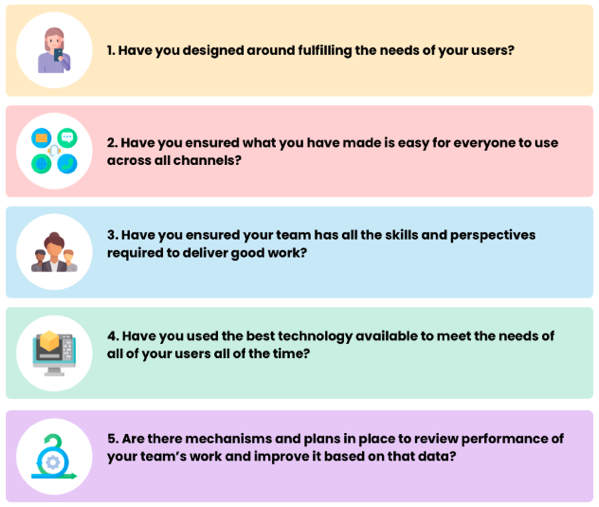
Alan Wright’s Definitions of Done Checklist.
Will Callaghan shares A new flatpack collaborative model for the public sector:
The goal was to identify a ‘flatpack model’ which would make collaboration as easy as going it alone. There are currently 317 councils in England still building or buying almost everything alone. It’s a waste of time and money, and a missed opportunity.
I have a feeling that everyone likes using AI tools to try doing someone else’s profession. They’re much less keen when someone else uses it for their profession.
A new entry in the Digital LGR Playbook has been published: Disaggregating services and data.
Feels like, following the announcements last week, that we will need to write a lot more on disaggregation as it seems like single-unitary counties are not going to be the thing.
When Nick and I started planning LGRCamp, we knew we wanted the audience to be local government folk only – plus a smattering of other bits of the public sector who have an interest. Of course there are suppliers who want to be in the room, but for a first event of this kind, there needs to be separation between the community and the commercials, to build trust. So, suppliers can come along, but they have to pony up to support the event, and they have to play by the rules.
That hasn’t stopped several commercial enterprises registering anyway, and It amuses me greatly to see them describing themselves as “other public sector” or “non-profit” or even as a council to try and slip through the net.
I’m all for building bridges between the buyers and sellers of digital products and services in the sector, but seriously, this is not helpful.
Really nice in depth case study looking at how Milton Keynes City Council transformed their planning services, using Arcus Global’s tech:
Legacy back-office systems are holding many planning departments back—slowing processes, frustrating staff, and limiting the ability to deliver efficient, modern services for our communities. Replacing them is no small task; for most councils, it feels like a mountain to climb. But it can be done. This case study shows how Milton Keynes City Council took on the challenge, navigated the risks, and is transforming its planning service with a new cloud-based platform. It is proof that while digital transformation is hard, it is not impossible.
Richard Pope – Unified inboxes, streams and augmentation:
The idea of a unified inbox for government is not a new one. Many governments around the world have developed one, as have public organisations like the National Health Service in England, which has a unified inbox for patients. Many commercial services, like banks, have them too.
Rather than seeing unified inboxes as a desirable end state, I argue that we should see them as a staging post to something else and a tool to further unbundle services. And that, long-term, we will come to see them as representing a missed opportunity.
Giles Turnbull points to Signboard, a kanban board app that saves data in plain text files. Neat!
Colin Stenning has updated his survey of what content management systems are used across local government – this time, with maps!
New resource added to the digital LGR playbook by the team – Cyber readiness.
Ensuring a new unitary council can protect data, detect threats, maintain secure access, and keep critical services running from day one.
Terence Eden – How Can Governments Pay Open Source Maintainers?:
When I worked for the UK Government I was once asked if we could find a way to pay for all the Open Source Software we were using. It is a surprisingly hard problem and I want to talk about some of the issues we faced.
I don’t entirely understand this, but it sure is interesting:
With my.WordPress.net, WordPress runs entirely and persistently in your browser. There’s no sign-up, no hosting plan, and no domain decision standing between you and getting started. Built on WordPress Playground, my.WordPress.net takes the same technology that powers instant WordPress demos and turns it into something permanent and personal. This isn’t a temporary environment meant to be discarded. It’s a WordPress that stays with you.
Good news – New pilot to help councils identify and support residents at risk to vulnerability earlier:
Local Digital is pleased to share that the Scalable Approach to Vulnerability via Interoperability (SAVVI) and Open Referral UK (ORUK) data standards are taking an important step forward.
The government is investing £1.1 million to test the adoption of these 2 leading data standards in real service environments. The findings will help shape future scaling across England.
Pilots with Greater Manchester Combined Authority (GMCA), and Bournemouth, Christchurch and Poole (BCP) Council will help both areas identify and support vulnerable people earlier, more effectively and more consistently.
These pilots mark a major step toward a future where councils can work proactively, not reactively, using data to identify early signs of people at risk to vulnerability and connect them to the right support before issues become more serious.
An excellent blog to follow for nerds like me that love old software.
Steph Tucker – An observation: many government content style guides exist, but they’re rarely used in practice (LinkedIn warning):
A much better approach is to make content patterns and standards an active team practice. You can do this by running regular sessions where you look at real pages and talk about links, words you use, buttons, components – the small stuff.
Consistency is what creates a good user experience. When patterns and language are predictable, users learn how a service works and move through it with confidence.
Another great hire at Luton – welcome to James Bovington, joining as principal developer in the newly formed digital team.
James is one of the most ingenious and thoughtful devs I’ve come across, so it’s fabulous having him on the team here.