Tuesday, 27 January, 2009

More IDeA social reporting

…is happening over at IDeA Performance. This is a great initiative by IDeA, trying to open up the training and workshops they provide to anyone with an internet connection.

If you, or anyone you know, is interested in local government performance, do check out the content we are putting up, leave a comment or tag your own stuff with ideaperf.

#More IDeA social reporting

Monday, 26 January, 2009

Social Media Exchange materials now online

As I mentioned in my previous post, in a few hours (must…sleep…) I’ll be running a couple of sessions at the Social Media Exchange.

I’ve now finished my slides, and have put them up on slideshare. Rather than make your life easy, though, I’m forcing you over to my posts on the Social Media Exchange site to get at them:

Would be good to have people’s thought on these in the comments over there!

#Social Media Exchange materials now online

Sunday, 25 January, 2009

Social reporting and learning at the Social Media Exchange

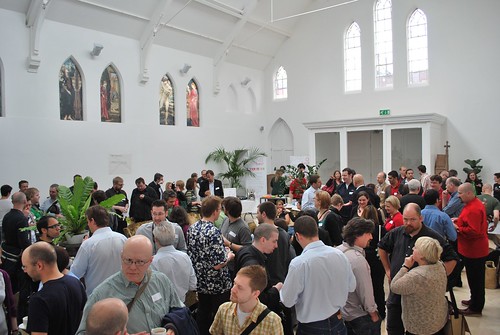
Tomorrow I will be hanging out with loads of cool people at the Social Media Exchange, which has been marvelously organised by Jude Habib and Mark Ellis at sounddelivery.

I’m helping out by running a couple of sessions, but also by lending my social reporting/learning WordPress theme, which I have spent today tweaking and filling with content ahead of tomorrow’s event.

The whole schedule has been added to the site as blog posts, so you can track who is presenting what and when by clicking the links on the schedule and speaker pages.

Sadly the home page dashbaord is bereft of live Twitter and Blogsearch updates as the server the site is hosted on didn’t seem to like pulling content in rom elsewhere with RSS. But there are links out, which people should be able to find easily enough.

One thing I am looking forward to is the amount of video that will be going on, thanks to Matt Waring and his team at Best Before TV, who are helping to cover the event with their VideoBoo package, which turns any Mac into a portable VideoBoo(th). We’ll get as much as we can embbed on the blog.

My two sessions are WordPress for Good, described as a masterclass (which means I get to talk a bit) and the other a surgery on blogging (which means I answer questions). I’ll be putting any slides and other media output up on the Social Media Exchange site as and when it gets created – just check out my tag page.

(Other great sessions (amongst many others!) will be those from my good friends Nick Booth and Steve Bridger.)

Of course, I did create the WordPress for Good microsite to house plenty of resources that people could use after they have been suitably inspired by my usual combination of mania and enthusiasm for all things WP. Thanks to all the stuff people have suggested, I’ve got plenty to be getting on with. Another late night, then…

#Social reporting and learning at the Social Media Exchange

Saturday, 24 January, 2009

What should a council’s website look like?

Simon Wakeman presents a nice roundup of some of the new websites being launched, comparing Barnet and Cheltenham‘s latest efforts with the current poster-child, Redbridge.

Generating an environment for residents to interact online with their councils will generate more engagement with the democratic process and council work in general – but it needs truly interactive platforms, a supportive culture within the council and a drive from officers and members to create genuinely two-way conversations.

Simon is right to call out Redbridge for the lack of interactivity in his post. Some basics have been missed: no RSS, no home page box for me to enter my email address to get news updates straight to me.

I think Redbridge and other sites like this are missing what the web is really about these days.

What local authorities (and government generally) need to understand is that they need to stop thinking about their websites as a destination. They should provide people with the information they want, where they want and in the format they want – not force them to spend hours personalising a site in which they have very little interest other than finding out when their bins get collected.

In fact, here’s a (only slightly stupid) vision for council websites. Make them look like Google. Not iGoogle, but the actual Google homepage, with just a search box on it. Make sure the search works, so people can actually find what they want, and then add an option to receive an email when that content changes.

Sorted.

#What should a council’s website look like?

Democracy and knowledge

Great, meaty article in this fortnight’s issue of The London Review of Books by David Runciman:

The wisdom of crowds: why the many are smarter than the few. We-think: the power of mass creativity. Infotopia: how many minds produce knowledge. Wikinomics: how mass collaboration changes everything. These are the titles of just a few of the books published in recent years on one of the hot topics of the moment: knowledge aggregation, or how lots of different people knowing many small things can result in a very big deal for everyone. The obvious impetus behind this publishing trend is the internet, which has generated astonishing new ways of finding out all the different things that people know and bringing that knowledge together. If you look for these books in bookshops (itself rather a quaint idea given that you’re supposed to be buying them online), you’ll discover them in the business or management sections, where their lessons about openness, flexibility, innovation and the importance of listening to what your customers are telling you have their most immediate applications. But the authors are usually more ambitious than this and want to apply their notions beyond the confines of management studies – and in social policy. If businesses can use the wisdom of crowds to predict what people really want, to innovate new ways of providing it, and to test whether it actually works, why can’t politicians?

#Democracy and knowledge

Friday, 23 January, 2009

Wednesday, 21 January, 2009

Bookmarks for January 14th through January 21st

Stuff I have bookmarked for January 14th through January 21st:

  • apophenia: Taken Out of Context — my PhD dissertation – Danah Boyd's PhD dissertation. Well worth a download.
  • Government 2.0 Club – "Government 2.0 Club is a national organization that brings together leading thinkers from government, academia and industry to share ideas and solutions for leveraging social media tools and Web 2.0 technologies to create a more collaborate, efficient and effective government — Government 2.0."
  • Anecdote: Profiting from Collaboration – "Google and P&G are both known for their innovation capabilities and strict internal policy. Driven by market forces, they made an exception. They swapped about two-dozen staffers who spent weeks dipping into each other's staff training programs and sitting in on meetings where business plans get hammered out. This is terrific example of purposeful collaboration delivering results."
  • DELL COMMUNITY – Great example of taking a community approach to customer service.
  • McLuhan Program – Research – Current Academic Research – "Because language is intimately integrated within the human mind, any technology that processes language in one way or another may have strong effects in the way the mind processes that content. Though they may have deciding common points such as plot, period and characters, a film adaptation is processed very differently by the mind of the viewer, than by that of the reader. "
#Bookmarks for January 14th through January 21st

Digital mentoring for public servants?

Ingrid has a very nice post about the training my good friend Steve Dale and I provided to some folk at the Local Government Association and the Improvement and Development Agency today.

I think people left the room enthused.  A colleague whose arm I twisted to attend the course (when I was worried it wasn’t full – in the end it was overfull) thanked me for getting her along.   I’m planning to meet with another colleague in the near future to take some of the training into real concrete action.  And that’s the best feedback of all.

Which is very gratifying to hear.

I think there is a real need for fairly basic overview sessions like this one, introducing people to some of key aspects of this social web thing: not just what the tools are and what they do, but some of the philosophy behind it all.

Digital mentoring for public servants? Quite possibly. Maybe a topic for Barcamp?

#Digital mentoring for public servants?

Learning from Obama

Edelman have published an interesting white paper on what lessons can be learnt from Obama’s use of the social web in his campaign. It’s worth a read.

Here’s the headline list of learning points:

  • Start early
  • Build to scale
  • Innovate where necessary; do everything incrementally better
  • Make it easy to find, forward and act
  • Pick where you want to play
  • Channel online enthusiasm into specific, targeted activities that further the campaign’s goals
  • Integrate online advocacy into every element of the campaign

This seems to tie in rather nicely with some of the messages I have been banging on about of late, including the emphasis on prototyping, ‘worse is better’, etc.

#Learning from Obama

Tuesday, 20 January, 2009

Be less boring

I wasn’t sure whether or not to blog about this. But I think I ought to, simply because this is such a cracking example of how badly digital engagement can be, and how easy it could be made much better.

My local authority, South Cambridgeshire District Council, has a modest announcement on its homepage:

Your views count!

Great!

Only, on clicking the link to the consultation area, what did I find? Classic local gov: PDFs and an email address. Sigh. Just click that link and look at that page! Hardly inspiring, is it? Not the sort of thing that makes you think ‘This is something I want to get involved with’ – is it?

But it does get worse. Try clicking one of those PDF links. Here’s one you can try from here. Yep, that’s right: they are just excerpts from council meeting reports. That one I linked to opens on page 11. You might want to know where the other ten pages are – it’s a reasonable question. I don’t know the answer.

Not rewriting the content to be more accessible for non-local government geeks is unforgivable. But to not even change the formatting, or the page numbers! to make it more understandable for the layman? Criminal.

In total there are four PDFs to download and read, cogitate on and then respond by email or in writing. The only way you can do this sensibly is by printing them all out, highlighting the important bits and then writing the response. And that’s assuming you can make sense of the reports themselves.

In fact, this consultation is so bad that I wonder whether the Council – shock, horror – actually wants any responses at all.

There are some occasions where providing some weighty PDFs and an email to respond to is an appropriate online consultation method. For example, when dealing with a large organisation, which needs the detail, and needs to incorporate the views of various different people in a response.

But this is most definitely not the case with consulting with what one might legitimately call normal people. For a start, it’s too boring. Why would anyone want to do it, seriously? Another issue is that by making people fire emails off into a black hole, how is anyone meant to know whether their comments actually make sense or not? With no conversation to react to, and very little in the way of context, those less confident at responding to these things just won’t bother because you can’t know whether what you are saying is appropriate or not.

Here’s what I would do with this, and similar attempts at engagement:

  1. Set up a micro site using something like WordPress.
  2. Split the material down into five sections.
  3. Put five big buttons on the site to go to the consultant for each section. Make it clear what they are about.
  4. Describe that section of the consultation in easy to understand language on different pages, linked to from the big buttons. Don’t use any more that half an average screen’s height to do so. Be informative, but keep it succinct. You can still link to the PDFs if people want to see the detail.
  5. Allow residents to leave comments underneath. Keep it all public, so that everyone can see, and respond to each others comments. Allow conversations to flow.
  6. If you like, make sure the relevant officers are on hand to answer any questions or put right misapprehensions.

What’s more, this would be really quick and easy to set up. It wouldn’t even use up that much time to moderate or manage. And you never know, some value might actually be generated.

I’ve emailed Cllr. Tim Wotherspoon, my local councillor, who happens to be the ‘Policy, Improvement and Communications Portfolio Holder’ – perfect! I’m hoping we can talk about making the way the Council engages with its residents just a little bit better.

#Be less boring

Monday, 19 January, 2009

If you don’t do it, someone else will

Here’s more proof.

bcpt

Birmingham City Council are asking for people’s views on their ‘Big City Plan’. They have even created a website to help people to do so.

I asked Jon Bounds, Birmingham blogger extraordinaire, what was wrong with the Council’s approach. He answered:

Not so much “wrong” per-se as we thought helping discussion (rather than just comment) would generate understanding & ideas.

So Jon and others did something to generate that understanding and those ideas. They’ve translated the consultation document out of local government regenero-speak and into something approaching normal English. They’ve also made the thing properly commentable enabling people to have discussions about their city and what should happen to it.

They’ve called it Big City Plan Talk, and it’s a lovely thing. Let’s hope that Birmingham City Council take note and engage with these people with an obvious love for their city.

Readers working within local government: how could you make the most of the civic energy in your area, to work with residents to create something really worthwhile?

Everyone else: What’s going on in your local area that you could take a bit of time out to help out with, or improve?

#If you don’t do it, someone else will

Saturday, 17 January, 2009

The search for shared meaning

…was the title of the talk I was asked to give at the Central London Branch of the British Computer Society last Thursday. Here are my minimalist* slides:

The search for shared meaning

View SlideShare presentation or Upload your own. (tags: bcs)

What was great to see was the Twitter back channel in operation, with some great conversations going on in the audience. If I had thought about it, I should have incorporated this more into the session. Anyway, at least everyone can still see what was being said at the time.

I’m not sure if I ever got to the bottom of what the shared meaning might be that the social web helps to bring about, if any at all.

It was really useful taking the time to think about this though. I am starting to develop the notion that perhaps web technology actually allows us to pursue very niche, individual interests, what with the ability to filter and drill down into vast amounts of relevant information using freely available and simple to use tools.

But at the same time, the web allows us to easily find others who share these interests, however niche they might be. So as well as promoting individual interests, there is also the ability to do something with others about it. It’s kinda where The Long Tail meets Here Comes Everybody, I guess.

* minimalist because I’m crap at PowerPoint rather than any design decisions.

#The search for shared meaning

6 days to stop MPs concealing their expenses

A quick repost of an important message on the MySociety blog:

Uh oh.  Ministers are about to conceal MPs’ expenses, even though the public hasjust paid £1m to get them all ready for publication, and even though the tax man expects citizens to do what MPs don’t have to. They buried the news on the day of the Heathrow runway announcement. This is heading in the diametric wrong direction from government openness.

You can help in the following three ways:

1. Please write to your MP about this www.WriteToThem.com – ask them to lobby against this concealment, and tell them that TheyWorkForYou will be permanently and prominently noting those MPs who took the opportunity to fight against this regressive move. The millions of constituents who will check this site before the next election will doutbtless be interested.

2. Join this facebook group and invite all your least political friends (plus your most political too). Send them personal mails, phone or text them. Encourage them to write to their politicians too.

3. Write to your local paper to tell them you’re angry, and ask them to ask their readers to do the above. mySociety’s never-finished site http://news.mysociety.orgmight be able to help you here.

NB. mySociety is strictly non-partisan, by mission and by ethics. However, when it looks like Parliament is about to take a huge step in the wrong direction on transparency, we’ve no problem at all with stepping up when changes happen that threaten both the public interest and the ongoing value of sites like TheyWorkForYou and WhatDoTheyKnow.

I’ve sent an email via WriteToThem to my local MP, James Plaice. Here’s the text I sent (mainly copied and pasted from other sources) – feel free to re-use it for your efforts:

I am writing to express my concern at the recent decision to conceal the details of MPs’ expenses. I do not understand why it is necessary for MP’s to be the only paid public officials who will not have to disclose the full details of their expenses and allowances.

After all, members of the Scottish Parliament have to declare all oftheir expenses – why does the British Parliament need to be different?

As my local MP, I hope you will be lobbying against this concealment and that you will also be of those enlightened MPs who, knowing that they have nothing to hide, are willing to publish the full details of their expenses anyway.

#6 days to stop MPs concealing their expenses

Wednesday, 14 January, 2009

Bookmarks for January 11th through January 14th

Stuff I have bookmarked for January 11th through January 14th:

#Bookmarks for January 11th through January 14th

Tuesday, 13 January, 2009

Life must go on in Gaza and Sderot

…is the title of a wonderful blog, which describes itself thus:

This blog is written by 2 friends. One lives in Sajaia refugee camp in Gaza and the other lives in Sderot, a small town near Gaza on the Israeli side. There is ongoing violence between Israel and Gaza which has intensified greatly since October 2000. Many have been killed and many have been injured. The media coverage on both sides has been extremely biased. Our Blog is written by 2 real people living and communicating on both sides of the border.

#Life must go on in Gaza and Sderot

Monday, 12 January, 2009

Dave @ BCS

 British Computer Society

I’m going to be talking to the good folk at the Central London branch of the British Computer Society this Thursday, on the topic of The Search for Shared Meaning: How Social Media Changes Everything:

Blogs, online video, photo sharing and social networking are redefining the way that people interact with each other and with organisations. Understanding the implications of this is vital for any organisation which wishes to remain relevant in a Web 2.0 world. Dave will discuss how organisations can approach these new tools, and how such an approach should relate to existing strategies and communication plans.

Weighty stuff, I hope I don’t disappoint!

It all kicks off at 6pm at the BCS HQ on Southampton Street in London.

Hope to see some DavePress regulars there – and for those that won’t be, I hope there will be a twitter back channel to keep folk at home informed on just how badly I’m doing. How about #davebcs for a tag?

#Dave @ BCS

Open Source Schools

Open Source Schools is a site that launched sometime last summer, I think, but has now had quite a bit of a makeover.

It’s chock full of great advice and resources on how schools can make use of open source software – and there is plenty in there that other organisations or individuals could pick up on too.

#Open Source Schools

Sunday, 11 January, 2009

What is Twitter for?

Whenever I mention Twitter to anyone who wasn’t previously aware of it, the first question they ask is always ‘What is it for?’

Like many social web services, it can be difficult to explain the concept of Twitter. I find it is best to respond with another question: ‘Well, what is talking for?’

‘Er, telling people about stuff. Asking questions. Finding out what’s going on.’

That’s what Twitter is for, too. It’s just like talking.

#What is Twitter for?

Saturday, 10 January, 2009

Bookmarks for January 7th through January 10th

Stuff I have bookmarked for January 7th through January 10th:

#Bookmarks for January 7th through January 10th

Wednesday, 7 January, 2009

Patients Know Best

Mohammed Al-Ubaydli

Dr Mohammed Al-Ubaydli from Patients Know Best came to talk to the Cambridge Refresh group this evening. Patients Know Best is a startup which aims to help patients make use of their ‘Personal Health Record’ – a copy of which can be requested by anyone from their doctor under data protection laws.

The idea is that the management of a patient’s health should be a partnership between the patient and their doctor, and that anything the patient can do to help their doctor must be a good thing. People should take some kind of responsibility for their own illnesses.

One example Mohammed gave of this working is where a patient may spot something in their own record that their doctor has missed – after all, doctors are jolly busy people, and mistakes and oversights do happen. The patient isn’t doing the doctor’s job for them, just providing a second pair of eyes.

It turns out that there is a huge amount going on in both the UK and the US with patients using their access to their records to research their conditions and provide support to each other through social networks and other means. One of the jobs Patients Know Best is doing is collecting all this stuff together, onto a wiki. This is not only useful stuff to be doing, but also good marketing, of course. Patients Know Best could become synonymous with this kind of social use of medical records.

Patients Know Best are developing a software package to enable patients and doctors to communicate better through the web. My understanding is that it will allow patients to access their records electronically and then discuss the details with their doctor, without needing to make an appointment, thus saving everyone time. Mohammed is looking for people: to act as beta testers and to offer their services to the startup – principally Java-savvy developers at this stage.

You can see Mohammed’s slides on Google Docs.

Below are the notes I made during the talk – there may well be inaccuracies and falsehoods amongst the typos – if you spot any do let me know in the comments. I’ve tried to add as many links in as I can to help make the notes as comprehensible as possible…

  • Communication is crucial in chronic diseases
  • Patient has time to learn about your condition
  • Patient has less than 1 hour with specialist per year
  • Lots of different people work together with patients
  • Patient knows more than anyone about their personal circumstances
  • Why don’t more people use the web to communicate about their condition? 1. Security risks around digital data; 2. Issues around consent and data protection act; 3. What if the right person doesn’t get access to the information they need (eg doctors seeing patient records); 4. Not knowing that you can communicate, or how you can communicate
  • 3 key questions for your clinician: 1. What are we doing; 2. Why are we doing it; 3. What happens if we don’t do it?
  • Get a copy of your personal health record – you can’t know what is going on without it
  • Patientslikeme.com – takes the view that you are safer the more people know about your situation – also rareshare.org (treat such open sites with a little caution)
  • Patients’ access to PHRs is a Lutheran revolution – everyone should have access and understanding
  • Having understanding of your notes make medicine participatory not paternalistic
  • You can check your records and possibly spot something that busy doctors might miss (is this treating a symptom rather than the actual disease in the system?!?)
  • More private tools: MyFamilyHealth, healthecard, PAERS, t+medical, healthspace
  • Rareshare – social network for people with rare diseases. Sharing of experience and stories. Clinicians also use it to learn (US based)
  • Patientslikeme – connect with similarly ill people and share knowledge, experience etc. Learning from peers rather than those in ‘authority’ (US based?)
  • Harold Shipman – got away with it by faking records, not possible if publicly available. Elimination of distrust
  • PAERS – access records through web interface
  • Healthecard – carry your records around on a USB card, very private (UK)
  • Healthspace – you put your own info on it. Good system but isolated from NHS records.
  • Think positive (vodafone backed?) Records home monitor data (couldn’t find a link within 2 minutes so got bored)
  • MyFamilyHealth (Cambridge based) Plot family tree with illness history. GenSeq backed – they use DNA samples to provides details of health risks etc also. Provides tailored health information – which drugs would work best for you, etc?
  • 3G doctor – phone based. Video phone consultation for £35 after you have given them details of your problem/history etc. Phone back after 24 hours so have time to consider. (I find this worrying)
  • Lots of information about all these services at podcast.patientsknowbest.com also on the wiki
  • PatientsKnowBest is developing software to provide communications link between patient and doctor to help explain the patient record and what it means
  • How are ‘official’ NHS initiatives liaising with this stuff?
  • Obama to put medical records online?
  • Currently 3 electronic medical records system providers in UK, not many of which work properly
  • UK Gov has set data standards – should all match – HL7
  • Role of Google Health, Microsoft Health Vault etc – use CCR data standard (better?)  – also US based so data protection issues with EU etc
  • What about digital divide – those with access, time and money to do this stuff. Are people without the skills etc really going to get involved, will they be left behind? 2 tier health service?
  • Involvement of support groups, third sector, community groups etc
  • Issue of insurers and employers accessing details of medical history – possibly a concern
  • Mohammed is looking for beta testers and people interested in helping out with the project – UK & then US focused to begin with
  • Tolven Java based is the software for the medical record software
  • Starting with genetic immune deficiencies, then diabetes, asthma etc
#Patients Know Best