Tuesday, 29 September, 2009

Understanding Finance for Business

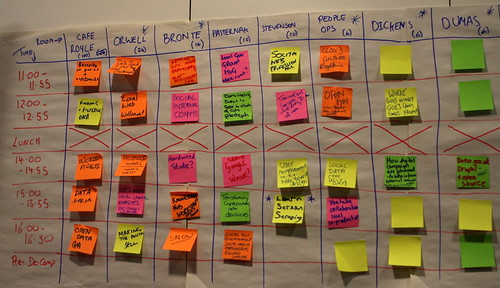
I’m spending some time today doing some social reporting for EEDA, my local regional development agency, at one of their Understanding Finance for Business workshops. I’m taking photos and recording quick interviews with some of those attending, as well as the presenters.

Here’s David Gill, Director of the St John’s Innovation Centre in Cambridge, who are running the workshops on behalf of EEDA, introducing the programme and what it is all about:

#Understanding Finance for Business

Monday, 28 September, 2009

UKGovCamp 2010 taking shape

After just one day, interest is already starting to build up for January’s barcamp. We have had a tonne of responses to the register of interest form, which is awesome, and have made significant headway in getting the venue arranged.

More on that as soon as I know it.

In the meantime, I’ve been doing some gardening on the community site we have set up on Ning. Deleting spammers, starting new conversations and creating some new groups.

We now have specific groups to discuss government data sharing and cloud computing – both hot topics. Make sure you sign up and jump into the conversations about these two topics.

#UKGovCamp 2010 taking shape

Bookmarks for September 25th through September 28th

Awesomeness off of the internet for September 25th to September 28th:

  • Improving data visualisation for the public sector – "Good data visualisation can help users explore and understand the patterns and trends in data, and also communicate that understanding to others to help them make robust decisions based on the data being presented. This site supports public sector researchers improve the way that they visualise data, by providing good practice examples and case studies, practical and step-by-step guides on how to visualise data, and links to more detailed resources. "
  • Google Blog Directory – All of the official Google blogs listed in one place.
  • Global Neighbourhoods: Using Lethal Generosity in Social Media – "In today's competitive environment, you need to understand that the customer is in control. If you want to win, give the customer what the customer wants. If you do this often enough and credibly enough it will be brutal to your competitors–unless the competitor rises to the occasion and tries to "out-generous" you back."
  • What will Council 2.0 look like? « Business Analysed – "The most useful phrase that I have heard when describing new technology and the debate when to implement is that some innovation can be ‘a solution without a problem’. I feel that this is true."
  • The BCS: enabling the information society « Conradiator – Conrad Taylor's view on the big BCS rebrand.
#Bookmarks for September 25th through September 28th

UkGovCamp 2010 – #ukgc10

UKGC10

The previous two UK government barcamps have been wonderful events – bringing people together to start and continue conversations about how web developments affect the public sector in this country.

If we are going to run the event in January 2010, we probably need to start organising it now. So I have kicked things off a bit by tidying up the online community, adding a blog post ‘announcing’ January’s event and setting up a form for people to register their interest in the event.

So do head over to the community and start sharing some ideas, stories and experiences. And make sure you tag your stuff with ukgc10!

#UkGovCamp 2010 – #ukgc10

More on culture – Getting Real

To carry on the culture theme, I’ve recently been reading 37 Signals‘ book Getting Real: The smarter, faster, easier way to build a successful web application. For those that don’t know, 37 Signals are the guys behind simple but useful collaboration tools like Basecamp, Backpack and Highrise.

It may describe itself as a book about web application development, but so many of the lessons can be applied to any organisation – and that can (and should) include government of course. I ordered the hard copy of the book, via LuLu, but you can read it for free, online. I’ve picked out some of my favourite bits, and linked them below for your reading pleasure.

#More on culture – Getting Real

Saturday, 26 September, 2009

Social media and local government culture

I had an enjoyable time on Thursday of this week, with the rest of the Learning Pool crew, customers and friends, at the Learning Pool networking event / third birthday party. Some good pals were there, and I got to meet plenty of new people too. Some photos are here.

I did my usual turn, with one or two additions. Here are the slides:

One of the new slides in this deck asks the question “Should local gov be like Apple or Google?”.

When I road tested this question on Twitter, I got a range of responses, some being quite clear cut, others wondering what the hell I was on about. One was particularly clever.

Here’s what I meant.

Apple are closed, switched off from the conversations about them. They keep their customers at a distance and go to remarkable lengths to prevent users from giving them ideas. As far as Apple are concerned, they know all the answers.

Apple’s products are also damn expensive. They charge as much as the market can bear – and sometimes more. So how come they are so popular?

It comes down to the user experience. It’s so awesome, that people like me will put up with all sorted of crap to be able to keep using it. So, an organisation can still succeed, even if it is closed in its culture, if the product is good enough. I think it would be difficult to argue that any level of government’s user experience is up to the same level as Apple’s right now…

Google, on the other hand, take a far more open culture. They have loads of blogs, just about one for every service they operate. They have forums for users to help one another, and to get help from support. An awful lot of Google’s technology is open source, and they run platforms for others to host and share their code, as well.

Google’s pricing model is different to Apples’s, too. Instead of charging as much as the market can bear, Google charges as little as it can bear, as Jeff Jarvis explains in What Would Google Do? Google wants as many people to use its products as possible, because that makes them work better, so they make them free, or as close to free as they can. Google is more a platform, or a network, than just a company that sells stuff.

Local Government needs to be more like Google, than Apple. It needs to listen to its users, and to develop and design services around their needs rather than deciding itself what is best for them. It needs to take the time to explain itself to its users, and set up feedback channels that feed directly into service design. In fact, communications, customer service and service delivery should all be part of one single process, each element constantly updating the others.

So this is all, really, less about technology, and more about organisational culture. What a surprise. I do fear that some local authorities, having set up a Twitter account, or started a blog, will think they have this thing licked. They haven’t – it’s bigger than that, and it goes back to Steph‘s point, that interactive websites need interactive organisations. Sticking some of these web tools on an organisation that doesn’t want to listen or engage will result in car crash.

People have been talking about changing culture in government for a very long time, and not a lot has changed – I’m reminded of Will Perrin’s point, which I often repeat, that government in the UK is trying to solve 21st century problems with 21st century technology through 19th century governance. But that doesn’t mean it isn’t worth giving a go. I think there is a lot that government at all levels can learn from the culture of organisations like Google, and other tech firms. Take Netflix, for example, a US based DVD rental company. Their culture, as described in this public presentation, is remarkable and one that probably any organisation could learn from:

I’ll be covering some more issues around culture, and leadership, in future posts, as it’s a fascinating (to me!) topic.

#Social media and local government culture

Tuesday, 22 September, 2009

Zoho Discussions

You may not have heard of Zoho, but they are one of the leading providers of cloud-based applications on the web. If you are looking for an alternative to the likes of Google Docs, you might not go too far wrong with Zoho.

They have just released a new service, called Discussions which allows you to run internal or external discussion forums, and includes loads of functionality like rating posts, creating idea style forums – a bit like UserVoice or IdeaScale – and a bunch of other stuff.

Well worth looking into, and this video explains more:

#Zoho Discussions

Bookmarks for September 21st through September 22nd

Awesomeness off of the internet for September 21st to September 22nd:

#Bookmarks for September 21st through September 22nd

Sunday, 20 September, 2009

Bookmarks for September 16th through September 20th

Awesomeness off of the internet for September 16th to September 20th:

  • Postscript two: Lessons from the great 2009 Birmingham City Council website disaster – Paul Canning keeps up the pace on the BCC website story.
  • Crowd Fusion | Web Publishing – "Crowd Fusion is a publishing platform that combines several popular applications – like blogging, wikis, tagging and workflow management – with some original concepts."
  • stribe.com – Welcome – "Stribe is a plug and play service to instantly create a social network on any website"
  • Case Study & Example Round-Up for Local Gov Using Social Media – Local Communities – Here's a simple round up of links to case studies and information about local governments using social media.
  • Apps.Gov – "Cloud computing plays a key role in the President’s initiative to modernize Information Technology (IT) by identifying enterprise -wide common services and solutions and adopting a new cloud-computing business model. The Federal CIO Council under the guidance of the Office of Management and Budget (OMB) and the Federal Chief Information Officer (CIO), Vivek Kundra, established the Cloud Computing Initiative to fulfill the President’s objectives for cloud computing."
#Bookmarks for September 16th through September 20th

Wednesday, 16 September, 2009

Building local government 2.0

The Knowledge Hub is a terrifically ambitious project being run by IDeA, in partnership with CLG, to bring knowledge and information sharing to the local government sector. A mixture of technology and capacity building, the aim is to alter the culture of local government, to change the way people in councils think about how success is measured, and how innovations and improvement can be rolled out across the entire sector.

Learning Pool are keen to play as big a role in this process as possible: after all, we have the background in local government, we have collaboration in our bone marrow, and we also have a pretty good idea about what works, technology-wise. So when the opportunity came up to bid for a project to develop a prototype which will inform the development of the Knowledge Hub, we pulled out all the stops to make sure we got it.

And get it we did (subject to the usual cooling off periods and boring contract stuff, of course).

The Partnerships and Places Library is an online resource of case studies from local authorities and local partnerships. It’s chock-full of useful content, but isn’t terribly interactive and probably isn’t the most engaging collection of content on the web.

Learning Pool will produce for the IDeA a fully interactive community, where content sharing, conversation and use of rich media will be encouraged and supported. Our concept for the site was called WorkTogether in recognition of the collaborative, silo-busting nature of the project.

We’re also keen to get the detail right on this project, and support open information and data sharing where we can. The new site will produce RSS a-plenty and will integrate with services like Calais to produce really useful semantic metadata. Everything will be built on open source technology, and where bespoke development is needed, that too will be released to the community.

Updates on development will be posted on the Learning Pool blog. We’re on a pretty tight schedule, so you all should be able to see some results before too long. If anyone is keen to be in on the user testing, leave us a comment here and we’ll do our best to involve you.

We’re delighted, because we see this as the first step in an exciting journey for Learning Pool. We’re going to be delivering a really innovative online project, and will be a part of the wider Knowledge Hub process. But this is also the start for us becoming local government’s trusted advisor and partner when it comes to developing social media, web 2.0 – or whatever you like to call it – strategies and products.

If your council is considering taking its first tentative steps into this new media world, get in touch with us – drop me a line on 07525 209589 or email me on dave@learningpool.com. I’d love to come and talk to you about this stuff, and see where Learning Pool can help.

Update: if you want to keep an eye on this project’s development on Twitter, follow @worktogetheruk!

Cross posted from the Learning Pool blog.

#Building local government 2.0

Socialwok

Socialwok

As a user of Google’s enterprise tools, usually known as Google Apps, Socialwok looks very interesting.

It sticks a social networking layer on top of your email, calendar, Docs and so on – something that the Google suite was really missing if being used as the main infrastructure for an organisation.

Here is a video to explain more:

#Socialwok

Bookmarks for September 13th through September 16th

Awesomeness off of the internet for September 13th to September 16th:

#Bookmarks for September 13th through September 16th

Tuesday, 15 September, 2009

Monday, 14 September, 2009

The decent council website – top 5 so far

There has been a great response to the What makes for a decent council website? experiment.

Here’s the top 5 at the end of the first day:

  1. Plain english – Jargon and acronyms should be kept to the absolute minimum, or if they must exist, they should be metatagged with common english counterparts eg. Penalty Charge Notice should be crossindexed with parking fine and parking ticket.
  2. Services not portals – Services that poke you when something of interest happens and help you sort something out when you are annoyed. Council websites should not be destinations/portals.
  3. A home page that gets you to where you want to go quickly – The home page should have a list of links that cover the main user tasks, as well as allowing the user to search by keyword, subject area, and offer predictive results as they type.
  4. Test the site before launch – This should be a no-brainer, but sadly it appears not to be. Yes there will always be problems no matter how much testing is done, but NEVER launch a site without ensuring that the majority of links work and that most of the pages contain content.
  5. Have people that respond to users’ suggestions – Use http://getsatisfaction.com to collect problems and suggestions in one place. Then have people employed to answer them, and engage in a conversation about the most interesting ones.

So, some good stuff, and there are even more ideas on the site. Keep them coming!

I’ll keep the site open til the 20th September, after which I will cobble all the thoughts together, along with comments and votes into a document everyone can share.

#The decent council website – top 5 so far

What makes for a decent Council website?

After the kerfuffle over the Birmingham City Council website, as expertly documented by Paul Canning, there has been a considerable amount of discussion about what a Council website should look like, and what it should actually do.

This isn’t just an academic debate, as some local authorities have been making some really innovative steps in redesigning their sites, such as the search dominated Westminster and Lancashire sites – which I quite like; and the personalised Redbridge and Nottingham sites – which I am less keen on.

There are, it seems to me, three main groups which have a view on council websites, in particular order: citizens in the area who use the site, internal staff, and the wider world of interested folk (I hesitate to say ‘experts’).

So I wondered how the third group might go about putting a wishlist together of features that a Council website really ought to have, and perhaps of deciding which are the most important. These could then be documented somewhere so that Councils have a free point of reference of some good quality advice on where they should go with their website.

So I have set up a page on IdeaScale, which is a bit like UserVoice only it has a few more collaborative features. You can find it at:

http://localgovweb.ideascale.com/

It is straightforward enough to submit an idea and then vote on it and others, you can comment on ideas and even edit them collaboratively, using wiki like features.

So do come and join in, leave your ideas and let people know what you make of theirs, and let’s build a really useful wishlist for what makes for a decent Council website.

#What makes for a decent Council website?

Sunday, 13 September, 2009

Upcoming events

I’ve got a few speaking engagements coming up, as well as other events that look like fun…

1. Developing Public Sector Communications through Social Media, 15th September, London

This is an LGC event, spending the whole day talking about how local authorities can be using social media.

My spot is part of a panel session alongside luminaries Dominic Campbell and Carl Haggerty. I’m talking blogs and podcasts.

2. Knowledge Hub Advisory Group, 17th September, London

The IDeA‘s Knowledge Hub is a game-changing project – an attempt to provide local government with some of the focus that central gov has through the Power of Information process. The Advisory Group will act as a sounding board for the project, which should be fun.

3. Learning Pool Summer Party, 23rd September, London

The annual Learning Pool summer bash will be my first, and I’m looking forward to it! If you fancy coming along, the details and the ticket thing is here. Just stick in the comments that you saw the event on here, and all will be well, I’m sure.

4. ProjectCamp, 26th September, Cheltenham

A LocalGovCamp with a project management flavour, as organised by Jon Hyde. All the details are on the dedicated online community, and signup in on a good old Google form.

5. LocalGovCamp Lincoln, 23rd October

Andrew Beekan has organised a LocalGovCamp for Lincoln in tandem with the local university, which should be wicked. Learning Pool are sponsoring this one!

6. Policing 2.0 – the Citizen and Social Media, 22 October, Ryton-on-Dunsmore, Coventry

The NPIA‘s Nick Keane has invited me to this event, to give an introductory overview to what this social media thing is, and why it might matter to the police. It should be fun, also speaking will be Sarah Drummond from MyPolice.

#Upcoming events

What I use

Sometimes it’s nice to hear what tech people use on a day to day basis. It’s useful to pick up hints and tips, and to pick up on cool tools you might not have heard of before.

Here’s my day-to-day kit:

1. Hardware

I have a 15 inch MacBookPro for travelling with, a 24 inch iMac for when I am in the office, and a Samsung NC10 for when I need two machines at the same time (for instance when I am out social reporting).

The iMac has a second screen, the main use of which I will come onto later.

I have a Kodak all in one printer, a Nikon D40 DSLR, a couple of Flip Ultras, a couple of GorillaPods, a MicroTrack II which I never use and an iPhone.

2. Software

In terms of desktop software, those that I use the most are:

  • Firefox – with all the plugins available for it, still the best browser by miles. Maybe when Chrome is out on the Mac I might reconsider, but until then…
  • Tweetdeck – I used to be a Twhirl man, but Tweetdeck has won me over recently, despite the large amount of screen real estate it takes up.
  • Yammer – Yammer is Twitter within an organisation – it’s limited to people on the same email domain. The Learning Pool team use it to keep one another up to date and as the official banter and abuse channel. The desktop app makes it easy to keep on top of it all.
  • Parallels – this makes running virtual machines on the Mac a doddle. Means I can run Windows XP virtually, which is handy for testing in Internet Explorer and other things which have to be done in Windows. On my iMac, it’s Windows that runs in full screen on my second monitor. Sweet.
  • Transmit – an FTP client that rocks.
  • Coda – a great code editor with built in FTP goodness.
  • MarsEdit – a blog post editor. For some reason it just makes writing posts quicker.
  • Photoshop Elements – for image and photo editing. This cut down version seems to do everything I need. Still not cheap, so I only have this on the iMac.
  • Pixelmator – a cheaper image editor than Photoshop, which I have on the MBP.
  • iCal – default Mac calendar app. Does the job for me.
  • Skitch – A simply awesome screenshot programme. So simple and a joy to use.
  • Skype – keeps the telephone costs down. There are more open VOIP systems out there, but the people I need to talk to are all on Skype, so…
  • Microsoft Office – sadly it’s still a must have.
  • MAMP – turns a mac into a web server with a couple of mouse clicks. Great for developing sites locally.
  • Omnigraffle – brilliant diagramming application. Like Visio, but good.
  • iTunes – manages all my music and backs up my iPhone. I use it because I have to, but it’s ok.
  • Internet Explorer versions 6-8 – under Parallels in XP, I use this application to run multiple versions of IE for website testing.

3. Sites and Services

My web based activity is mainly spent using:

  • Gmail – the best email interface, like, ever. I have loads of different email addresses feeding into the one account and managing them all is a dream. I use the Apps version, tethered to my domain.
  • Google Docs – great for quickly typing up ideas and sharing them with people – though I still prefer a desktop word processor for big documents.
  • Twitter – still visit the website now and again, mainly to find and follow new people.
  • Google Reader – at the last count, I follow about 700 feeds. Reader makes it possible, without going mad.
  • WordPress – the online publishing platform of the gods.
  • Ning – even with some of the accessibility issues, it’s still the easiest way to build a community online.
  • Delicious – the biggest social bookmarking community and that makes it the best, in my view.
  • MobileMe – an Apple service that keeps my calendar and contacts synched across all my computers, the web, and my iphone, without me having to do anything. Nice one!
  • Flickr – the only photo sharing site worth using? Possibly. It;s the one I have been using for 4 years or so now, so I am not going to change any time soon!
  • YouTube, Blip.tv and Vimeo – unlike with photos or bookmarks, choosing a video host isn’t quite a no brainer, depending on the length of your clips, the levels of privacy you need or the quality you require.
  • Facebook – despite Twitter’s ascendancy, I still use Facebook most days. It’s mainly my non-geek friends that are there, and it’s important to remember that not everyone is on the bleeding edge…
  • LinkedIn – my network here is growing day by day – but I’m still not sure what value I get out of it. Worth keeping up with though, just in case.
  • Google Groups – a dead simple way of getting an email list together. It isn’t hip, but it does work.
  • Huddle – online project management. Great for keeping groups of people up to date with activity.
  • Basecamp – sometimes Huddle is just too good, and a less feature rich service is needed. Hence Basecamp, which can annoy as much as it delights, but it’s email integration is excellent.

So that’s what I use on regular basis. It would be good to know what other people are up to, to see if I can steal some ideas!

#What I use

Saturday, 12 September, 2009

Bookmarks for September 9th through September 12th

Stuff I have bookmarked for September 9th through September 12th:

#Bookmarks for September 9th through September 12th

Obama’s democracy

Interesting paper from Delib on the approach to government taken by the Obama administration in the States:

The reality has certainly been a lot more muted than most geeks would have liked. Nothing overly glam and technologically ground-breaking, but instead a steady stream of pilot e-democracy projects and iterative improvements using an array of different web 2.0 tools.

Obama’s democracy 2.0

#Obama’s democracy

Dotspots

DotSpots looks interesting:

DotSpots is an annotation platform that allows users to add text or video comments to any piece of text on the web. Dotspots searches through millions of online news articles, indexing paragraphs of text and using an algorithm to determine when certain passages appear multiple times across different sites.

Here’s a video that explains more:

#Dotspots